

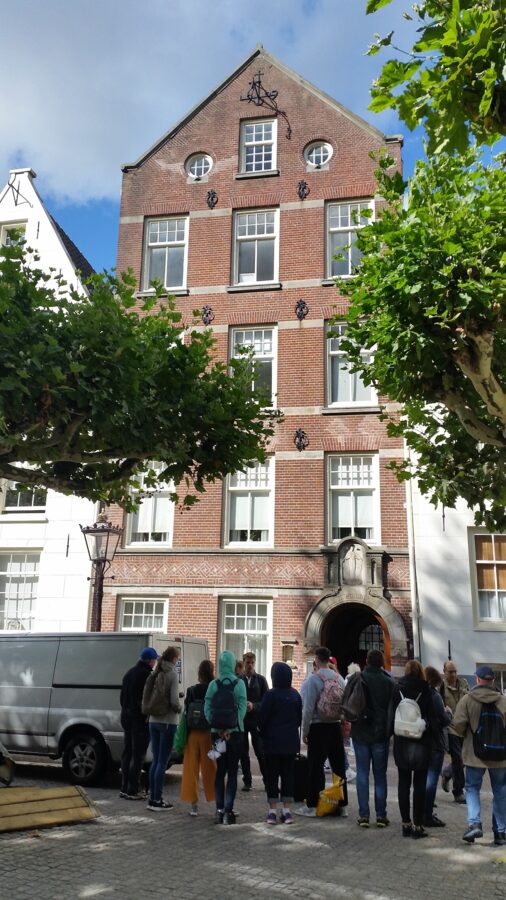
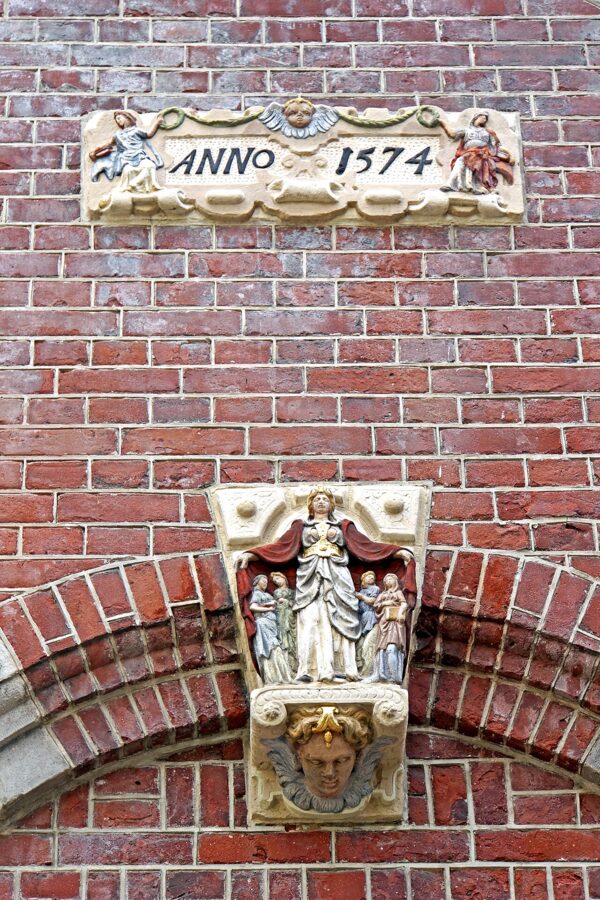
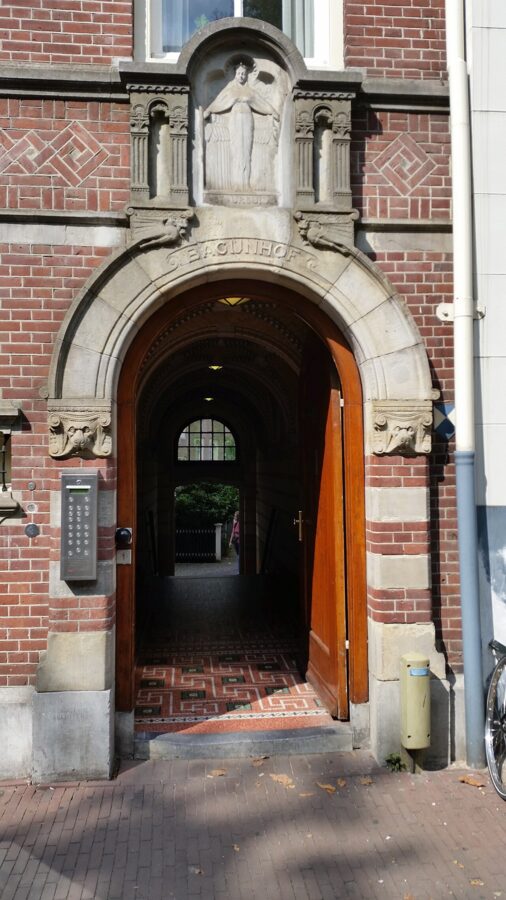
The arched door on the Spui has Saint Ursula over it, a brick gatehouse from 1907 around it and a bell panel beside it, and every older guidebook tells you to walk through it. In the daytime it stays shut to you. The people who press the big black button before 9:30 in the morning are going to Mass, and the ones who come back after 18:00 ring number 30 and wait to be let in.
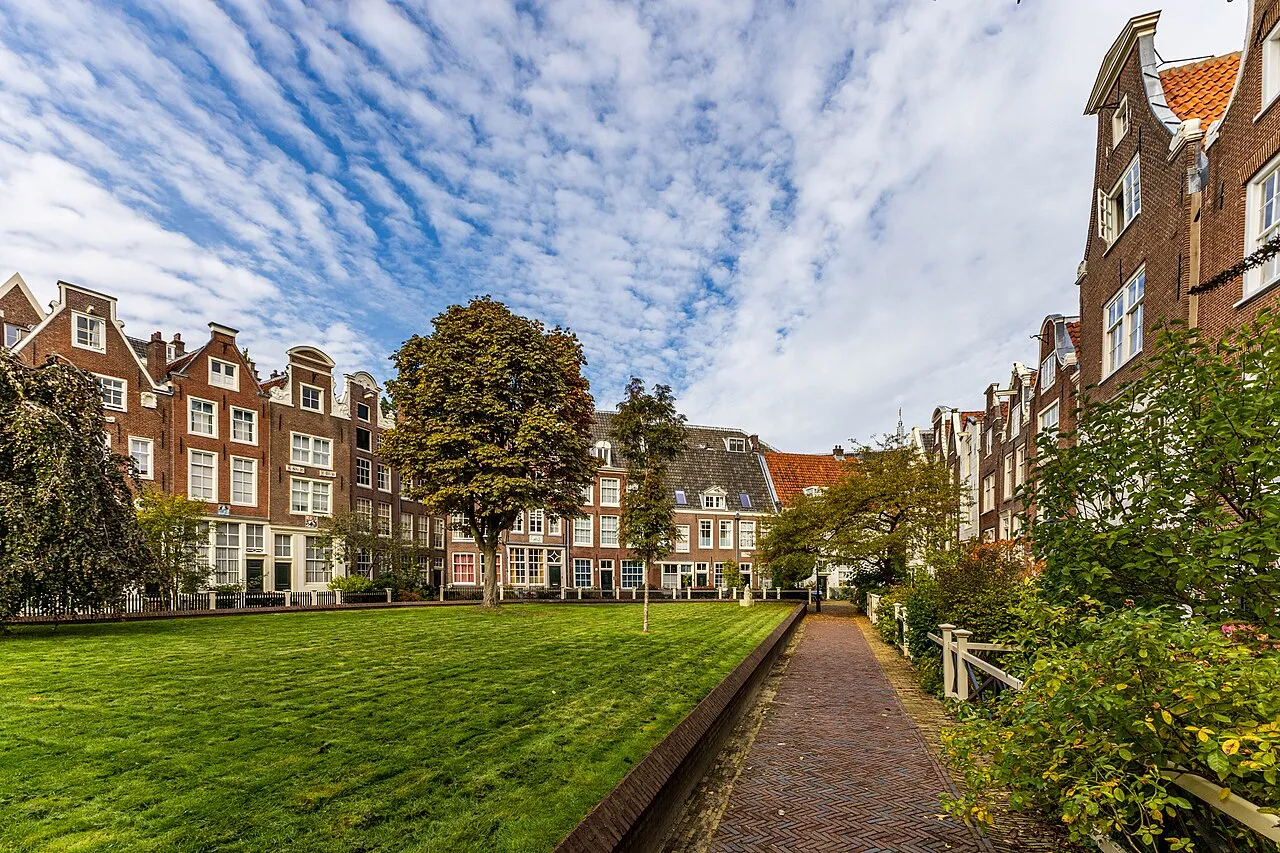
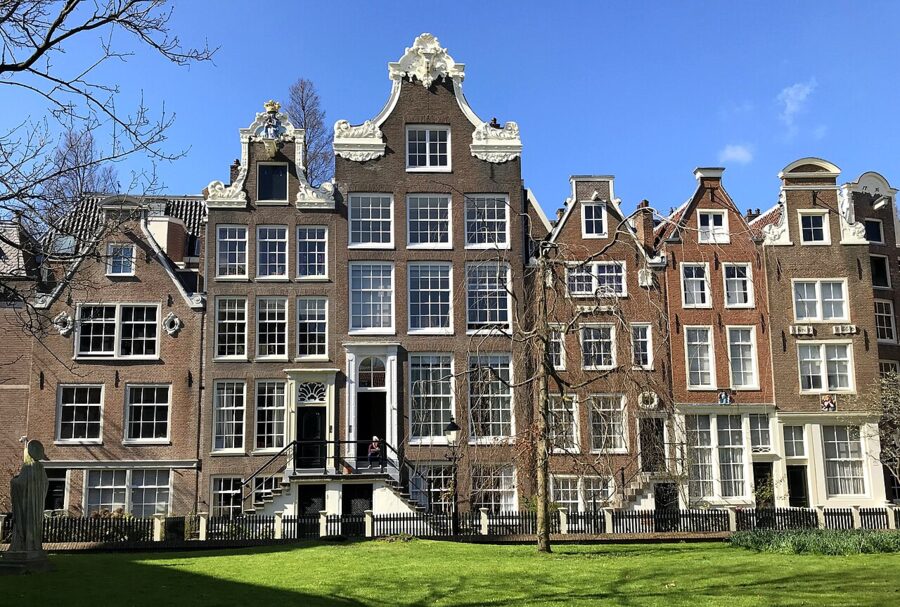
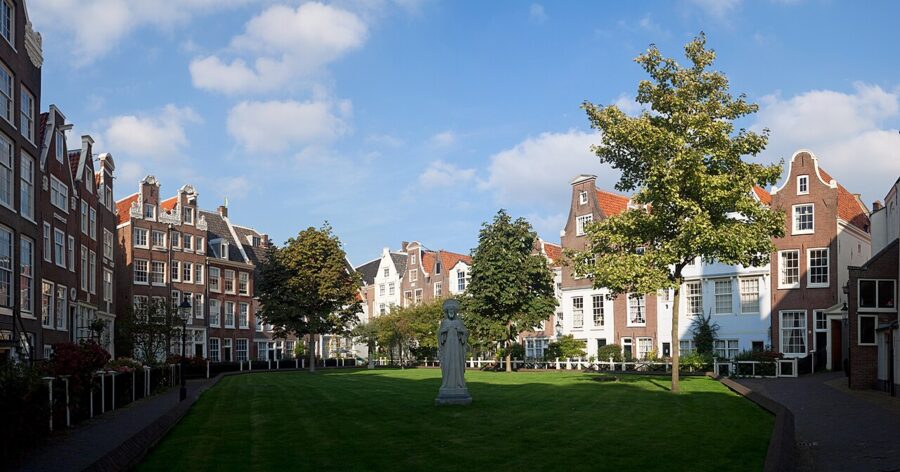
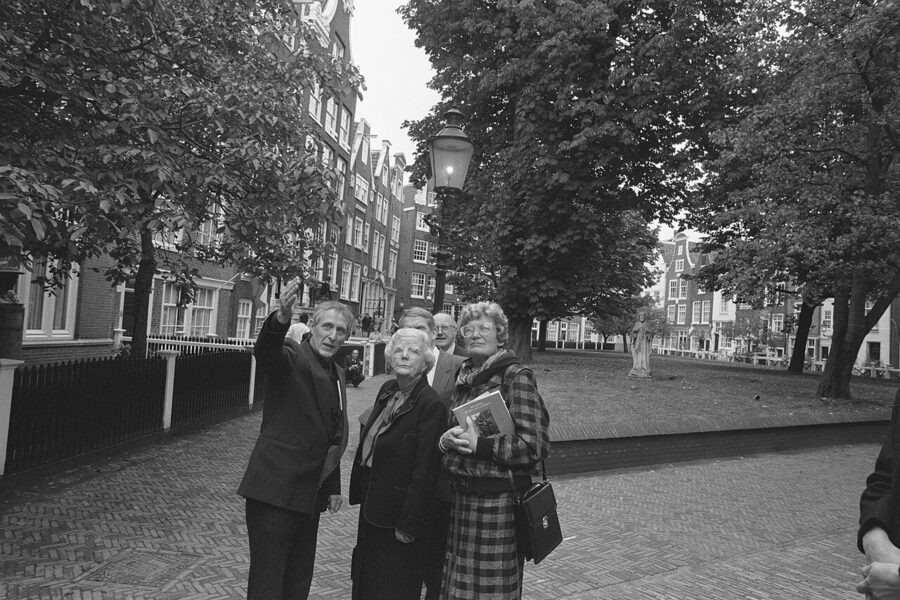
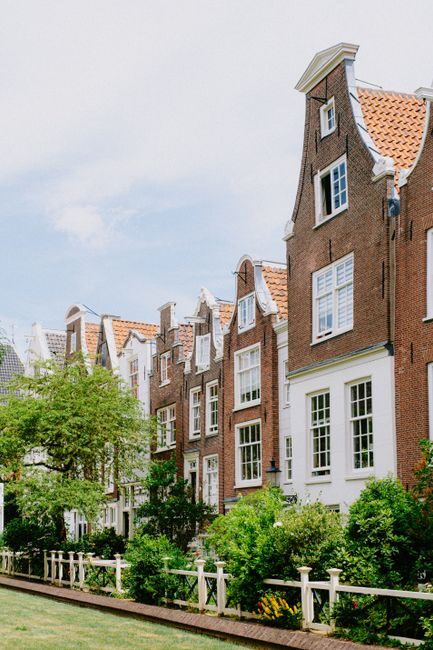
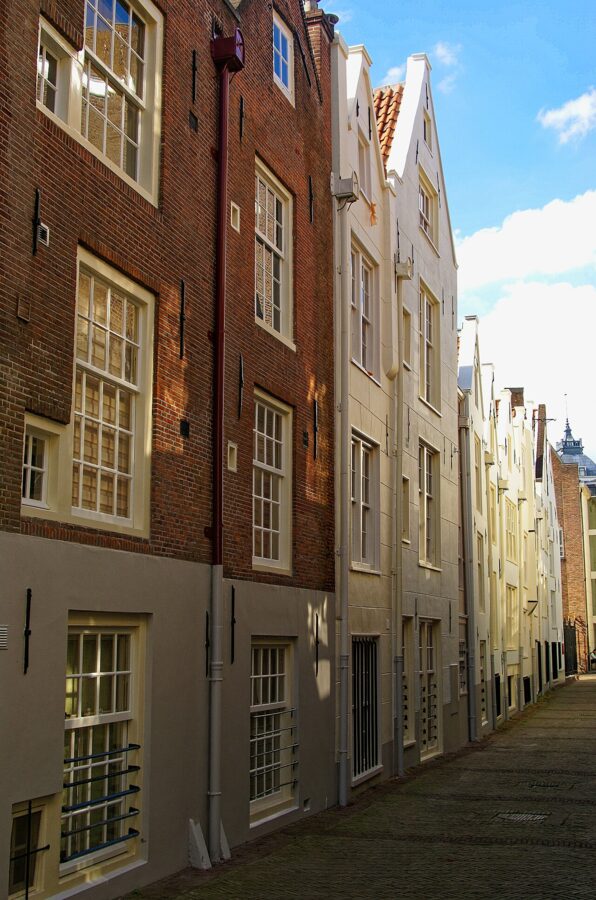
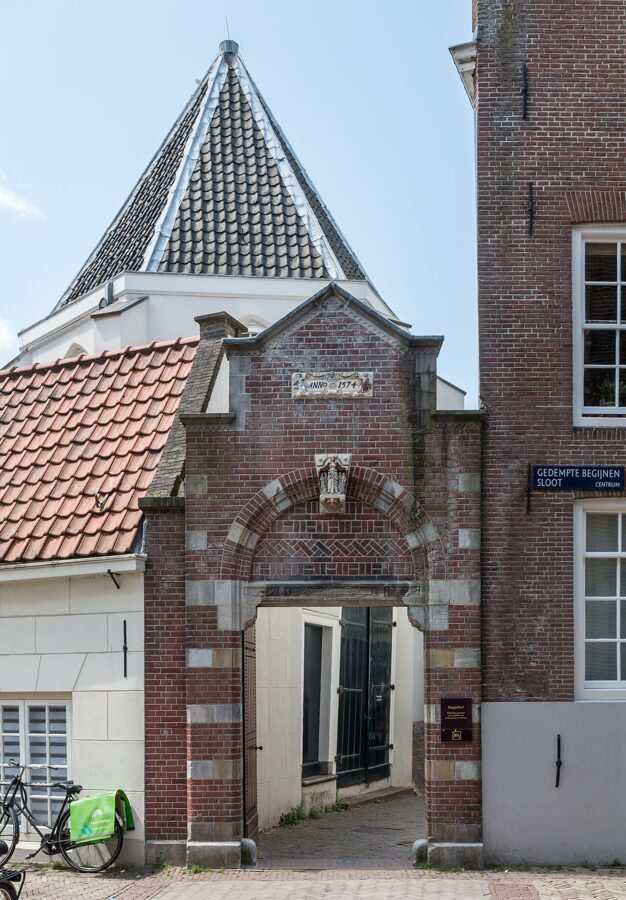
Walk round the corner instead, into the narrow lane called the Gedempte Begijnensloot, and the gate on your left is the one that opens. Behind it are 47 houses around a lawn, set about 80 centimeters below the level of the street, and a little over a hundred women who live in them. They are the reason the rules here are strict, the reason groups larger than 12 are turned back and the reason there is not a single bin: the foundation that owns the place would rather you carried your coffee cup out than left it on a doorstep.
So the decision is a small one, and it is yours. Come early, keep your voice down and stay on the open paths, and you get one of the oldest corners of Amsterdam nearly to yourself. Come at two on a Saturday behind a guide with a flag, and you are why, in 2003, the residents went to court and a judge let the foundation lock the gate after 11 in the morning.



The rules, the hours and the right gate
The Begijnhof is not a museum and not a park. It is private property, owned with its paths and lawns by a foundation, Het Begijnhof, which rents the houses to single women and uses the rent to keep 600-year-old buildings standing. Entry is free. The foundation sets the house rules, and they are short:
- No bicycles, no dogs and no wheeled suitcases inside the gate.
- No eating or drinking in the courtyard, and no bins to leave anything in.
- Groups of 12 people at most.
- Only the open part of the courtyard is for visitors; the fenced and gated paths are for residents.
- On busy days and at weekends hosts stand at the entrance, and you do what they say.
Add the unwritten ones. Do not lean over a garden fence to photograph through a window, do not sit on a doorstep and do not take a phone call in the middle of the lawn. Sound carries off the walls here in a way it never does on the Kalverstraat a block away.
| What | When (as of November 2026) |
|---|---|
| Courtyard, visitor gate on the Gedempte Begijnensloot | Daily 10:00–18:00, public holidays included; closed on King’s Day, 27 April |
| Begijnhofkapel, Mass (in Dutch) | Monday to Friday 09:00 and 17:00, Saturday 09:00, Sunday 10:00 |
| English Reformed Church | Sunday service 10:30; no fixed visiting hours at present |
| Spui door | Churchgoers only, before 09:30 and after 18:00 |
The foundation gives 10:00 as opening time. The chapel’s own notice says the visitor gate opens at 9:30, so if you are there at ten you are safe either way. The one day it stays shut is King’s Day, when the city outside turns into a street party and the residents close the gate.

The Spui door was closed to sightseers years ago, after complaints about loudspeaker tours and people pushing into front gardens to film through windows. Groups and guided tours were banned in consultation with the city from July 1996, and the 2003 court case followed when they kept coming. A legal study of the deeds settled the old question of who owns the paths: like the lawns and most of the buildings, they belong to the foundation, which may close them.

Who the beguines were
The name means “court of the beguines”, and the beguines were neither nuns nor ordinary laywomen. They were unmarried women who lived together in a religious community, vowed chastity and obeyed the court’s priest for as long as they stayed, but took no lifelong vow and no vow of poverty. They kept their own money and property. They could leave at any time, and some did, to marry.
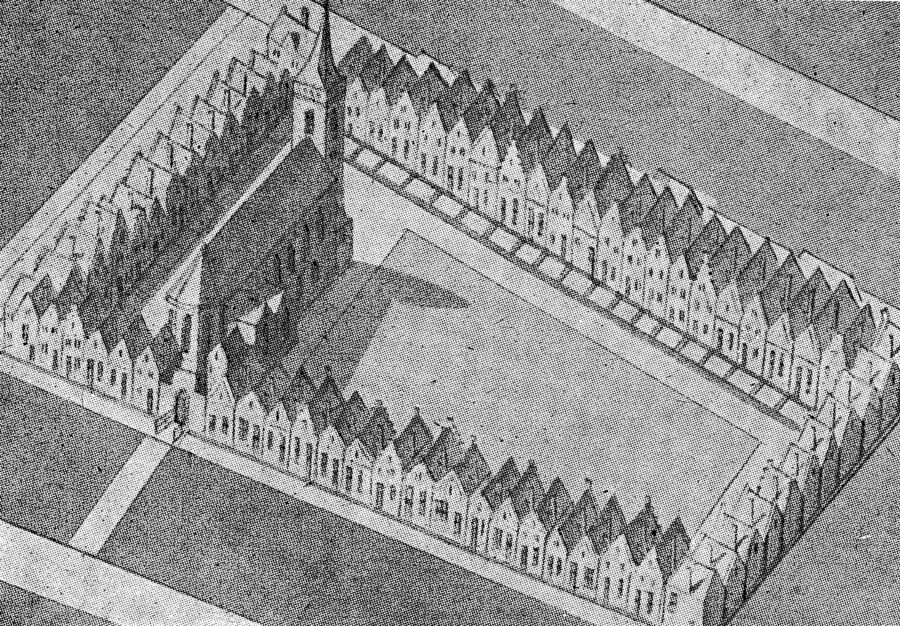
The movement began in Western Europe around the end of the 11th century, and Amsterdam’s beguines are first mentioned in the accounts of the bailiff of Amstelland in 1307. On 31 July 1346 a man named Coppe van der Lane handed over a “Beghynhuys” to them, and in 1393 Albrecht of Bavaria, count of Holland, confirmed their statutes. His rules give a sense of the life: no leaving the court without permission, every beguine in her own house by nine, lights out at ten, no dogs, no roosters and no boys over the age of three.

The women nursed the sick, which made them valuable to a medieval city with no hospitals to speak of, and later they taught small children. For a woman whose family wanted to marry her off, or a widow who did not want to marry again, the court was a way to live independently with a roof and a community. Women could join young or late, and a newcomer had to live on the court for 18 months before she was received as a beguine.
An island that kept its faith
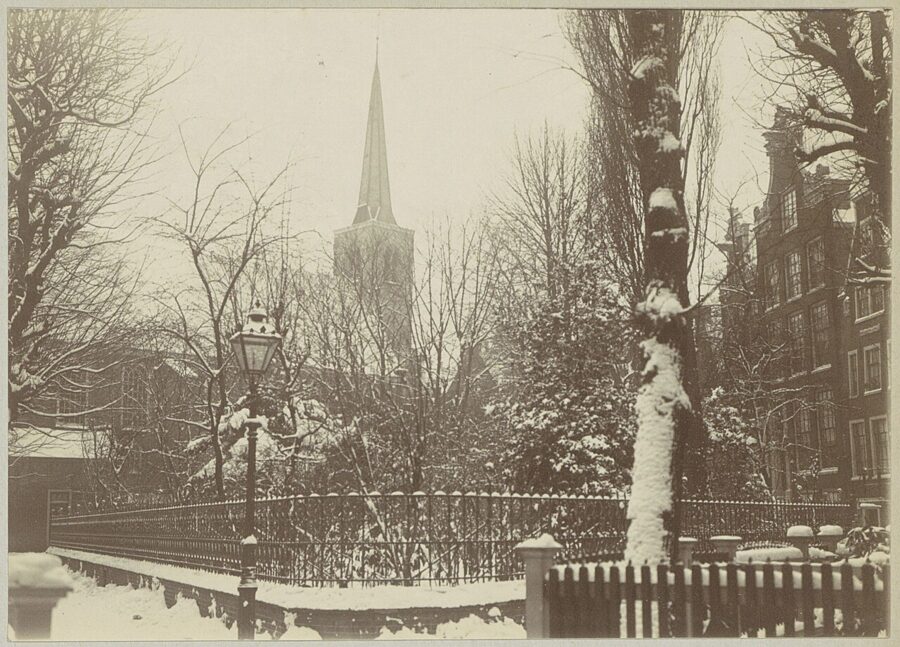
For centuries the Begijnhof was an island: the Spui ran along the south, the Nieuwezijds Voorburgwal along the west and a ditch, the Begijnensloot, along the east. Until 1417 the court did not reach south of today’s Begijnensteeg; the beguines filled the marsh between there and the Spui with rubble, refuse and sand until it would carry houses. After the city fires of 1421 and 1452, many of the houses were rebuilt in brick. The water went in the 19th century, when the Begijnensloot was filled in 1865, the Spui in 1882 and the Voorburgwal two years later.
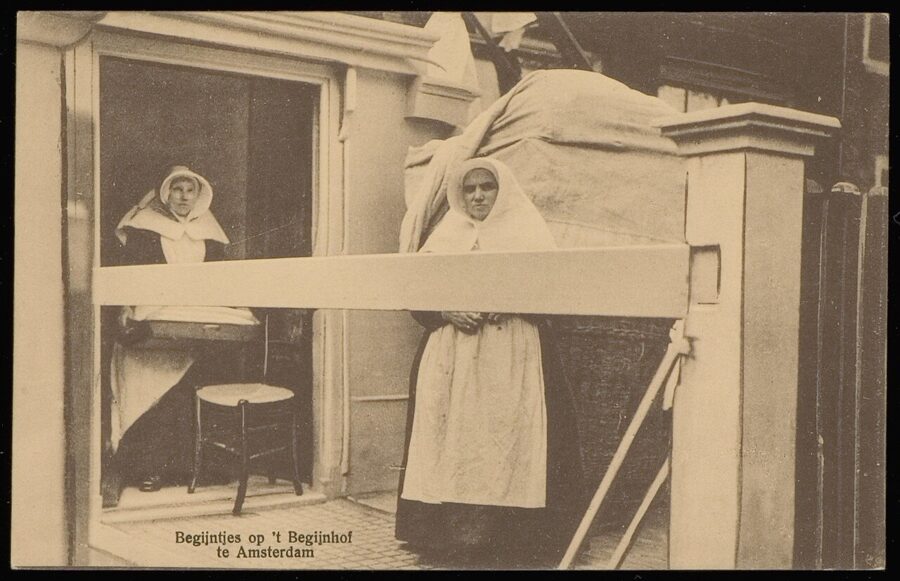
Then came the Alteration of 1578, when Protestants took over the city government. Every Catholic church and convent in Amsterdam was seized. The Begijnhof survived, the only Catholic institution in the city that did, because the houses were the private property of the women who lived in them, and many of those women came from families the new council could not afford to offend. The beguines lost their church, but kept their homes and their faith, and worshipped quietly in a house until they could build a hidden chapel.
Not everyone on the court was a saint. Between 1700 and 1744 a resident called Margriet van Ray terrorized her neighbors with what the records call an unbearably malicious temper: buckets of water poured over the floor of the people below, noise at night, slammed doors and the only key to the water tank kept for herself. The mayors were called in and ordered her to behave like a decent beguine. It did not work, and the court only had peace when she died.
The last beguine
In 1862 the remaining beguines moved in together, into the large house called Bethanië at number 26. In 1950 there were still ten of them. The last, Sister Antonia, born Agatha Kaptein in Akersloot in 1887, died on 23 May 1971 at the age of 84, and with her the community ended after more than six centuries.
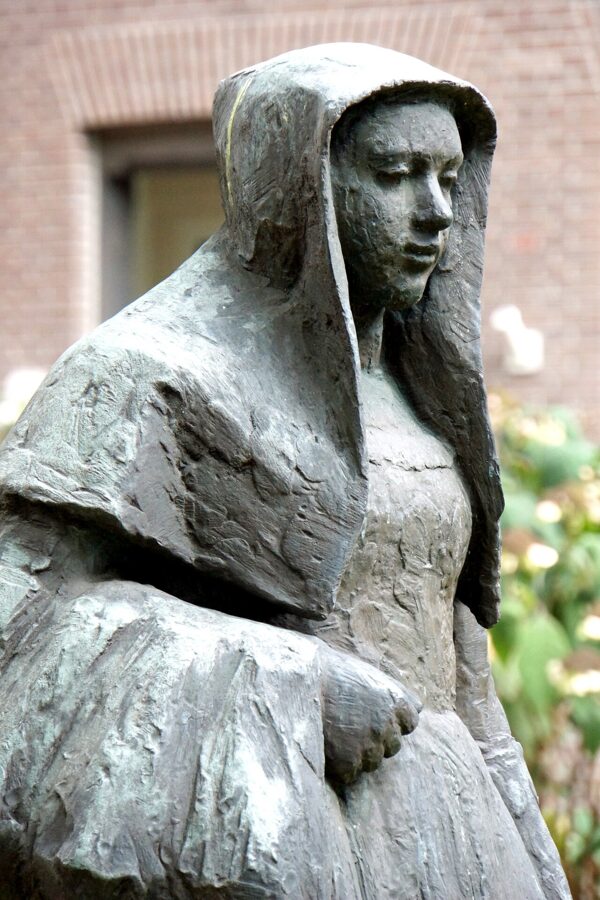

The court did not empty. The foundation’s statutes, last revised in 1985, still give priority to widows and other single women, preferably Catholic, and in practice the houses go to single women over 30, ideally with some religious background. There used to be 140 tiny homes, most of them one room. A long restoration, finished in 1987, joined them into larger flats, and the number of residents has stayed at around 105 since.
Het Houten Huys at number 34
The black house in the corner is the reason half the visitors come. Het Houten Huys has a front and back wall made entirely of wood, a gable that leans forward over the path, and inside a complete Gothic timber frame. A fragment of a 15th-century wall painting of the Virgin with a unicorn survives in it. There is no public access inside.
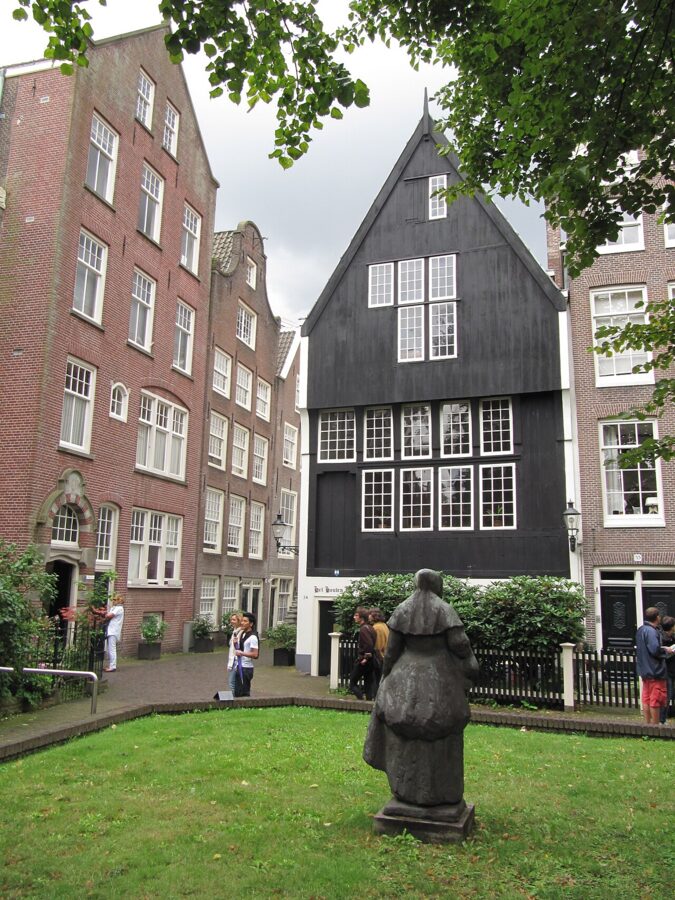

How old it is depends on whom you ask, and the disagreement is worth knowing. The foundation dates it to before the great fire of 1452. For most of the 20th century it was billed as the oldest wooden house in the Netherlands, built around 1420. Later research put it at 1528 or shortly after, which is still remarkable for a wooden house in a city that banned wooden building after its fires.
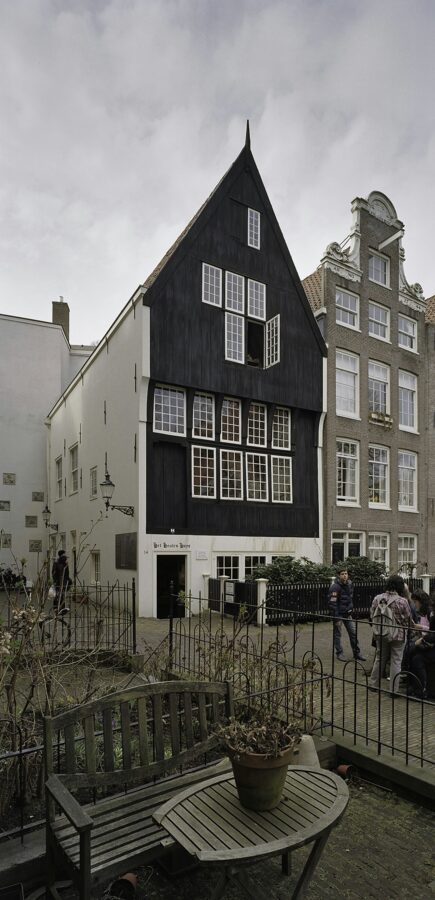

It is one of only two houses in the city with a wooden front. The other is at Zeedijk 1 in De Wallen, the café In ‘t Aepjen, built about 15 years later. Neither is the oldest house in Amsterdam any more: in 2012 a house of around 1485 was found on the Warmoesstraat, hidden behind a 19th-century front that gives nothing away.
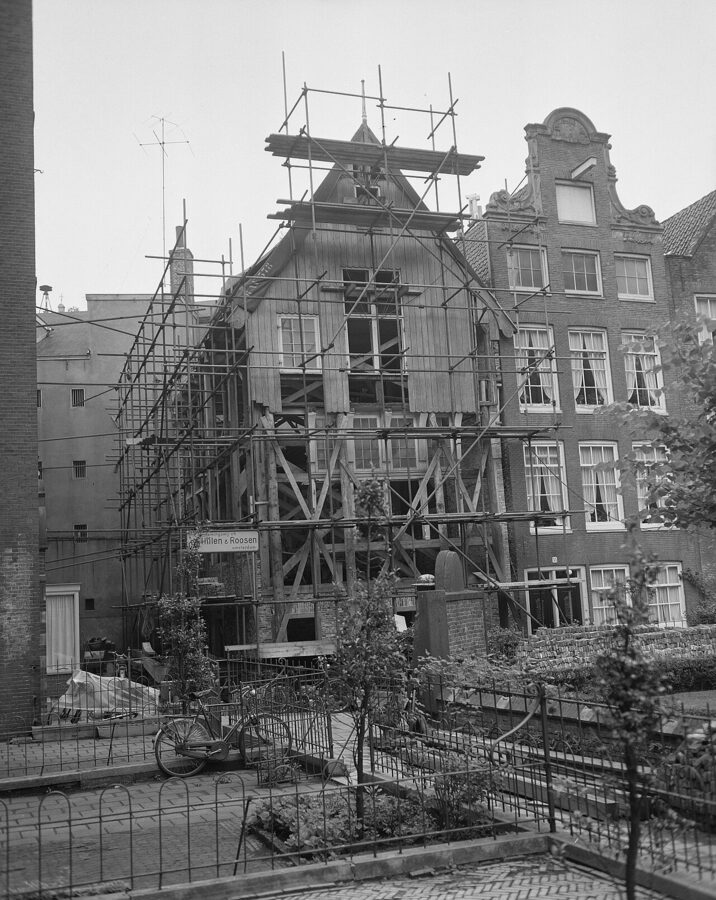
The gable stones on the blind wall
Turn left around the wooden house and the white wall beside it carries a row of painted gable stones. They do not belong here. They came from Amsterdam houses that were demolished, and were set into this wall in the 1960s: Abraham about to sacrifice Isaac (1631), the flight into Egypt (1612), the road to Emmaus (1626), the glowing oven (1651) and others. A board on number 34 explains each one.
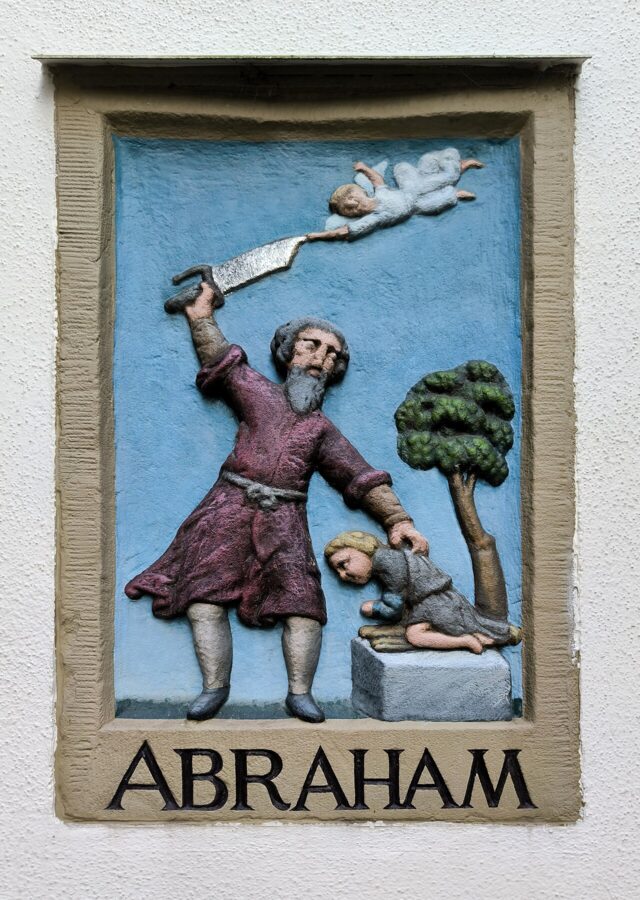

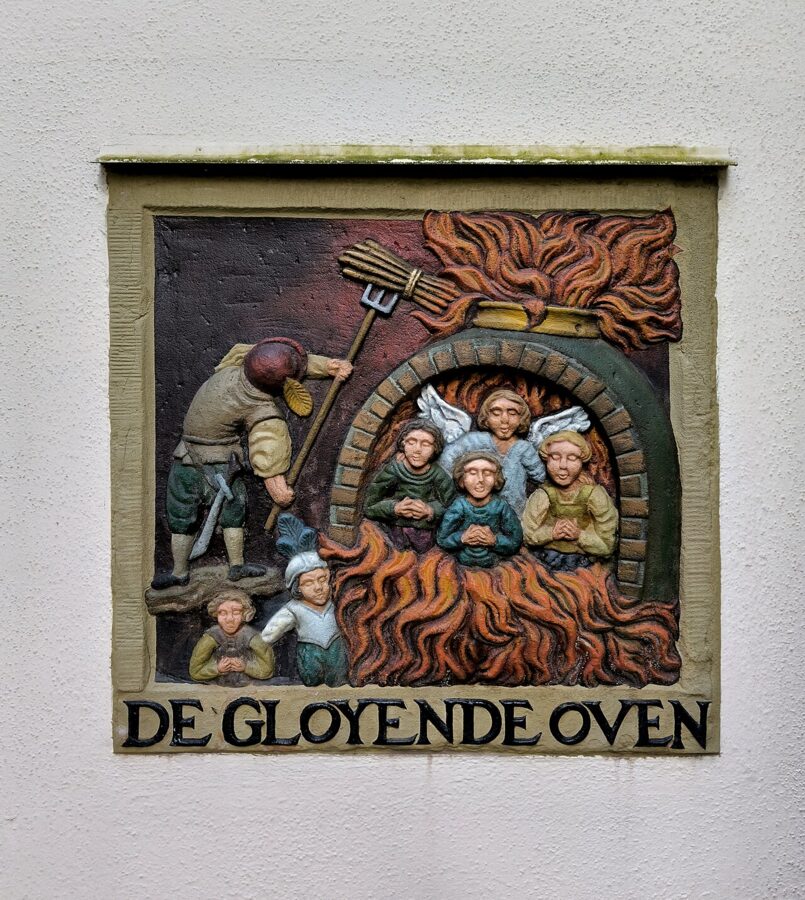

The stones that do belong to the court are on the houses. Numbers 23 and 24 show the court’s patrons, Saint Ursula and Saint John. Number 19 carries Joseph leading the donkey with mother and child, and the line “Uyt Egypten hebbe ik mynen soon geroepen” (out of Egypt have I called my son).
The English Reformed Church
The brick church in the middle of the court was the beguines’ own. The court had a chapel from 1397, and the first church on this spot was consecrated in 1419, only to burn two years later in the fire that took most of the court; the tower survived. The present building went up toward the end of the 15th century. After the Alteration it was taken from the beguines and stood empty until the city gave it in 1607 to the English-speaking Presbyterians, who have held it ever since.
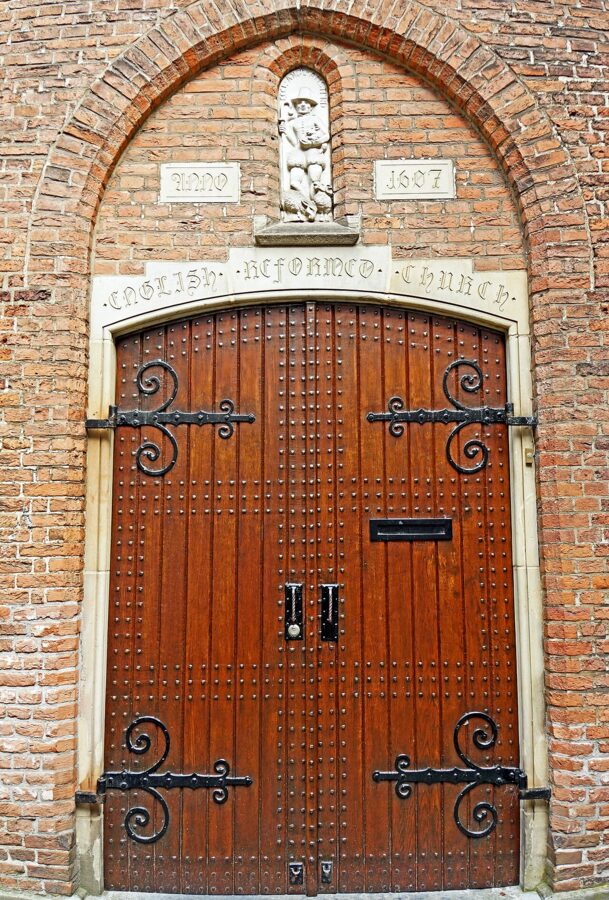

Today the English Reformed Church belongs both to the Church of Scotland and to the Protestant Church in the Netherlands, and its congregation of almost 400 comes from more than 30 countries. The pulpit panels were designed by Piet Mondriaan, years before his grids, and carved by Edema van der Tuuk to mark Queen Wilhelmina’s accession in 1898. The brass lectern was a gift in 1689 from William III and Mary Stuart when they became joint monarchs of Great Britain.
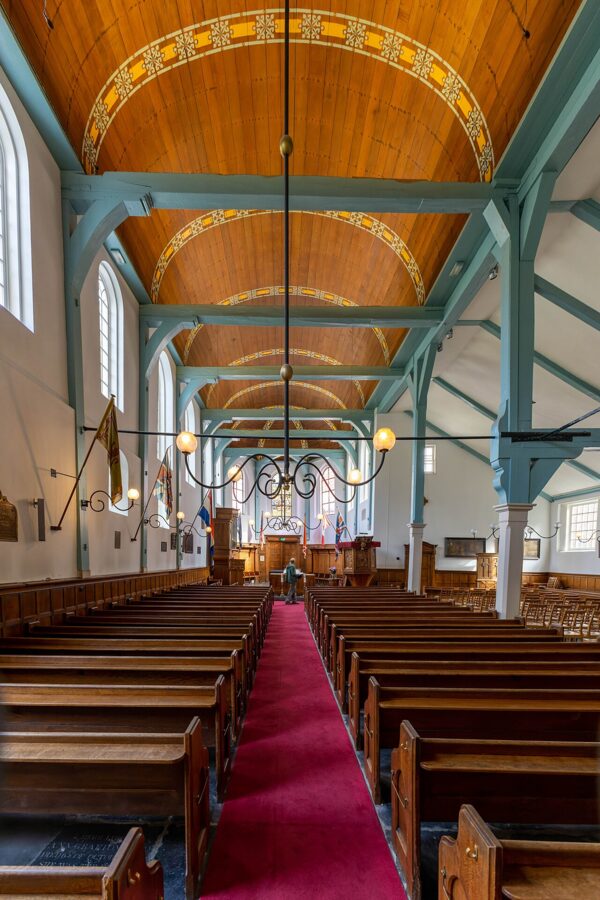

The only stained-glass window, at the back of the chancel, was given in 1920 by the American editor Edward Bok for the 300th anniversary of the Pilgrim Fathers sailing from Leiden; many of them had lived in Amsterdam first. The main organ, by the Dutch builders Flentrop, was finished in 2000 as a near copy of Christian Müller’s instrument of 1753.
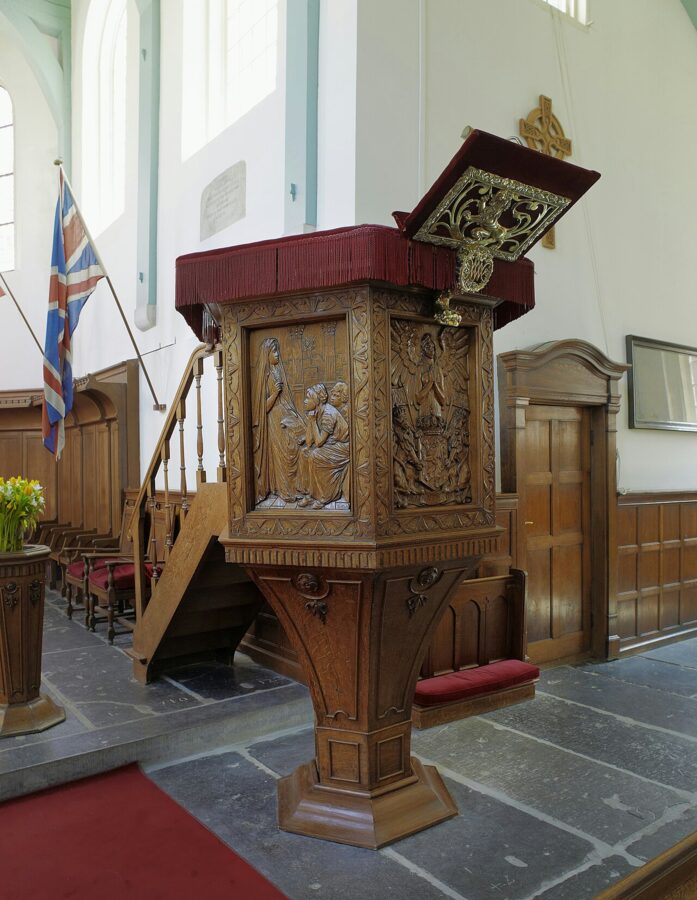

Can you go in? On Sunday, yes: the service is at 10:30 and everyone is welcome.
On weekdays it depends on the volunteer guides, and as of November 2026 the church lists no fixed visiting hours, so check its calendar before you count on it. The surer way in is a concert. The church hosts more than a hundred in an average year, with tickets sold at the door from half an hour before the start.
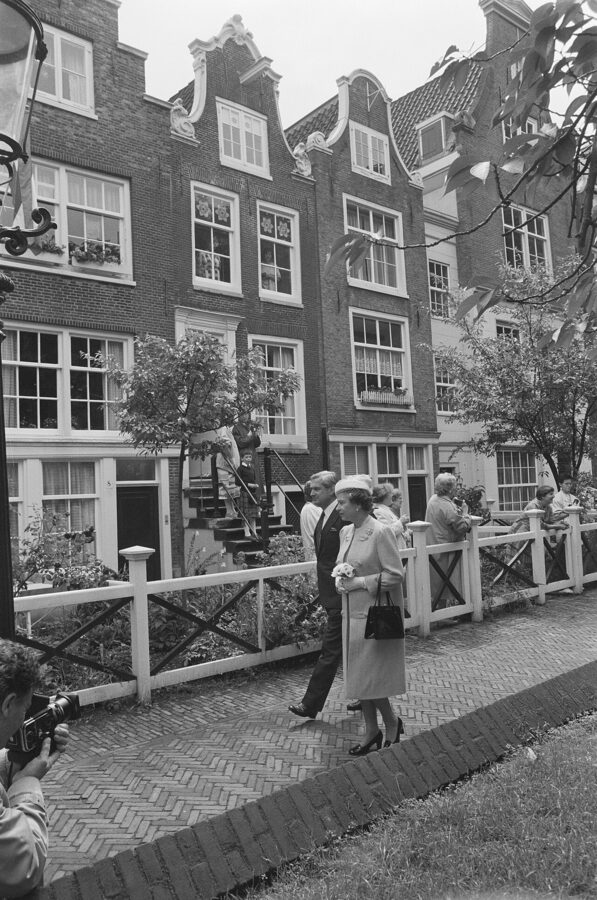
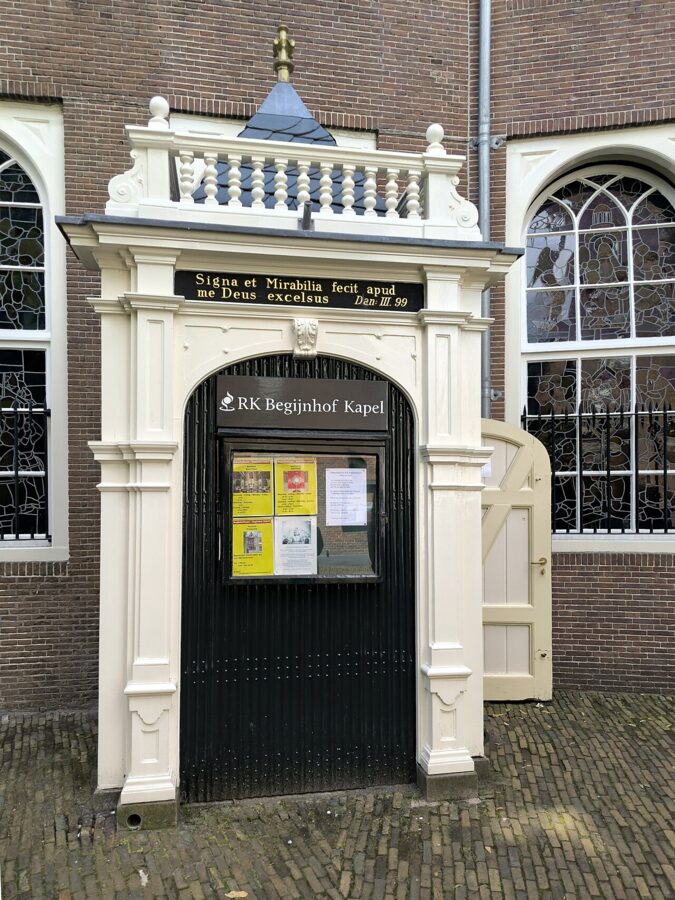
The Begijnhofkapel, a church disguised as two houses
Opposite the English Church is the answer to one of the questions people most often ask about Amsterdam: is there a hidden church? There is more than one, and this is the one still in daily use.
After losing their church, the beguines heard Mass in its sacristy, then, when that was refused too, in one of the houses. In 1665 two houses were joined into one space, and on 2 July 1671 the first stone was laid for a proper church inside them, designed by the Catholic architect Philips Vingboons. The city allowed it on one condition: from the outside, nobody was to see that it was a church.

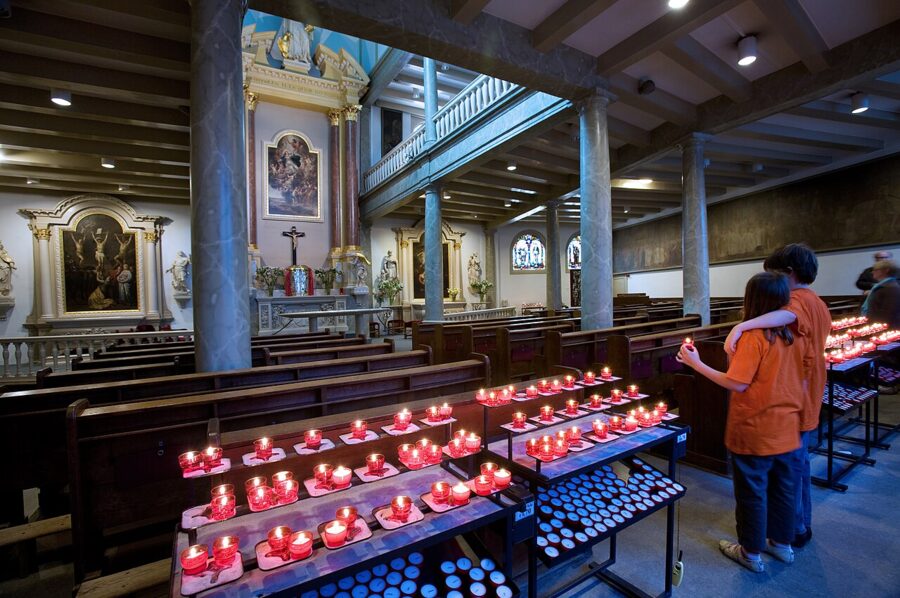
Inside, the trick is obvious. A gallery runs around the walls to fit more people into two houses’ worth of floor, a painting of the Assumption hangs above the high altar, and the side chapel on the left is devoted to the Miracle of Amsterdam. The stained-glass windows were designed and made in the late 1940s and early 1950s by Gisèle d’Ailly van Waterschoot van der Gracht, who put herself into the window of 1950.

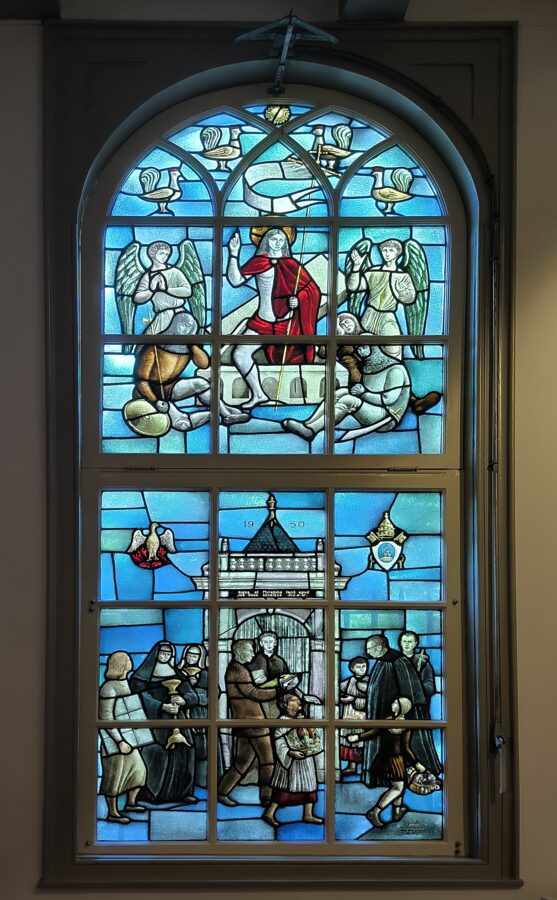

The Miracle and the Silent Procession
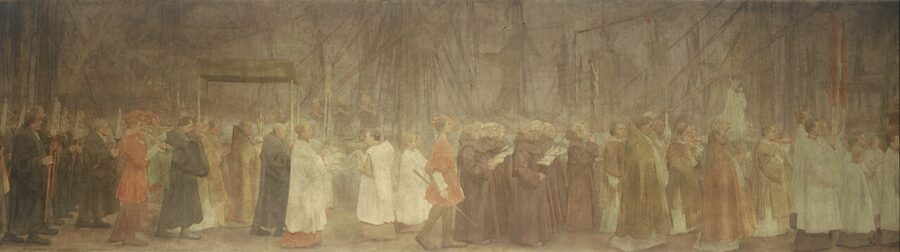
In 1345, the story goes, a sick man in the Kalverstraat was given communion and vomited, and what he brought up was thrown on the fire. The host floated in the flames unburned, a woman lifted it out without hurting her hands, and when the priest carried it back to the parish church, now the Oude Kerk, it kept returning to the house. A chapel, the Heilige Stede, was built on the spot, and the city became a place of pilgrimage until the Alteration ended the processions.
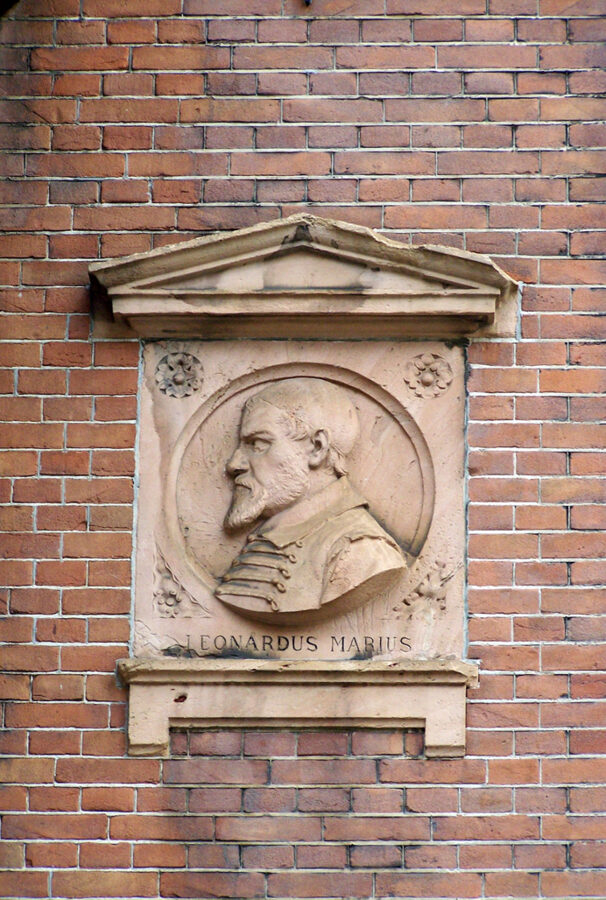
The Begijnhof kept the devotion alive. From 1631 its priest, Leonardus Marius, made the court a second Heilige Stede in all but name. When the Protestants demolished the original chapel in 1908 rather than sell it back to the Catholics, the Begijnhofkapel officially became the miracle church, served today by the fathers of the Congregation of the Blessed Sacrament.

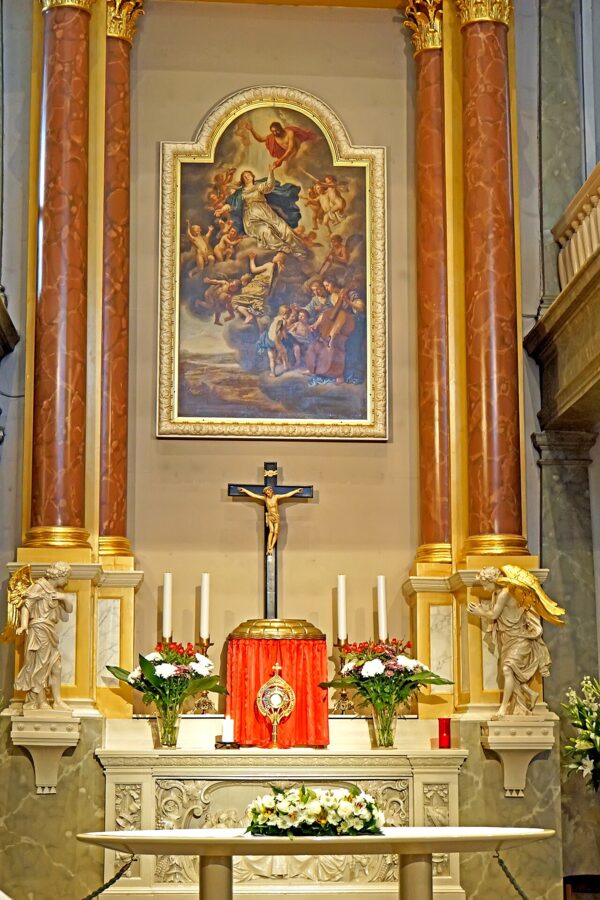

The procession itself came back in the 1880s as the Stille Omgang, a silent walk at night, without singing, banners or vestments, which was how it slipped around the national ban on processions. The ban was lifted in 1983. The silent walk still goes through the old center every March, and it passes along the Kalverstraat.

If you want the other kind of hidden church, the museum one, Our Lord in the Attic on the Oudezijds Voorburgwal is a whole Catholic church built into the top of a merchant’s house; it is covered with its hours in the guide to Amsterdam’s museums. And for the city’s medieval parish church, where the miracle host was first carried, go to the Oude Kerk.
Outside the gate: the Spui and the Kalverstraat
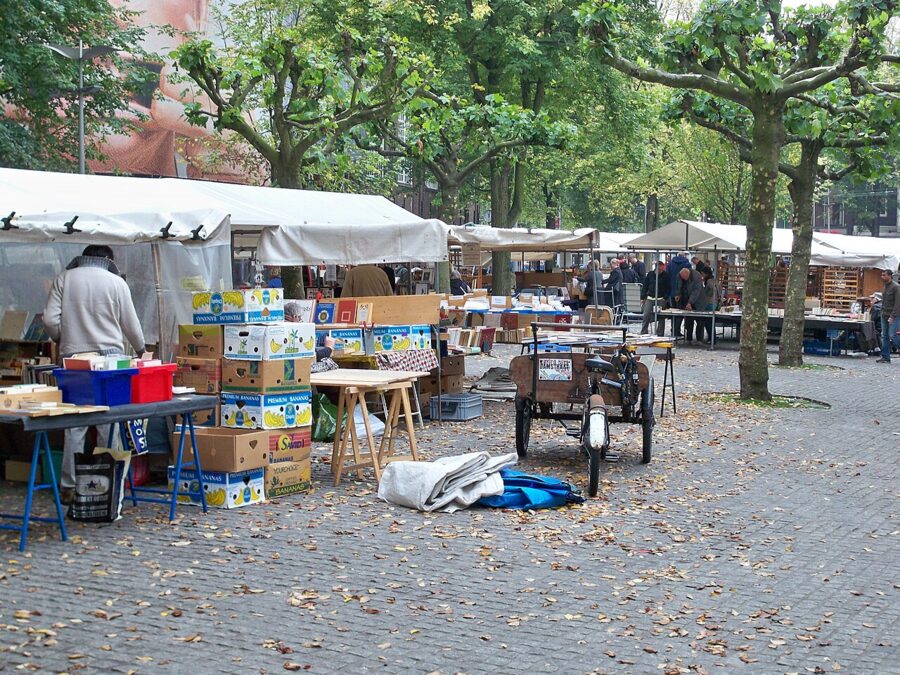
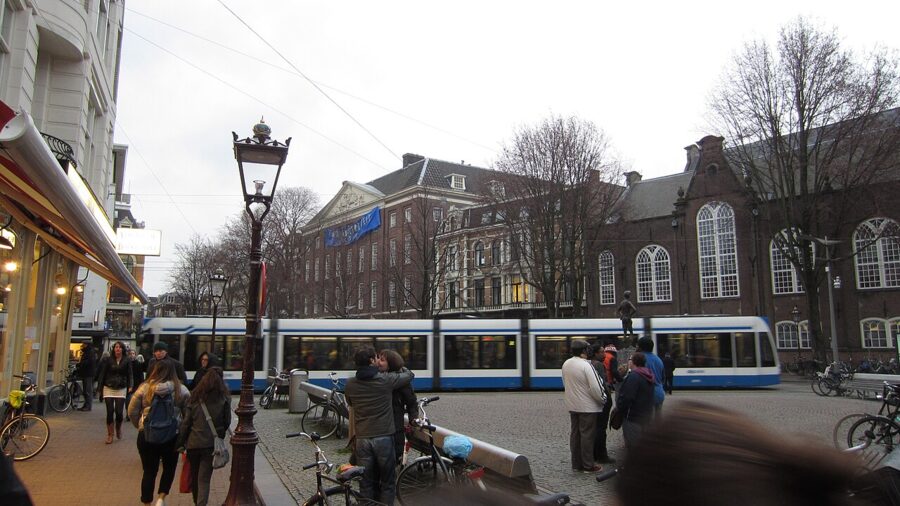
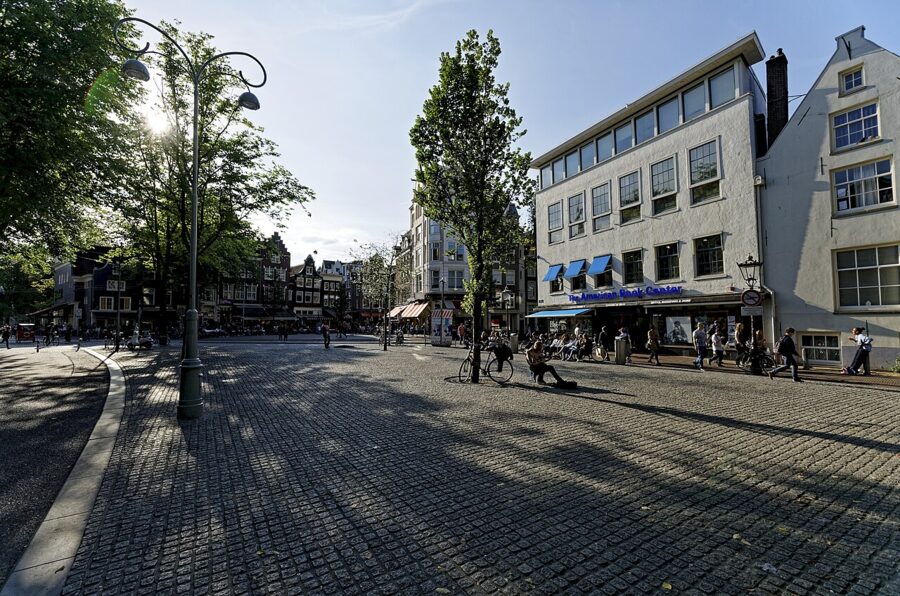
The Spui was water until 1882, the southern edge of the medieval city, and it is now a small square of cafés and bookshops with a tram line along one side. On Fridays the book market fills it, with secondhand and antiquarian dealers from around the country selling books in Dutch, English, French and German, plus prints and old magazines. The city’s listing gives both 9:00 and 10:00 as the start, and 18:00 as the close; go after ten. On Sundays from March to December an art market takes the same spot, from 11:00 to 18:00.

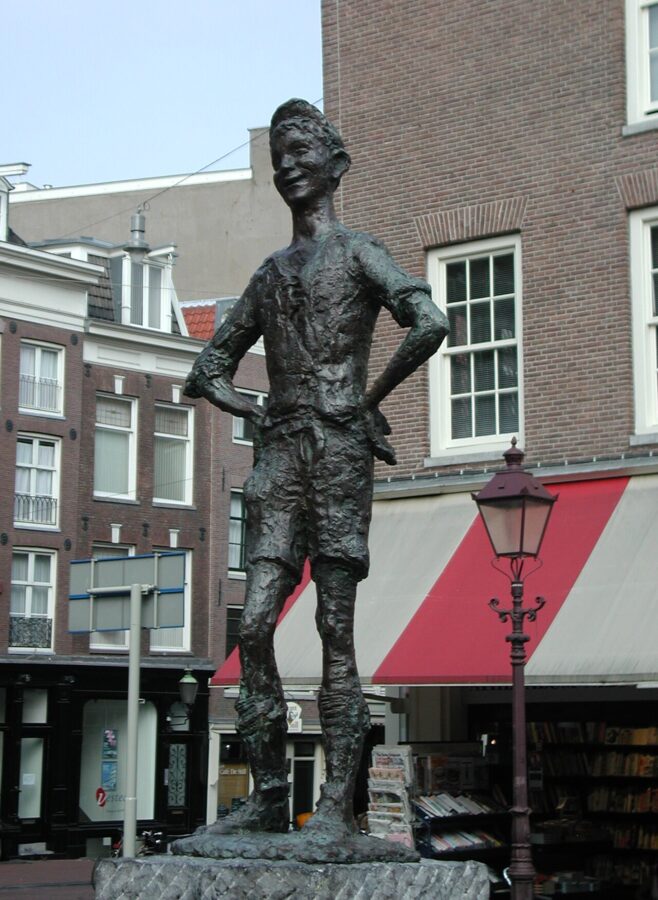
In the middle stands a statue the size of a ten-year-old. Het Lieverdje (the little darling) is Carel Kneulman’s bronze street boy, unveiled on 10 September 1960 and paid for, after an appeal to newspaper readers fell short, by a cigarette company. That sponsorship made it the target, from 1964, of Robert Jasper Grootveld’s anti-smoking happenings, and the crowds and police around the statue gave birth to the Provo movement. A delivery truck backed into it in March 2024, and it was back on a new plinth by June.

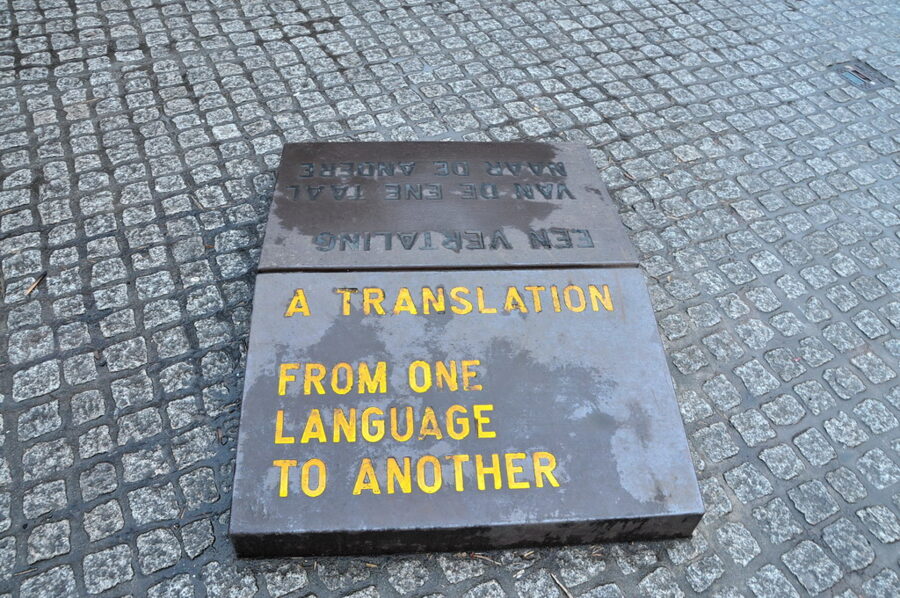
Look down near the book stalls for three iron slabs shaped like books, set into the paving in 1996 by the American artist Lawrence Weiner. They carry the line “a translation from one language to another” in Dutch and in English, Arabic or Sranan Tongo. Opposite the Begijnhof gate, the long classical front of the Maagdenhuis, built from 1783 to 1787 as a Catholic girls’ orphanage, now belongs to the University of Amsterdam and has been occupied by protesting students more than once.


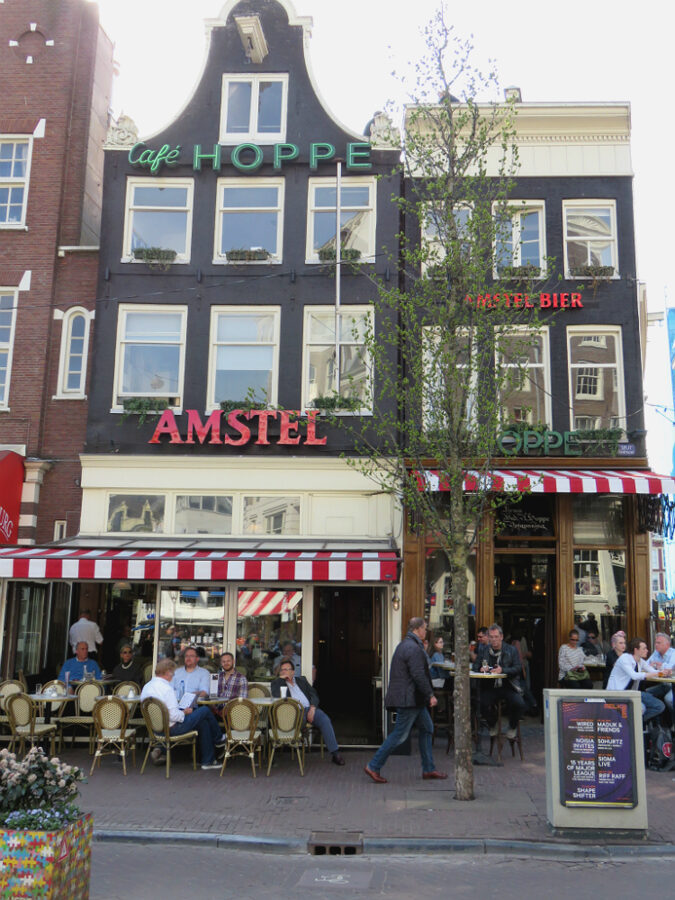
For a drink, Café Hoppe at Spui 18-20 has poured beer since 1670, with a standing room in one half and seats in the other. For new books, the Athenaeum Boekhandel is on the square itself.


The Amsterdam Museum and the Civic Guard Gallery
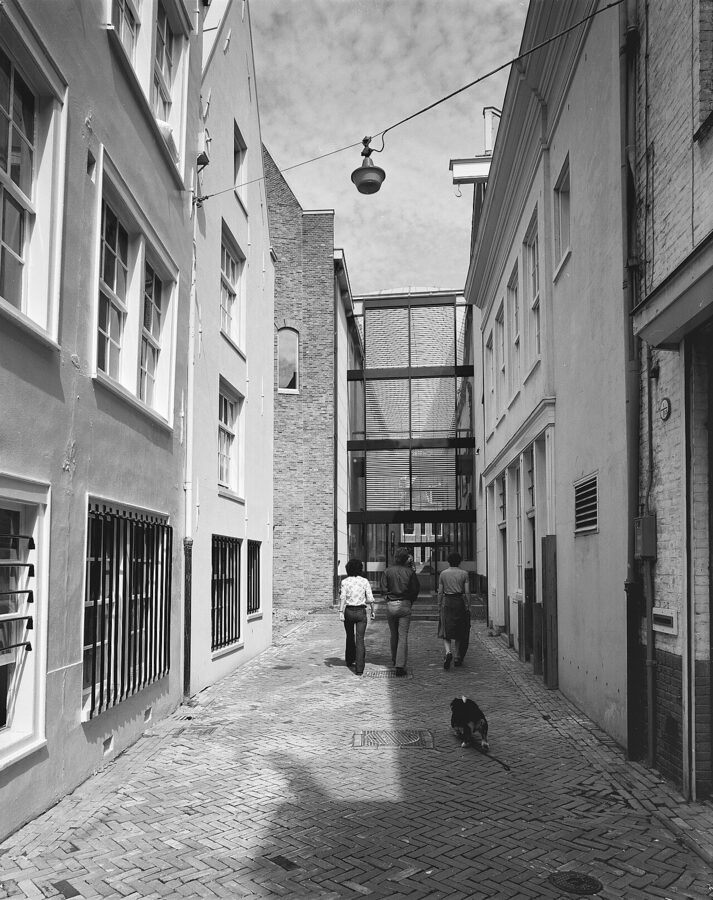
Until recently, the best way out of the Begijnhof was a few steps up the Gedempte Begijnensloot and into the glass-roofed Civic Guard Gallery, a covered street hung with 17th-century group portraits that you could walk through for free. It belongs to the Amsterdam Museum in the old city orphanage, and the whole complex is shut. The renovation began on 3 September 2026 and the museum plans to reopen in 2030.

The Kalverstraat
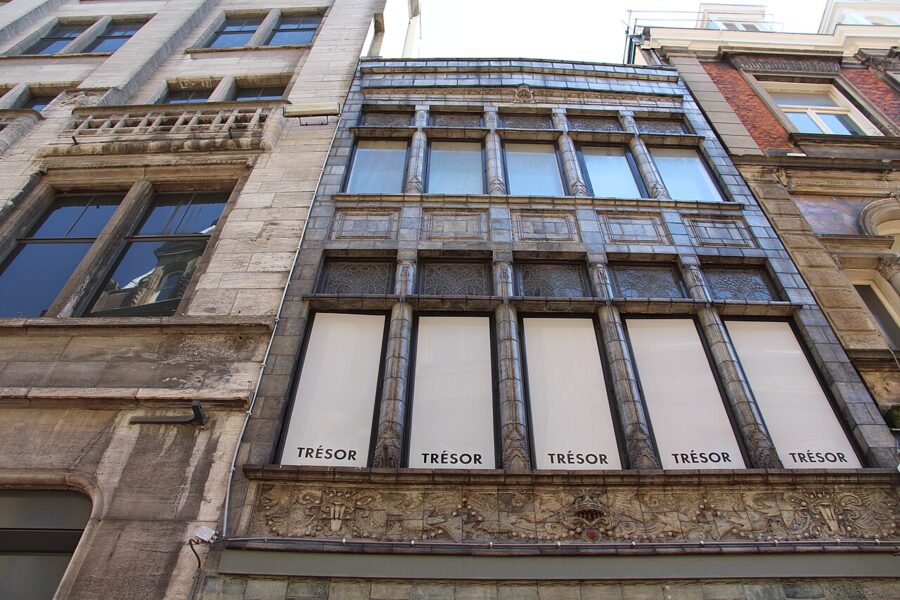
One block east runs the Kalverstraat, the city’s busiest shopping street, lined with chain stores, and the street where the Miracle happened in 1345. It is worth walking once for the scale of the crowd and not worth shopping in unless you need something. From early 2027 the city is digging it up for new sewers, pipes and paving, with work expected to last until 2028, and the book market may have to move off the Spui for a while so the square can hold building materials.

When to go, and how to get there
Is it worth it? Yes, for twenty minutes, if you go at the right time and treat it as somebody’s front garden. Arrive at 10:00 on a weekday and you share the lawn with a few early walkers; by late morning the groups arrive, and by early afternoon at a weekend the hosts are counting people in.
The last hour before the 18:00 close is quiet again. In winter the light goes early and the courtyard is dark by half past four, so go before lunch.

The nearest metro stop is Rokin on metro 52, the Noord/Zuidlijn: come up to the street, cross the Kalverstraat and you are on the Spui in about five minutes. Trams stop at Spui on the Nieuwezijds Voorburgwal and at Rokin. From Centraal Station it is about 15 minutes on foot, straight down the Damrak to Dam Square, which trams 2, 4, 14 and 24 also serve, and on down the Kalverstraat.

Put it in a morning with its neighbors. The Bloemenmarkt is five minutes south along the Singel, the Dam is ten minutes north, and the canals of the Jordaan start a short walk west. If you want to sleep this close, the Estherea is on the Singel between the Dam and the Spui.
And use the right gate. Walk past the Spui door with Saint Ursula over it, turn into the Gedempte Begijnensloot, go in at ten, leave the coffee outside and speak as you would in someone’s hallway.