
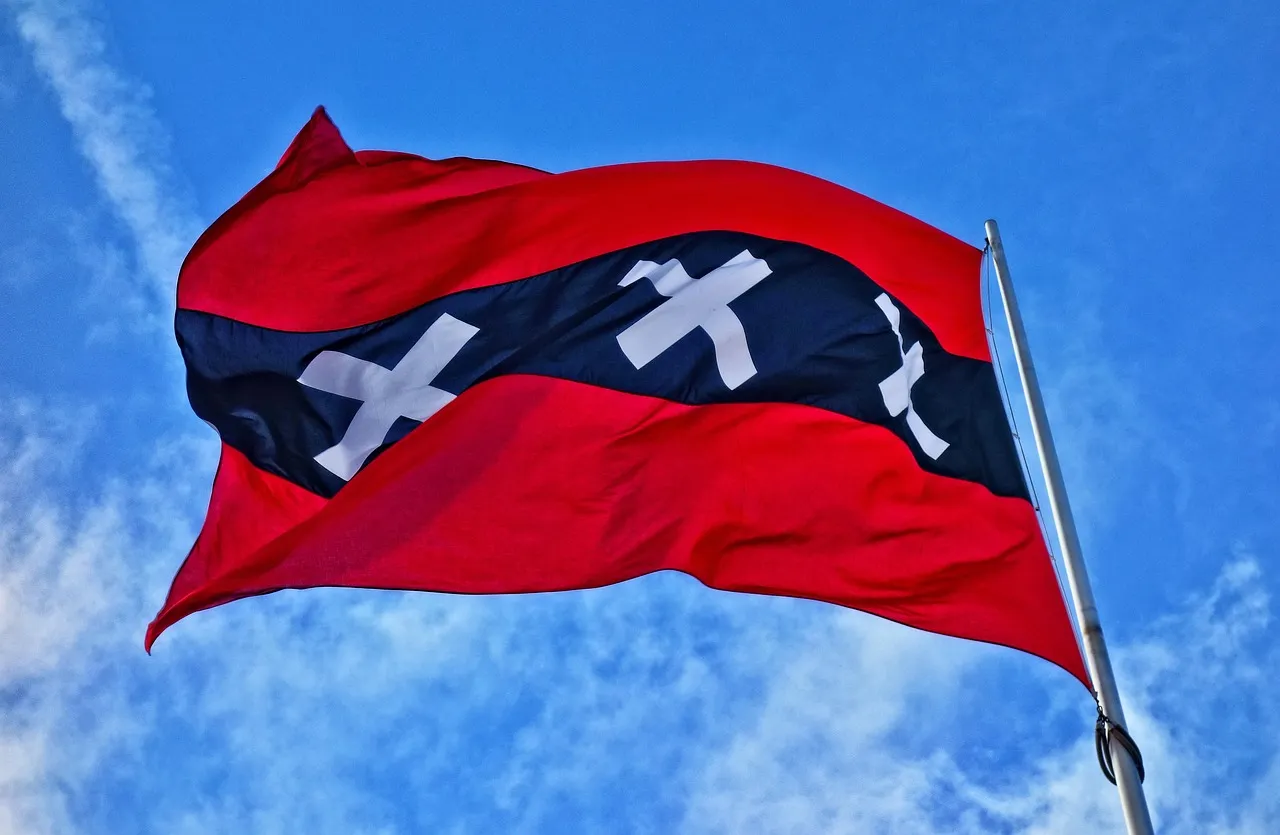
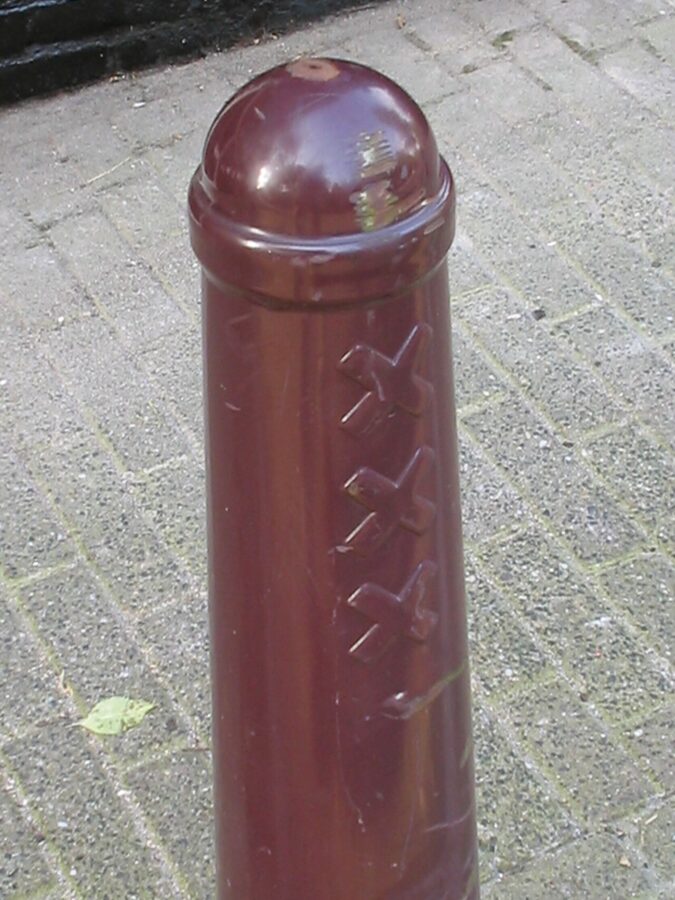
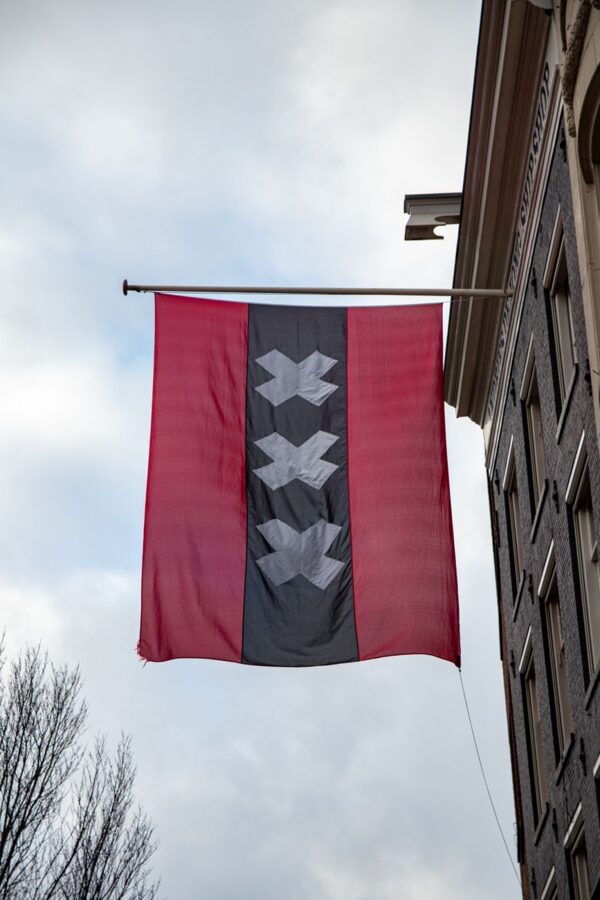
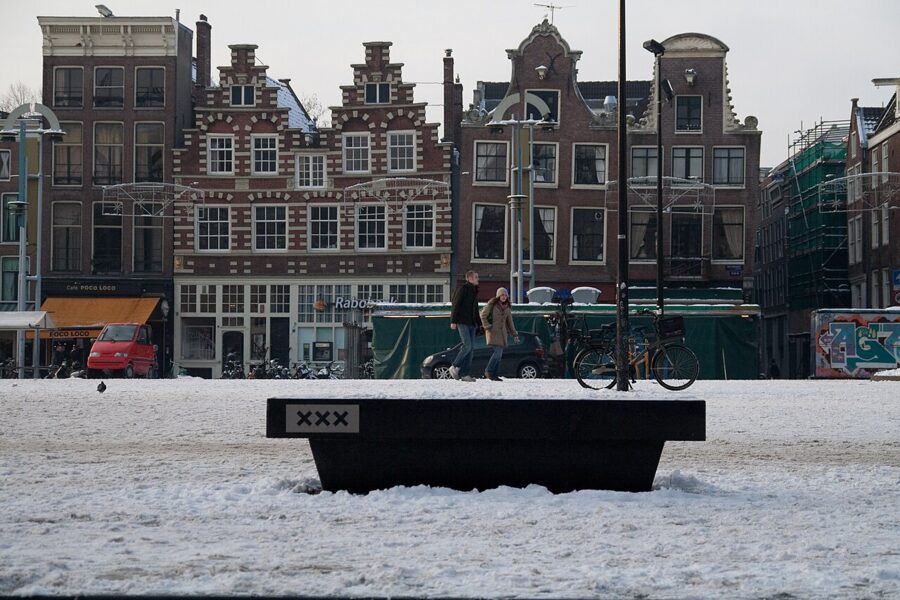
Walk down any canal street in the center and you pass them every few steps: knee-high red-brown posts, a shade darker than dried blood, each with three white X’s stamped one above the other down its side. Look up and the same three X’s fly on a red and black flag from a canal house. Look down and they are on a drain cover, a bench, the door of a city truck. By the time you reach Dam Square you have seen the mark a few hundred times without anyone explaining it.
The souvenir shops on the Damrak explain it for you, with a wink, on T-shirts and shot glasses. They are wrong, and so is most of what gets said about the X’s online. The three marks are St Andrew’s crosses, they sit at the center of the coat of arms of Amsterdam, and the city has been using them since at least the middle of the 14th century, roughly six hundred years before anyone printed XXX on a film poster.
What nobody can tell you for certain is why. The crown above the shield has a paper trail down to the exact loan that paid for it. The motto under it has a queen and a war behind it. The crosses themselves have theories, one of them surprisingly good, and a single hard fact dug out of the mud under the Damrak.


Three St Andrew’s crosses, not three X’s
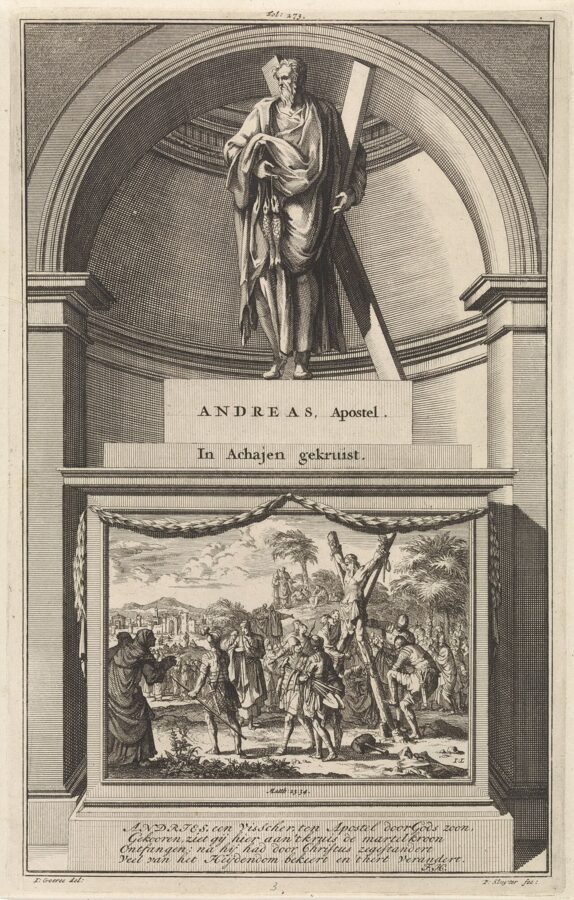
An X-shaped cross is called a saltire in heraldry, and a St Andrew’s cross in ordinary speech, after the apostle. Andrew was a fisherman from Galilee, Simon Peter’s brother, and Christian tradition has him executed at Patras in Greece around AD 60. The oldest accounts say he was bound to an upright cross like the one in every church. The story that he asked for a diagonal one, because he did not deserve to die the way Christ did, came later, and painters only settled on the X-shaped cross in the late Middle Ages.
By then the diagonal cross was common in European heraldry, from Scotland’s flag to the arms of plenty of Dutch families. In Dutch the crosses on the Amsterdam shield are Andreaskruisen, and the official description of the arms in the register of the Hoge Raad van Adel, the Dutch heraldic authority, calls them “verkorte St. Andrieskruisen”: St Andrew’s crosses cut short, so that the arms stop before they reach the edge of the black band.
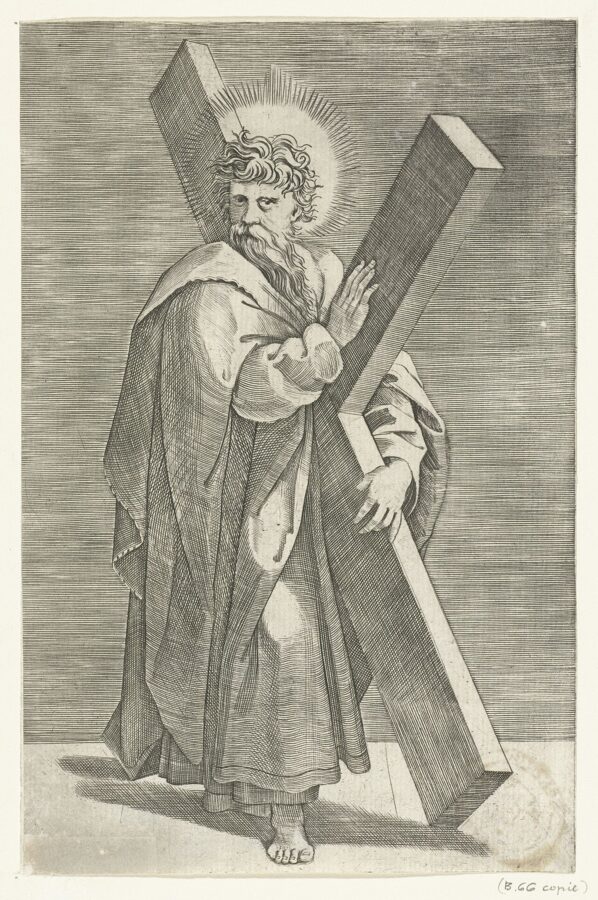
Naming the crosses after Andrew does not mean the city chose them for him. No medieval document says Amsterdam put the apostle on its shield, and the popular line that the fishermen’s saint suited a fishing town is a guess made after the fact. Keep that in mind for everything below: what the crosses are called and why they are there are two separate questions.
The coat of arms, piece by piece
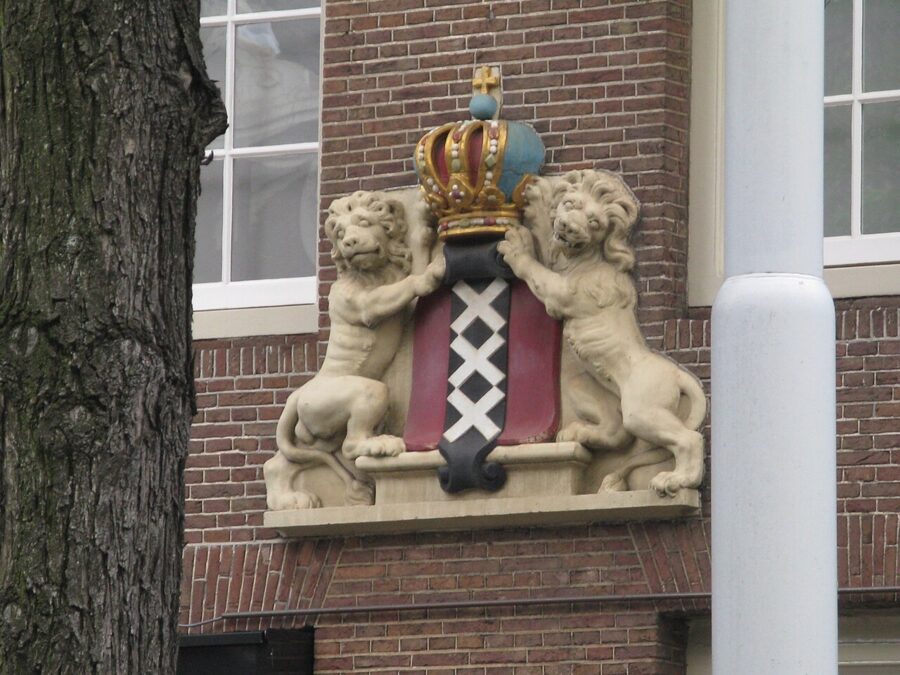
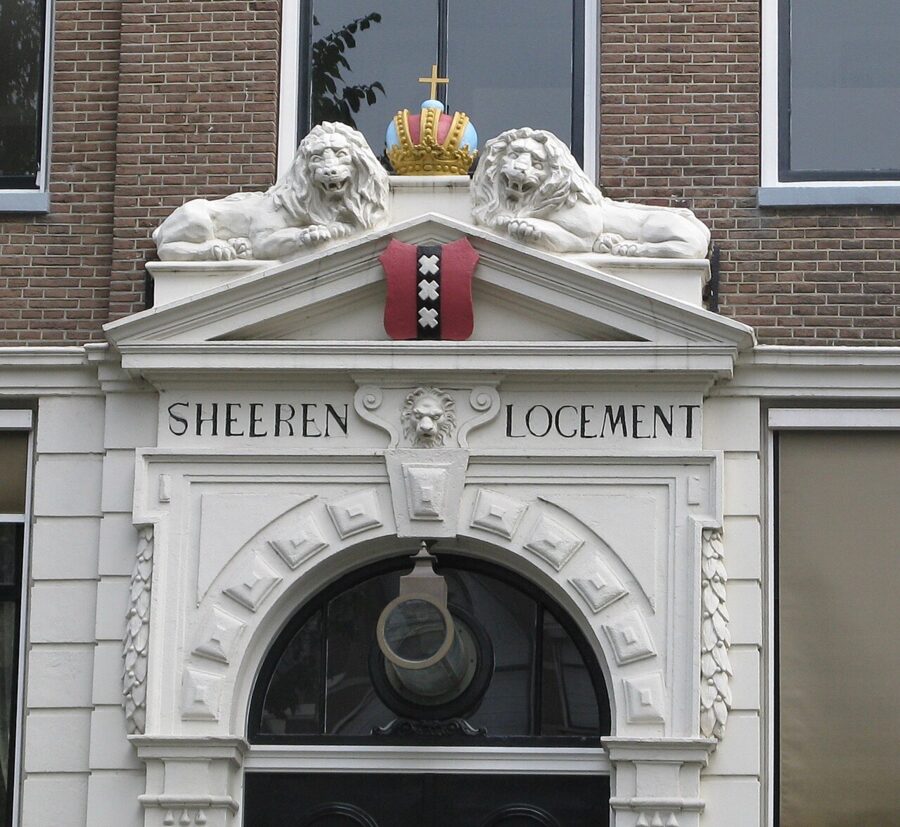
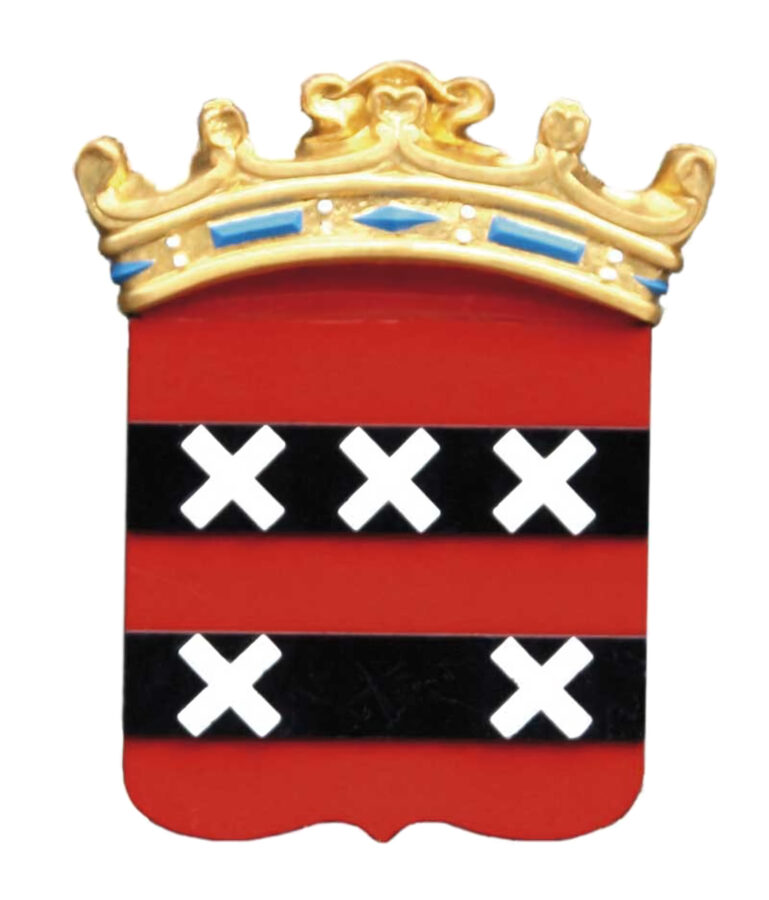
The full arms are a red shield with a black vertical band (a pale) carrying the three silver crosses, the imperial crown on top, a lion on each side holding the shield, and a white ribbon underneath with the motto Heldhaftig, Vastberaden, Barmhartig. Each part arrived at a different time, and only the crown and the motto come with paperwork.
The shield: a riddle in red and black
Heraldry has an old rule that a color should not sit on a color: red, black, blue and green need a metal (gold or silver) between them. Amsterdam’s black pale sits straight on red, which breaks the rule, and Dutch heralds call such arms a raadselwapen, a riddle coat of arms. It gets away with it because the pale looks like a division of the shield into three stripes rather than a charge laid on top.
The city’s own explanation, repeated on its pages for decades, is short: the origin of the arms is not known. The black band might stand for water, as similar bands do in the arms of Dordrecht and Delft, which would make it the Amstel. That is a plausible reading, not a documented one.

The crown: bought, not given (1489)
The story still told is that Maximilian of Austria fell gravely ill, vowed a pilgrimage to the Holy Place on the Rokin if he survived, came to Amsterdam cured and gave the city his crown out of gratitude. Maximilian did come to Amsterdam. The gratitude is not the reason. As the Ons Amsterdam piece on the crown legend sets out, the illness was in 1484, and the first city archivist quietly “corrected” the year to 1489 in 1855 to make the legend fit.
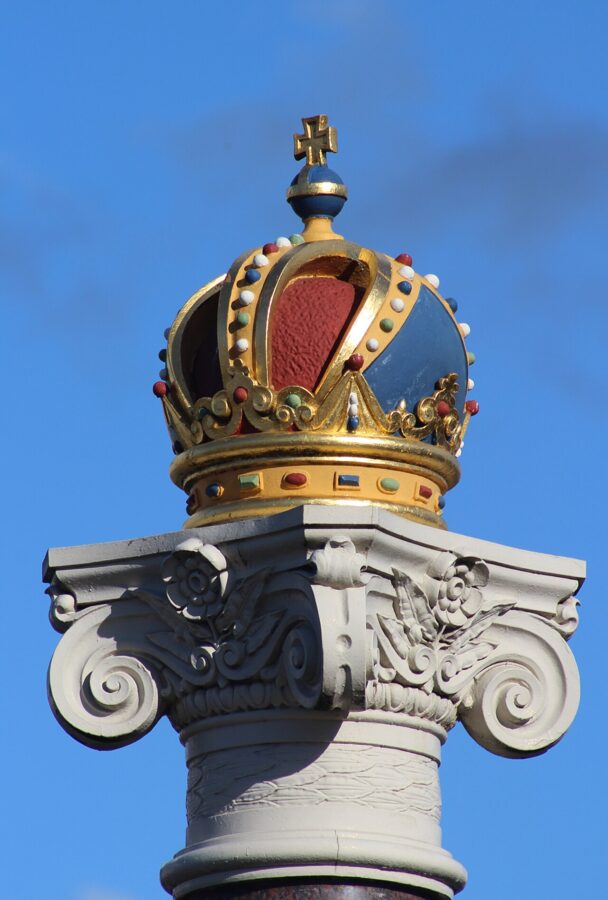
What actually happened is on the record. Late in 1488, in the middle of the Hook and Cod wars, Amsterdam lent Maximilian 10,240 Flemish pounds. The interest was covered partly by handing the city the bailiwick of Amstelland, Waterland and Zeevang, its jurisdiction was pushed out beyond the Singel moat, and Maximilian signed a privilege to decorate its arms “metter crone van onsen Rijcke”, with the crown of his realm, “from now on until eternal days”. In short, Amsterdam bought its crown.
Eternity lasted five years. Maximilian’s son Philip the Fair voided his parents’ privileges in 1494, and burgomaster Andries Boelens had to chase the new ruler to The Hague after his ceremonial entry into Amsterdam on 27 June 1497 to get the crown confirmed, for another fee. Both charters, the unsealed one of 1489 and the sealed confirmation, survive in the city archive.
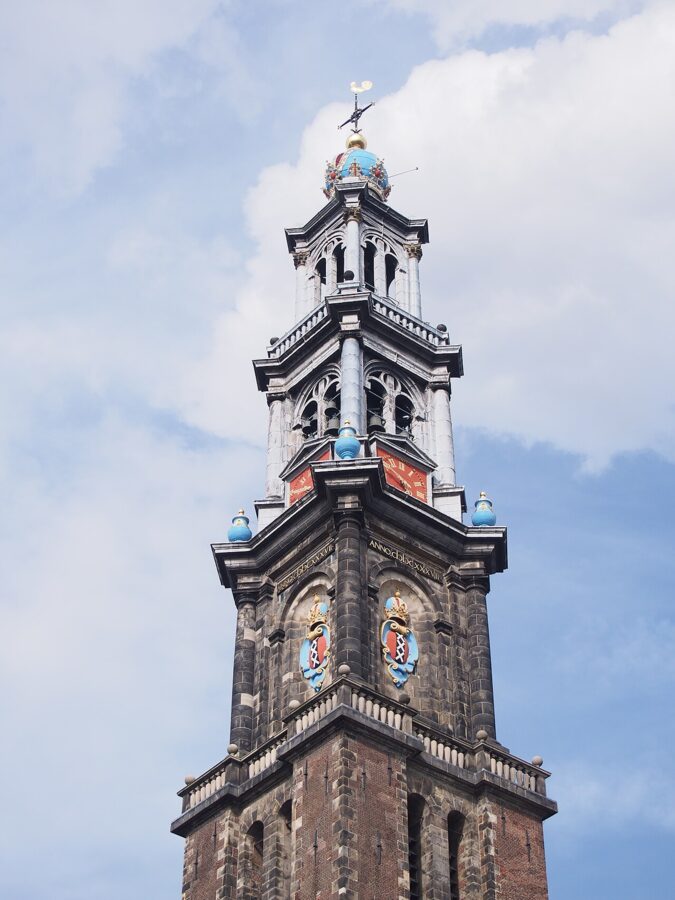

Two more details spoil the legend. Maximilian was not an emperor in 1489, only King of the Romans; he took the imperial title in 1508, and the crown on the arms was upgraded to match. Then, when Rudolf II commissioned a new personal crown in 1602, Amsterdam switched to that model, and it is still the one on the arms today. Rudolf’s crown became the crown of the Austrian Empire in 1804, which is why English guides call it the Imperial Crown of Austria.

The lions
Nobody knows exactly when the two lions arrived. The city dates them to the 16th century, and they are certainly there on a print of the arms from 1639 in the Rijksmuseum, where they hold the crowned shield above a dolphin’s head. Everyone calls them the golden lions. The registered description is fussier: lions “in natural color”, with red tongues, standing on a pedestal or console.
The arms have been redrawn more than once. Napoleon granted Amsterdam a new coat of arms on 3 June 1811, with a mural crown and a wreath that ranked it as the third city of his empire after Paris and Rome. In 1813 King Willem I restored something close to the old design, but with a count’s coronet and the lions facing outward on a patch of grass, and the familiar version came back later. Through all of it, the three crosses never moved.

The motto: Heldhaftig, Vastberaden, Barmhartig
The newest part of the arms is the one with the clearest meaning. On 25 and 26 February 1941, tens of thousands of Amsterdammers walked off the job in protest against the first German roundups of Jewish men in the city. The February Strike is generally counted as the only large, open protest against the persecution of the Jews anywhere in occupied Europe. It lasted two days.
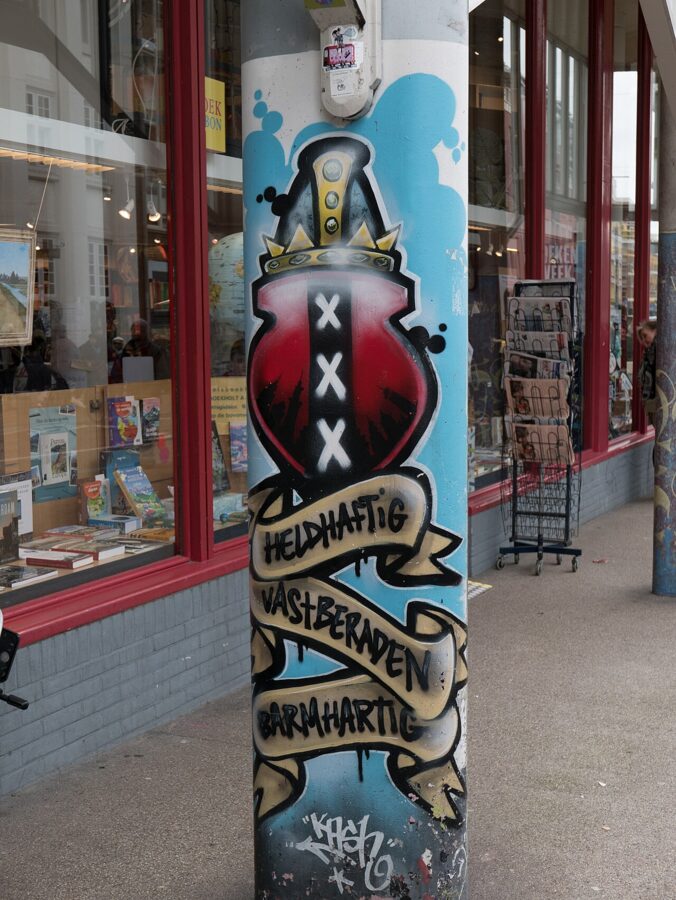
Queen Wilhelmina, who had heard about it in exile in London, gave the city the motto Heldhaftig, Vastberaden, Barmhartig: valiant, steadfast, compassionate. The city dates the grant to 29 March 1947. The historian Annet Mooij, in her book on the strike’s commemoration, puts it at the first official commemoration on 25 February 1946, and the city itself notes both dates. On 17 December 1947 the queen added a February Strike flag, designed by Pam Rueter, whose original turned up again in a museum depot in 2008.

One theory you will hear is that the three crosses stand for the three words of the motto. They cannot: the crosses are six centuries older. The motto explains what the city decided to say about itself after 1941, and it is the reason Amsterdammers who shrug at the rest of the heraldry still take the ribbon seriously.
Where the crosses come from: what the sources can and cannot say
Here the paperwork runs out. There is no grant, no charter, no chronicle entry explaining the crosses. What there is: one dated object, a family with similar arms, a pair of neighboring villages, an odd custom recorded on a Danish island, and a set of folk explanations with no evidence behind them at all.
Older than the souvenir shops claim
Shop tags and plenty of older guidebooks give 1505 as the date of the symbol, when Amsterdam was supposedly a fishing town flying the crosses on its ships. That date does not survive contact with the ground. In 2008, during the dig for the Noord/Zuidlijn metro under the Damrak, archaeologists found a pair of marking tongs, the tool used to stamp the town’s mark on cloth, engraved with the three crosses. It dates to around 1350.
So by the mid-14th century the crosses were already Amsterdam’s quality mark on its cloth trade, and they had to come from somewhere before that. The city’s oldest seals show something else entirely: a cog ship with men and a dog aboard, a design the city kept using for centuries. The cog is still up there as the weathervane on the dome of the Royal Palace.

The Persijn family
The explanation historians have leaned on longest points to the Persijns, a noble family from Kennemerland and Waterland who held a great deal of land in and around Amsterdam in the 13th century. A knight named Jan Persijn was lord of Amsterdam from 1280 to 1282. The family arms carried rows of small St Andrew’s crosses: on later drawings, six bars in blue and gold, with red crosses on the gold ones, four, three and two.
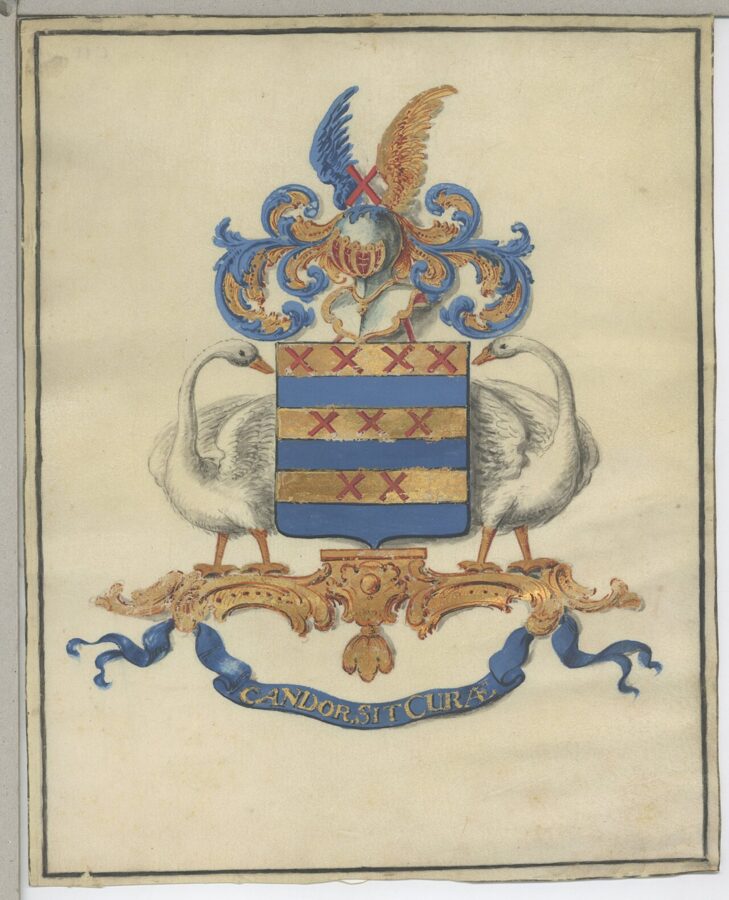
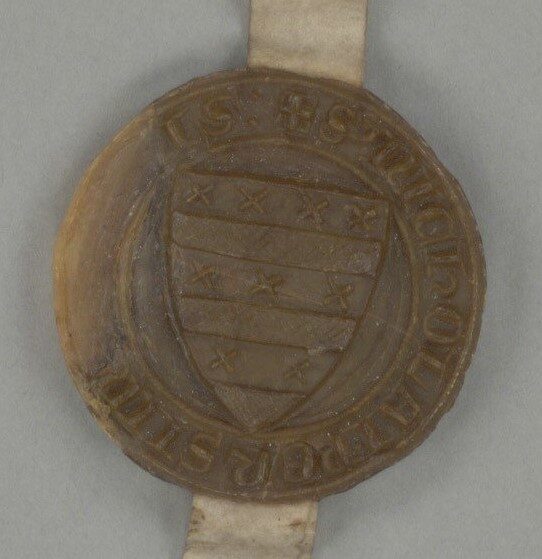
The case for the Persijns rests on two neighbors. Ouder-Amstel and Nieuwer-Amstel (now Amstelveen), both once Persijn property on the Amstel, carry red shields with black bands and white St Andrew’s crosses too, confirmed to them by the Hoge Raad van Adel on 26 June 1816. Amstelveen has two black bars with three crosses on the top one and one on the bottom; Ouder-Amstel has five crosses spread over its two bars. Three places on the same river with the same unusual design is hard to put down to chance.
What the Persijn theory cannot do is explain the crosses themselves. It moves the question back one step, to why the family had them, and Dutch reference works still treat it as an open question whether Amsterdam borrowed from the Persijns or both drew on something older.
Chalk crosses on a court table
The most interesting answer came from an unexpected direction. In a 2017 article in the Flemish-Dutch journal Ons Erfdeel, Joost Robbe, a teacher of Dutch working abroad, followed the farmers from Waterland whom King Christian II of Denmark invited to settle on the island of Amager, south of Copenhagen, in 1515 and 1516. Their privilege of 1521 let them keep living by Holland law.
In 1758 the Danish architect Lauritz de Thurah described how the Dutch village council on Amager opened court. The schout, the village head, stood bareheaded with his seven aldermen, drew three small crosses on the table, and declared the session open in the name of God, the king and the community. At the close he wiped the three crosses away and declared it shut in the same words.
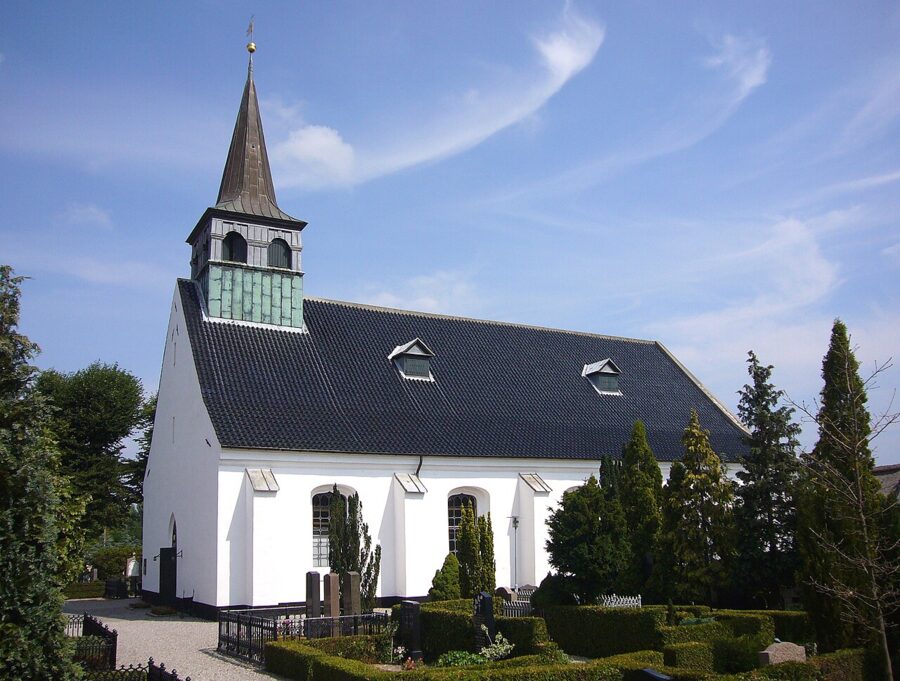
Robbe’s argument: if the emigrants brought the ritual from Waterland, and Waterland shared one bailiwick and one legal practice with Amstelland since the days of Count Floris V in the 13th century, then three crosses meant a lawful court and legal certainty in exactly the area where Amsterdam, Ouder-Amstel, Nieuwer-Amstel and the Persijns all used them. The black pale would be a council table, not the Amstel. It is the only theory that explains why the number is three and why the mark turns up across a whole district, but it rests on an 18th-century Danish description and an inference back four centuries. Treat it as the best argument so far, not a settled fact.
Fire, flood and plague
The version you will hear most is that the three crosses ward off the three great dangers of old Amsterdam: water, fire and the Black Death. Some tellers assign the colors instead, red for fire, white for water, black for plague. It is a good story for a wooden city on a marsh, and it has no historical basis whatsoever. The Persijn crosses were in use in the 13th century, before the plague reached Europe in 1347.
The other folk readings fare no better. One holds that the crosses mark three fords in the Amstel. Olfert Dapper, writing a description of the city in 1663, decided they were windmill sails, perhaps because the cross-shaped iron fitting of a mill, the molenijzer, was a common charge in family arms such as those of the regent family Van Loon. Where the sources disagree, they disagree because none of them knows.
Why it has nothing to do with the sex trade
The three X’s are on a cloth merchants’ tool from around 1350. The X rating for adult films was invented by the American film industry in 1968, and the triple X that porn marketing stacked on top of it came after that. Amsterdam’s crosses are older by six centuries, and the overlap is a coincidence the souvenir trade on the Damrak and around De Wallen is happy to milk. The city’s flag flies over the Red Light District because it flies over every district.

Where to see them
You do not need to go anywhere to see the crosses; you need to go somewhere to see them well. These are the places where the symbol tells you something.
The Amsterdammertjes
The bollards have their own small history. Posts to stop carts scraping house corners appeared in the 18th century, dark at first, later white, finally red-brown. The oldest known drawing of a cast-iron post with the three crosses is a 1903 specification for the Melkmeisjesbrug, bridge 16 over the Brouwersgracht, and from 1915 that slimmer, square-footed post became the standard Amsterdam bridge bollard.
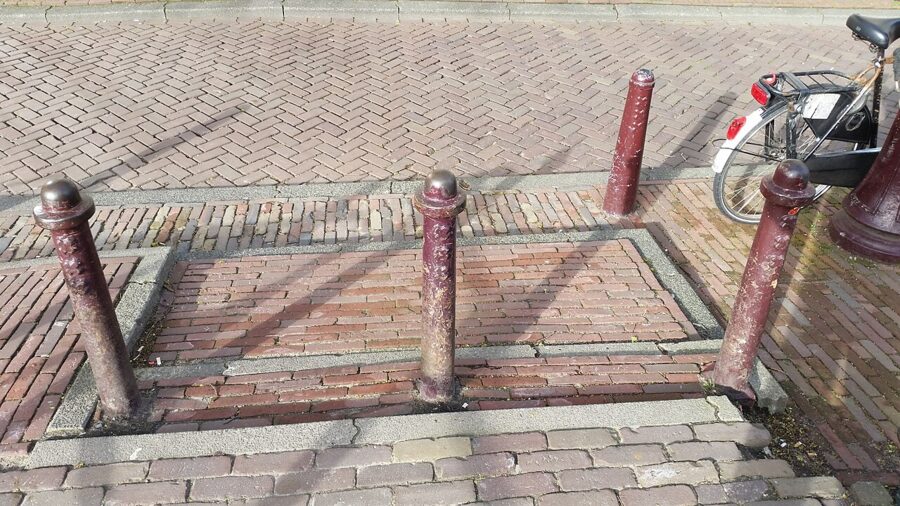

After the war the posts multiplied to stop cars parking on the pavement. From the 1970s the heavy cast-iron type, about 70 kilos, gave way to the one you see now: 4 mm sheet steel, about 20 kilos, 1.06 m long with 75 cm above the paving. Amsterdam had about 100,000 of them in 1984. Trucks flattened them, the city raised its curbs with hard stone instead, and by 2003 fewer than 40,000 were left in the city.
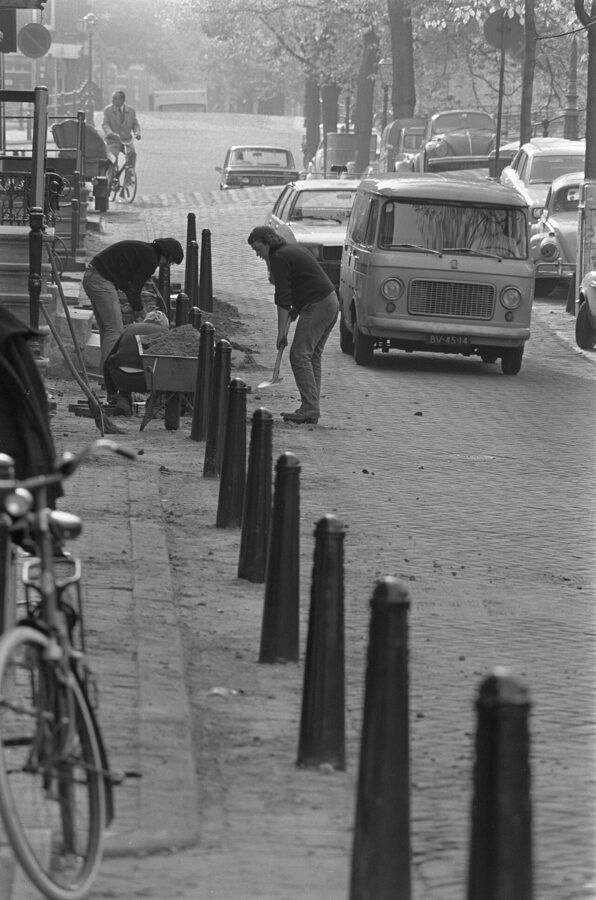
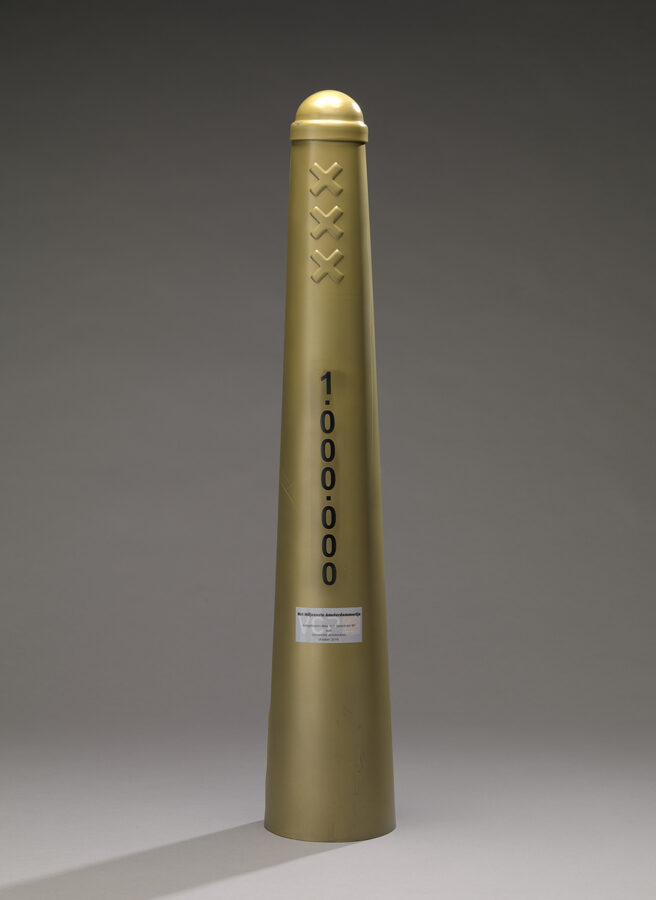
Two stories about them are wrong. The bollards were never old cannon barrels planted upright; the historian Anneke van der Stoel looked into it and found nothing to support the tale. And the city kept ordering them long after the cast-iron days: the millionth Amsterdammertje came off the production line in 2010, painted gold, and was presented to the then mayor, Eberhard van der Laan. The shape is copied in Leiden, The Hague, Ghent and Leuven, but only Amsterdam’s carry the crosses.
The city flag
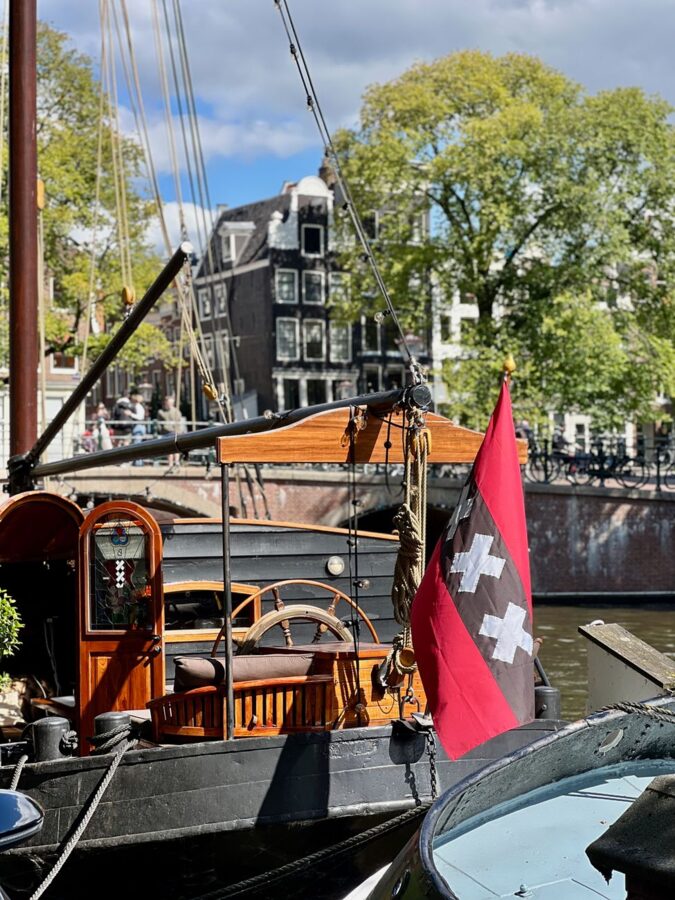
Amsterdam formally adopted its flag only on 5 February 1975, three horizontal bands in red, black and red with the crosses in the black, in a 2:3 ratio. It had been flown long before: it is on the cover of the day program of the 1928 Olympics in Amsterdam, and for centuries the city also used other combinations of red, white and black, including a tricolor with the arms in the middle. Ajax captains wear it as their armband.
The Rijksmuseum
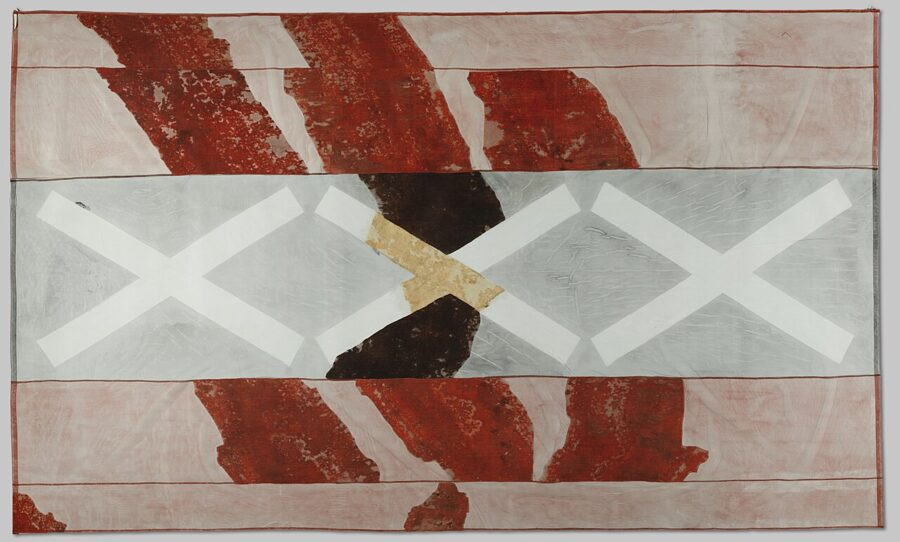
Two objects in the Rijksmuseum‘s collection put the crosses in context. The first is a woollen ship’s flag, about 2.75 by 4.8 meters, in red, black and red with three white crosses, made in Amsterdam around 1596. It comes from Willem Barentsz and Jacob van Heemskerck’s attempt on the Northeast Passage and the winter they spent stranded on Novaya Zemlya, and it was pieced back together in 1978 from fragments, six of them held in Tromsø.
Amsterdam ships really did sail under the crosses; this is one of their flags. I could not confirm whether it is on display now, so check the collection before you go looking for it.
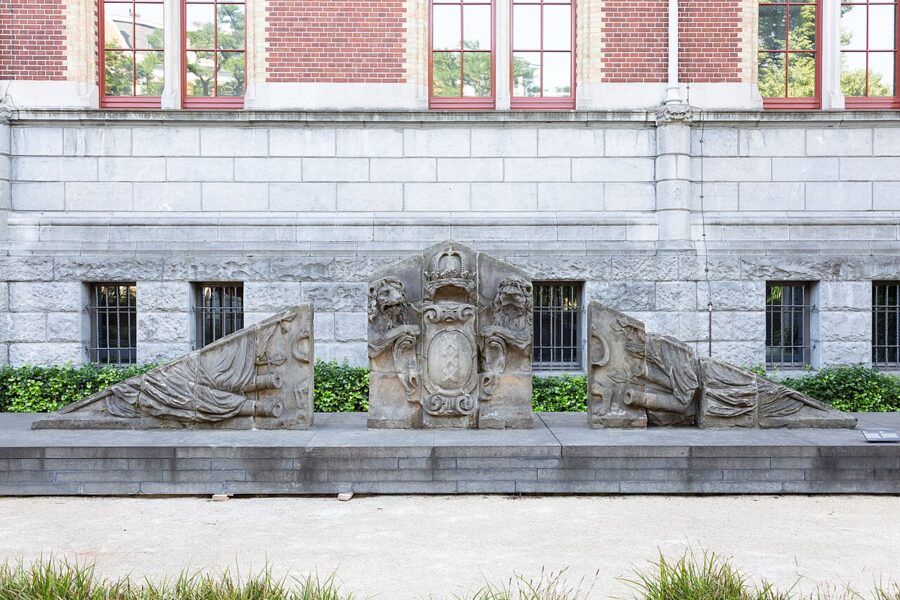
The second is outside. A stone pediment carved by Hendrick Rusius in 1654-55, with the crowned arms of Amsterdam, came from the old Boterwaag, the butter weigh house on the square that is now Rembrandtplein. The museum’s notes link Rusius’s pediments to the Regulierspoort city gate, one face carved with the old cog-ship emblem and the other with the new arms. The pediment, on loan from the city, stands in the museum’s garden.
The gardens are free and open 9:00-18:00 (as of 2026), but part of them closes outside summer and a new sculpture garden was due to open in autumn 2026, so check before you go. A ticket for the museum itself is €25 (about US$29), free for 18 and under, daily 9:00-17:00 (as of 2026).
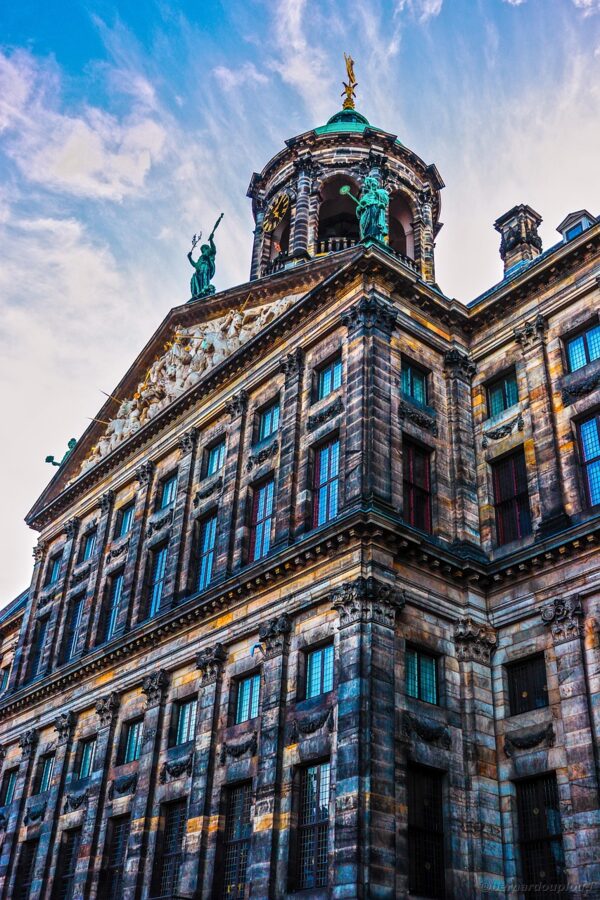
The Royal Palace on the Dam
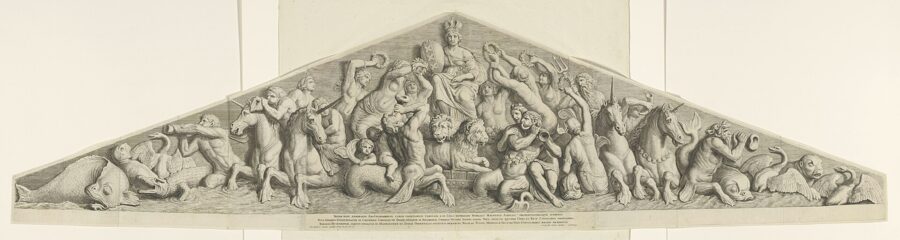
The Royal Palace was built as Amsterdam’s town hall in the 1650s, and its sculpture is a statement about the city. On the front pediment, facing the Dam, the Maid of Amsterdam sits enthroned with the city’s shield on her knee and the imperial crown on her head while the sea gods of four oceans bring her tribute. The terracotta model, by Artus Quellinus and his workshop, is in the Rijksmuseum’s collection, and its catalogue entry for the Maid of Amsterdam spells out the shield and the crown.
Inside, the Maid appears again above the entrance to the Burgerzaal, the great marble hall, flanked by Strength and Wisdom. The palace is open from 10:00 on more than 230 days in 2026, closing for royal and state occasions, so check the calendar. Tickets for the Royal Palace are €13.50 (about US$16) for adults with an audio tour, €9 for students, and free under 17 or with a Museumkaart (as of 2026).
The Stadsarchief
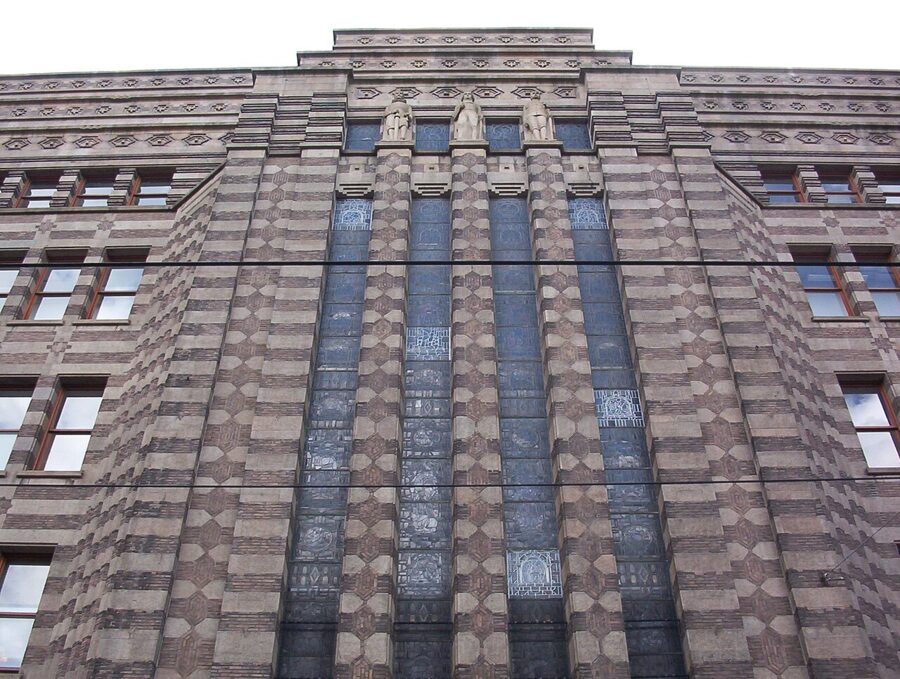
The city archive lives in De Bazel, the striped former bank headquarters at Vijzelstraat 32, and its Schatkamer (treasure room) shows more than 300 of its best pieces in a free permanent display. The crown charters of 1489 and 1497 belong to this archive, though I could not confirm which documents are on show at any given time. It is closed on Mondays; weekday hours start at 10:00 and weekend hours at 12:00, with closing at 17:00 (as of 2026). Listings disagree about Fridays, so check the archive’s museum listing first.

On buildings, bridges and the city’s own logo
Once you start looking, the arms are carved into gable stones, gateways, bridges and office blocks of every century. The city’s own logo is the three crosses beside the words Gemeente Amsterdam: a house style built in the early 2000s by the design studio Thonik to replace more than 50 separate department logos with one mark. That is why the crosses are on street signs, letters and the city’s trucks, and why they feel more like a brand than a coat of arms.
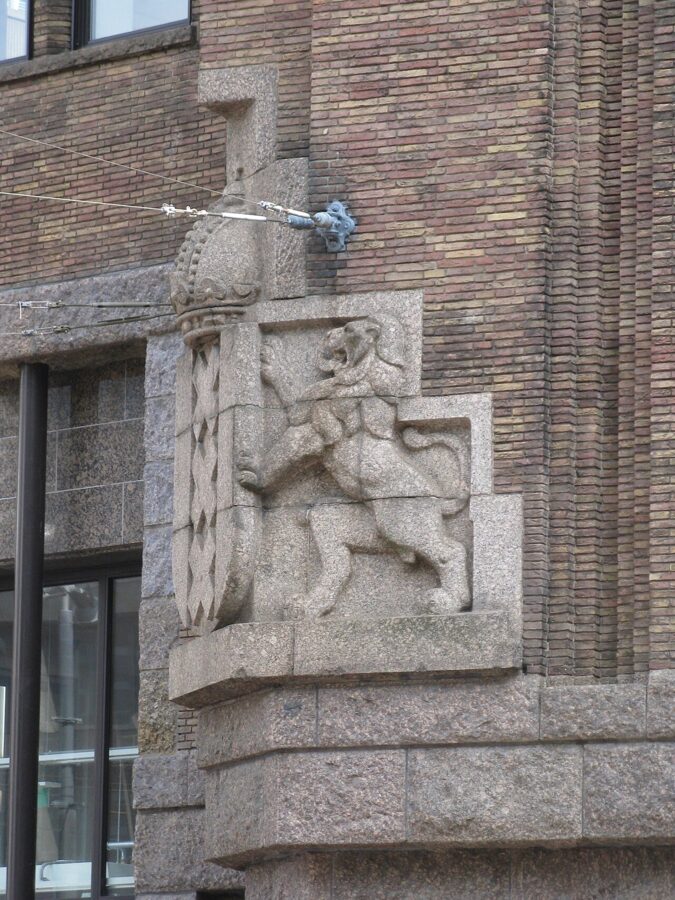

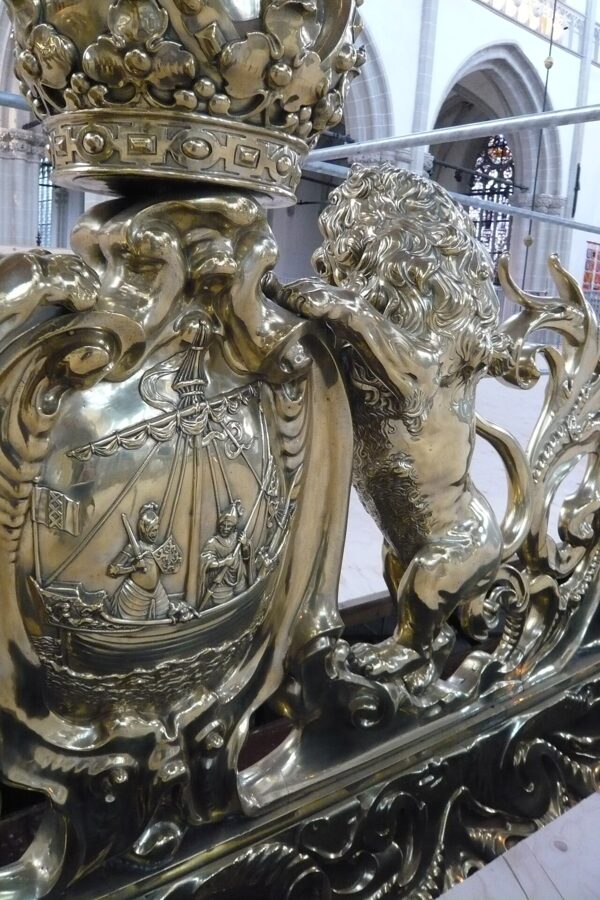

A walk past the crosses
You can see everything above in a morning on foot. Start on the Dam for the palace pediment and the cog on the dome, step into the Nieuwe Kerk if an exhibition draws you, then walk west to the Westermarkt for the crown on the tower and the crown lanterns below it. Head south along the Keizersgracht past the gate at number 365A, cut through to Vijzelstraat 32 for the Schatkamer, and finish at Rembrandtplein, or carry on to the Blauwbrug and the crowned pylons over the Amstel.
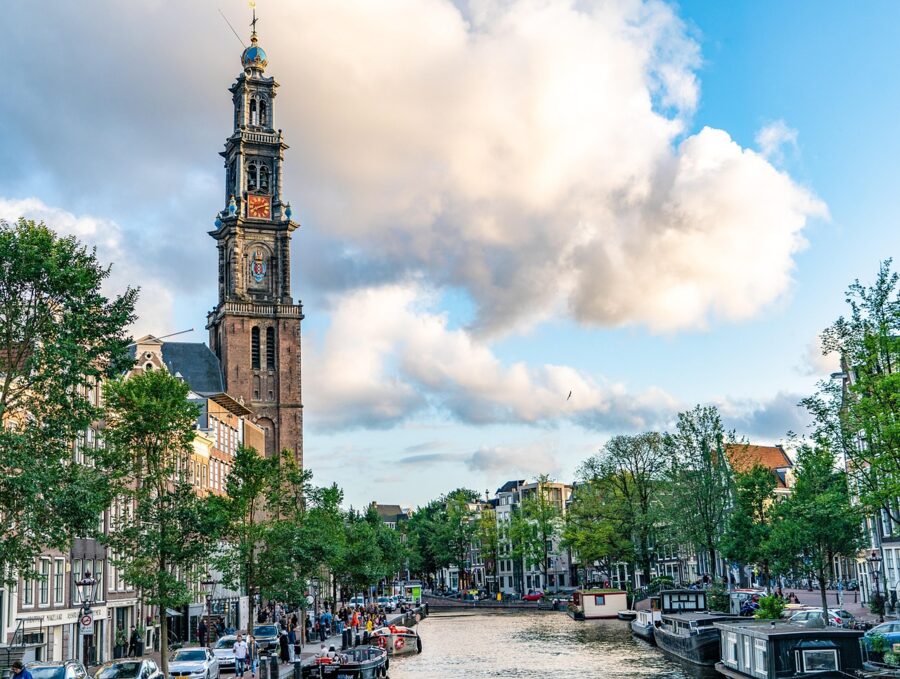
For the Rijksmuseum and its garden, take metro 52 to Vijzelgracht and walk ten minutes west, or walk on from the Stadsarchief along the Vijzelstraat. Metro 52 also stops at Rokin, a short walk from both the Dam and the archive. On the way, every bridge you cross will have its row of red-brown posts, three crosses each, and by now you know more about them than the shop on the Damrak selling them as a joke.