
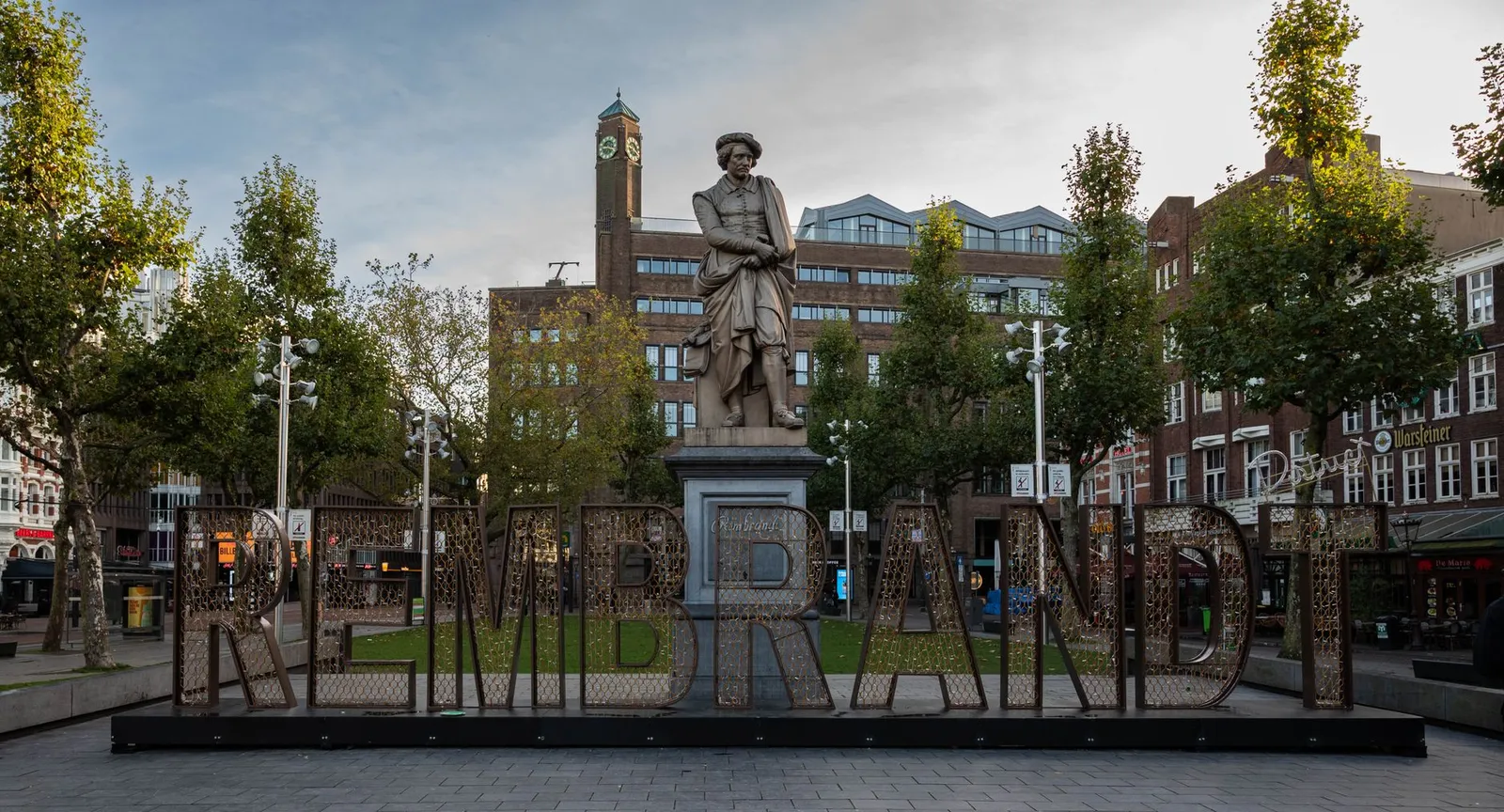
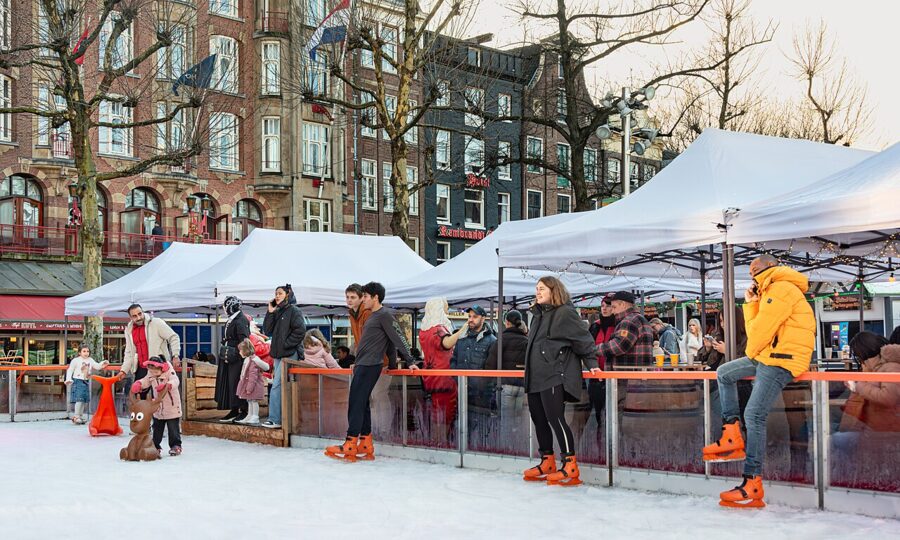
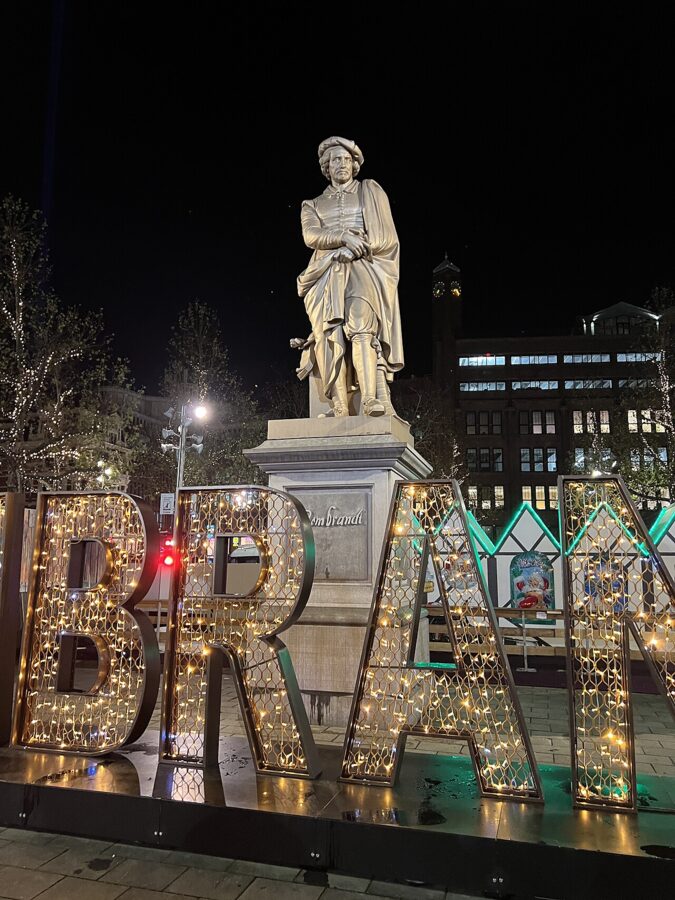
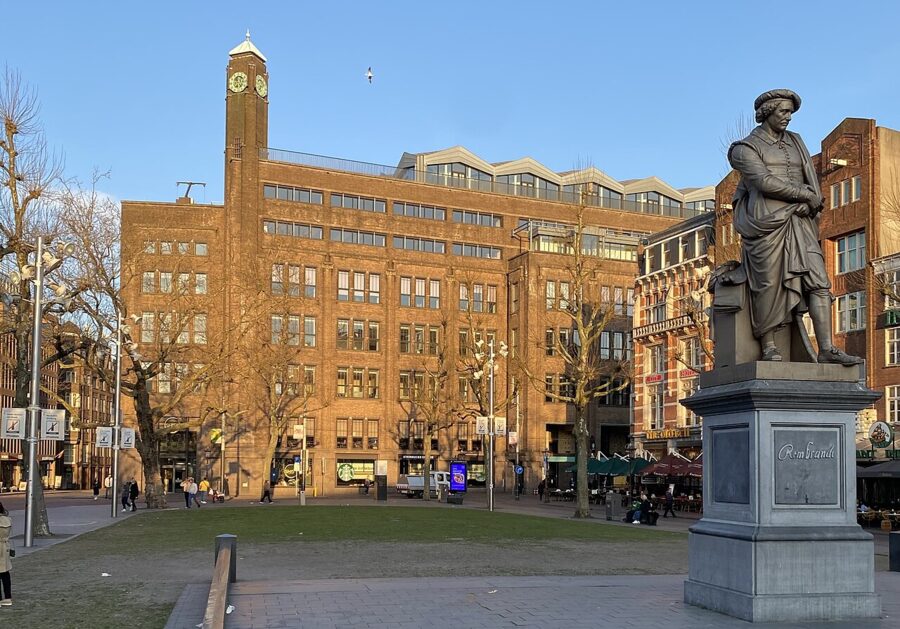
Rembrandt stands on his stone pedestal on the west side of the square with an etching needle in his right hand, and this winter he has a rink at his feet. From 13 November 2026 to 3 January 2027 a skating rink with wooden chalets fills the middle of Rembrandtplein, open 10 a.m. to 11 p.m., €15 (about US$17) with skates. Skaters go round beneath him, and the chalets sell mulled wine, oliebollen and bratwurst.
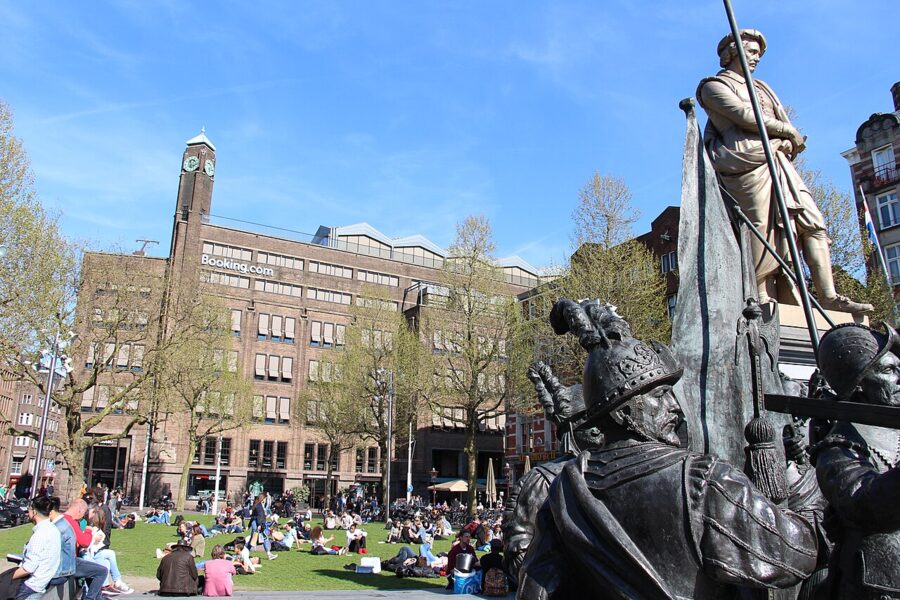
What you will not find is the crowd he used to have. For most of the years between 2006 and 2020, twenty-two life-size bronze figures from The Night Watch stood on the lawn in front of him, and you could stand in the painting for a photo. They left in February 2020 and are not coming back. People still walk onto the square looking for them, phones ready, and find one cast-iron painter.
That is Rembrandtplein in short: a square that keeps being rearranged around a statue that has stayed. By day it is a lawn with terraces on three sides and trams grinding through.
After 11 p.m. it is one of the center’s two big going-out squares, with clubs open until 4 or 5. The interesting parts are the history under it and the streets off it.



What is on the square now
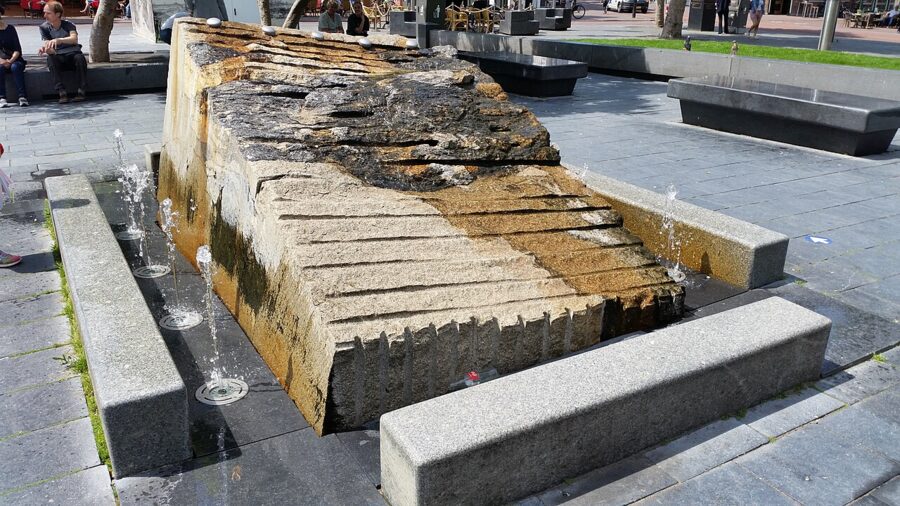
Rembrandtplein is a rough rectangle between the Reguliersbreestraat, which comes in from the Munt on the west, and the Amstelstraat, which runs out east toward the river. Tram tracks cross it along that line. The middle is a lawn with a few trees, the statue at the western end and, since the 2009 redesign, a fountain where water slides over a long block of stone. The same redesign cleared most of the old planting to open the square up and added a dozen tall light masts that can flood it with bright white light in an emergency.
Around the edges stand the big cafés with glassed-in fronts, two hotels, a nightclub and the brick bulk of a former bank. The Thorbeckeplein opens off the south side, and the Utrechtsestraat, the Halvemaansteeg and the Korte Reguliersdwarsstraat lead away from the corners. You can cross the whole thing in two minutes, which is why most people pass through it on the way from the Bloemenmarkt to the Amstel without stopping.

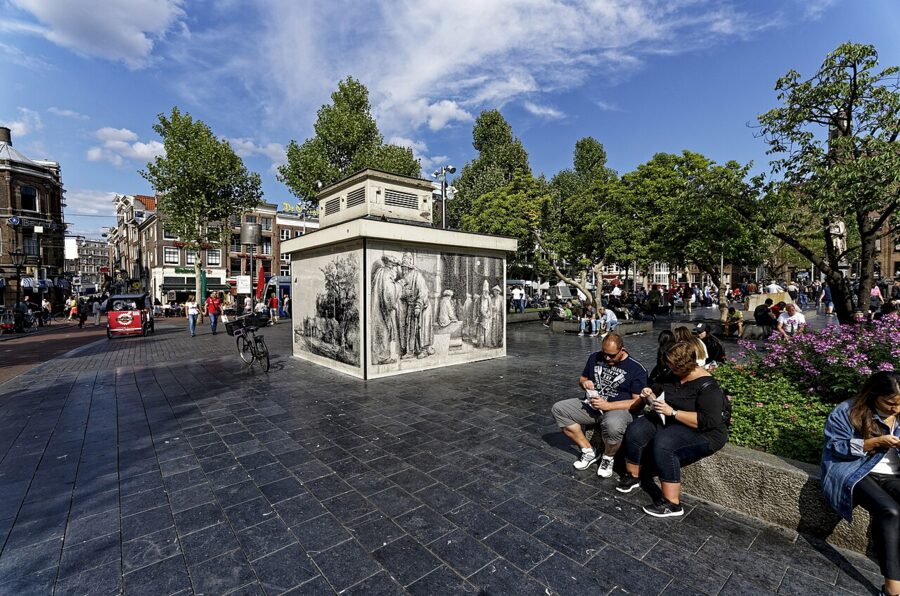
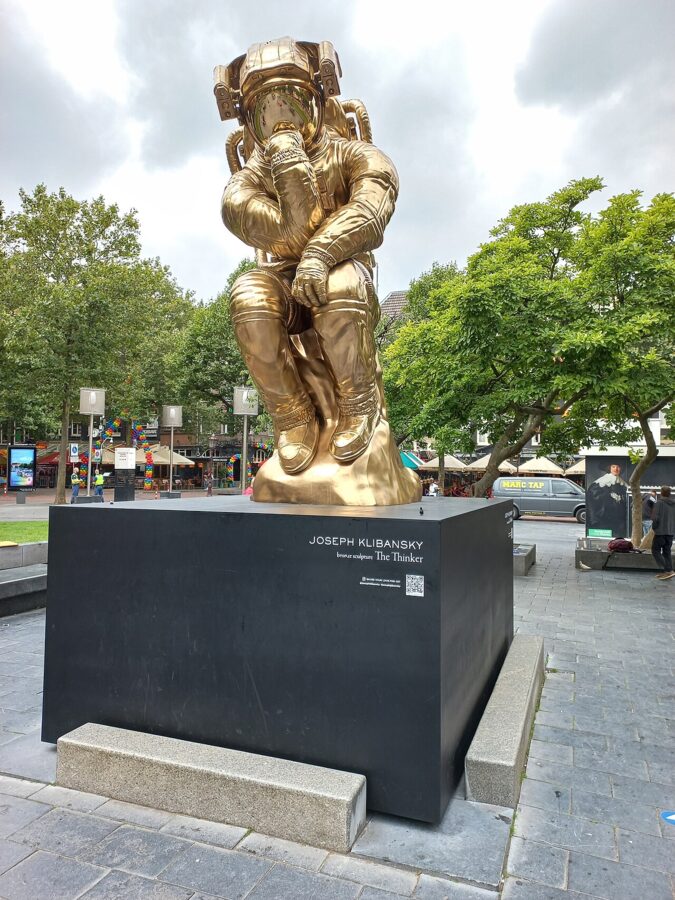
The square also collects temporary art. In 2011 the transformer house on the lawn was wrapped in Rembrandt imagery by Peter Doeswijk and has been called the Rembrandthuisje (little Rembrandt house) since. In July 2023 Joseph Klibansky’s The Thinker, a gold figure in a space helmet, was set on a plinth over the fountain. It has since gone, too.


From butter market to Rembrandt’s square
The square starts with a city gate. In 1655 Amsterdam built the Regulierspoort here, in the wall on the Reguliersbreestraat, and within a few years the city had expanded past it and it was useless. In 1668 the gate became the Boterwaag, the weigh house for butter, and in 1669 the Monday dairy market moved here from the Dam. For two centuries this was the Botermarkt.
Poultry was sold in a corner known as the Kippenhoek, and the open ground to the south, then called the Reguliersplein, held the city’s fair.
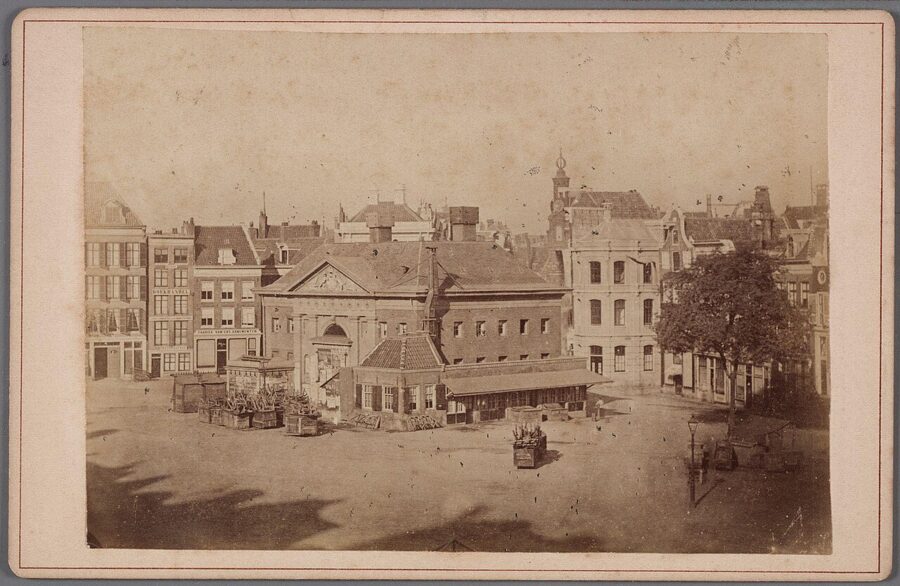
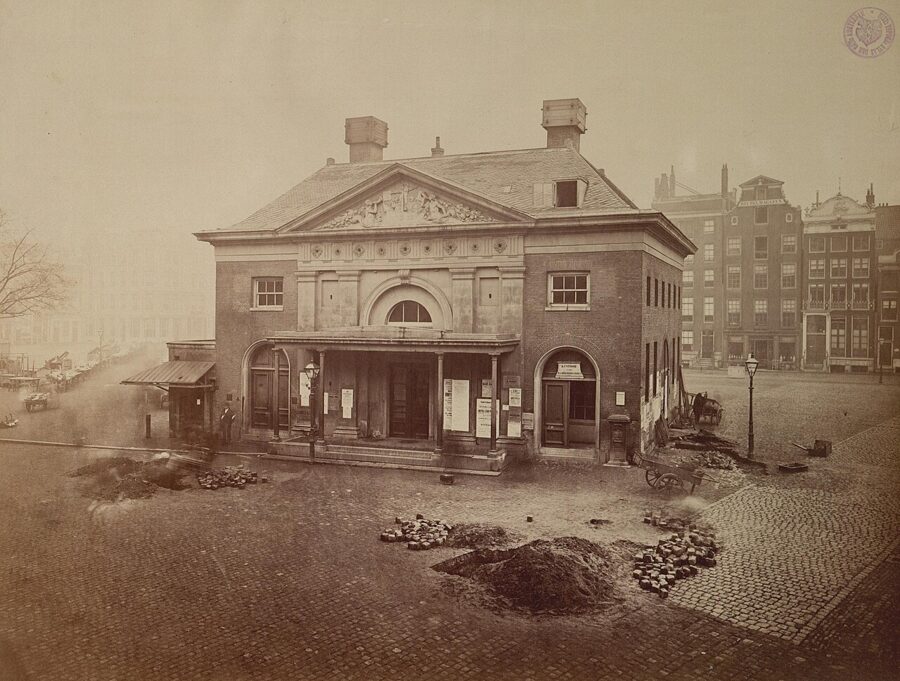
The butter and cheese trade had drifted away by about 1870, and in 1874 the Boterwaag came down. On 17 May 1876 the city council, meeting in a closed session, renamed the Botermarkt the Rembrandtsplein and the Reguliersplein the Thorbeckeplein. The street signs kept the extra “s” until 1985.
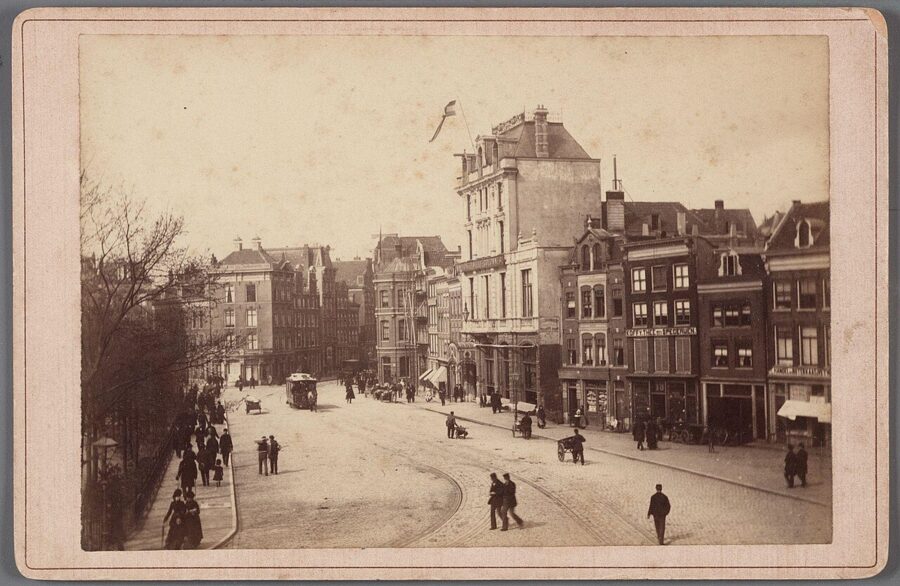
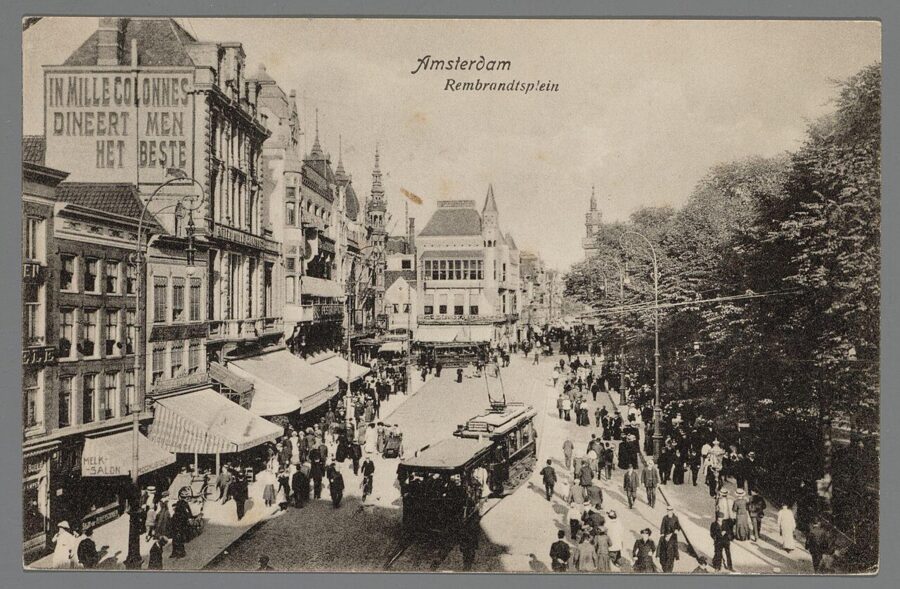
The cafés came with the new name. From the 1880s the square filled with grand cafés, variety theaters and later cinemas, and the old market became the place Amsterdam went out. A painter is the patron of a square that was built for drinking, which suits most of its customers fine.
The statue
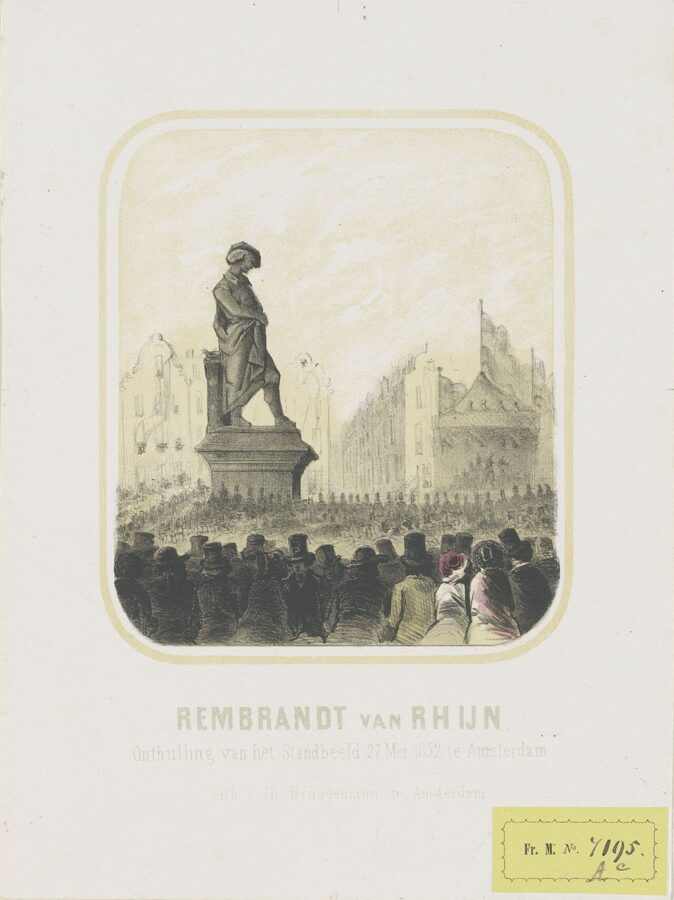
The Rembrandt monument was paid for by subscription, gifts and a raffle of 230 artworks held at a ball, and the commission went to the sculptor Louis Royer in 1842 without a competition. Royer’s design dates from 1843, his model was finished in 1847 (he signed the back “L. Royer fcit 1847”), and the Enthoven foundry in The Hague cast the figure in iron in 1851.
King Willem III and Prince Hendrik unveiled it on the Botermarkt on 27 May 1852. It is the oldest surviving public statue in Amsterdam and the first statue of a visual artist anywhere in the Netherlands.
It has moved several times since. When the weigh house came down it went into a new public garden in the middle of the square, in 1875 or 1876 depending on the source. In 1924 it got a new pedestal and was turned to face the Amstelstraat, and in the 2009 redesign it was turned around again, so he now looks west, toward the Reguliersbreestraat and the way most people arrive.
The figure is lifesize, painted iron rather than bronze, with a book and a palette on a block behind him. It has been a national monument since 2002.
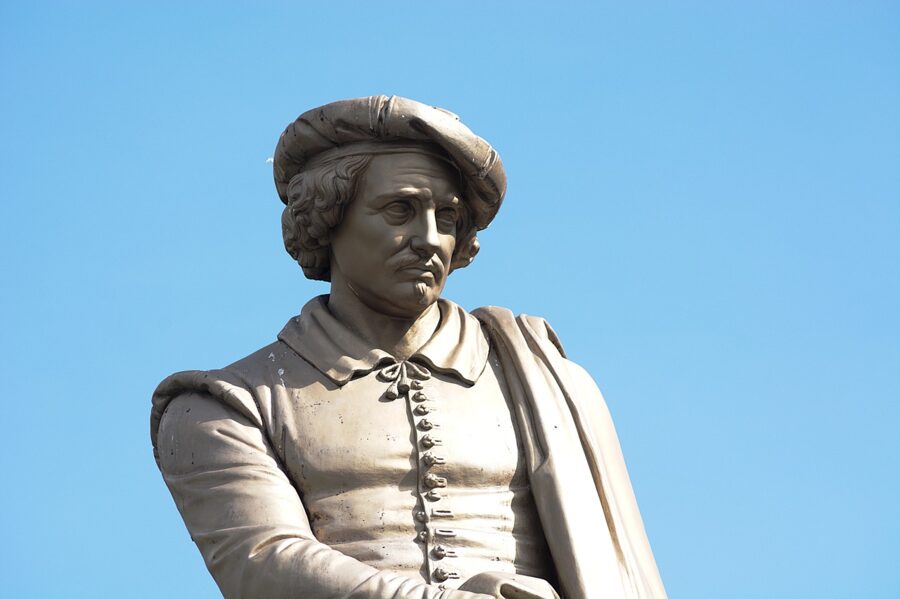
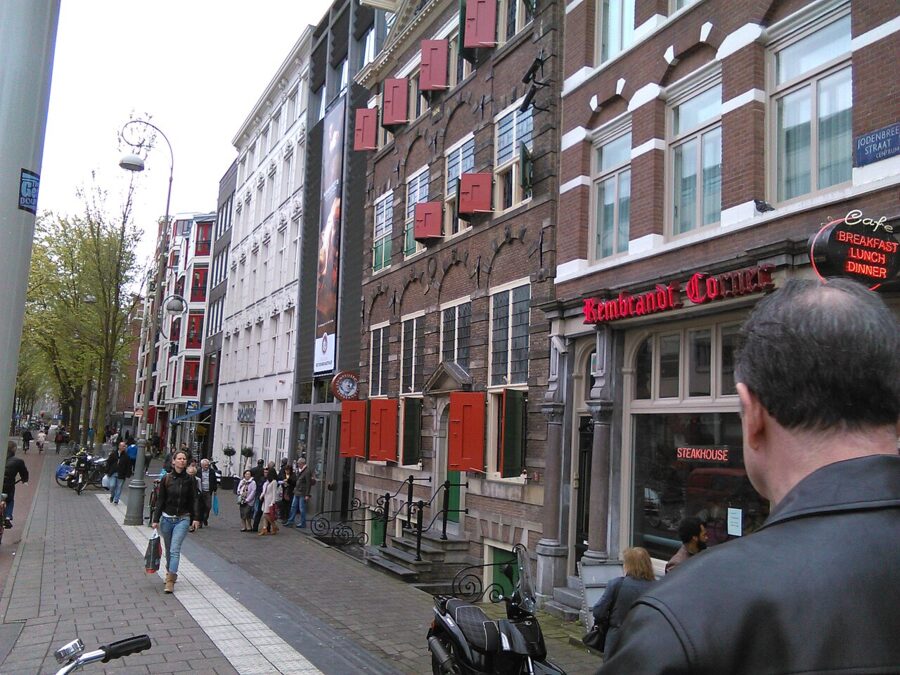
Rembrandt himself had nothing to do with the spot. He lived and worked from 1639 to 1658 in the house on the Jodenbreestraat that is now the Rembrandthuis, about ten minutes’ walk east past the Waterlooplein. The square got him because the city wanted a monument and had a market that needed a reason to exist.
The Night Watch that left
For the 400th anniversary of Rembrandt’s birth in 2006, the Russian sculptors Alexander Taratynov and Mikhail Dronov made a full-size bronze version of The Night Watch: twenty-two figures, laid out on the lawn as they stand in the painting. They were placed on the square on 20 December 2005. A few years later they went away, and after about three years’ absence they came back in December 2012.
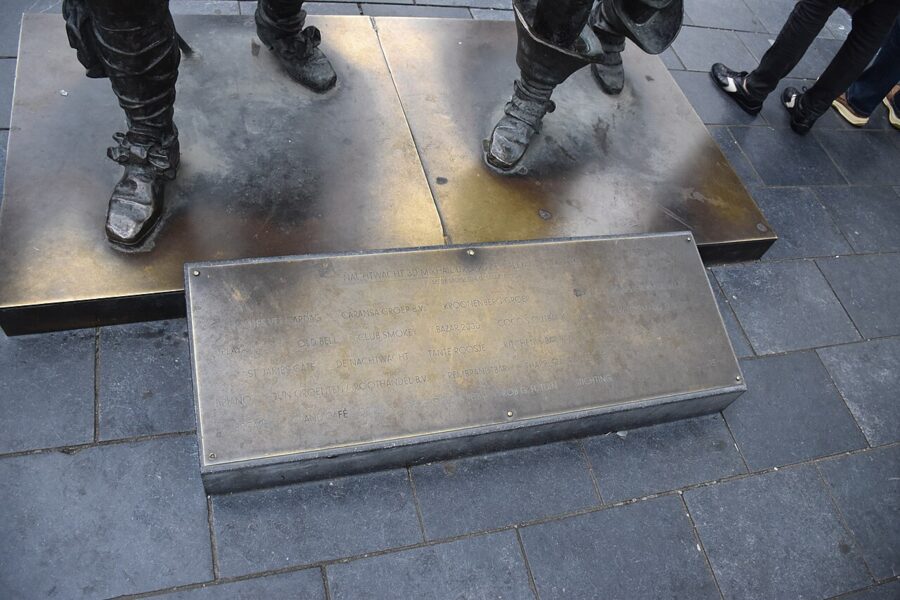

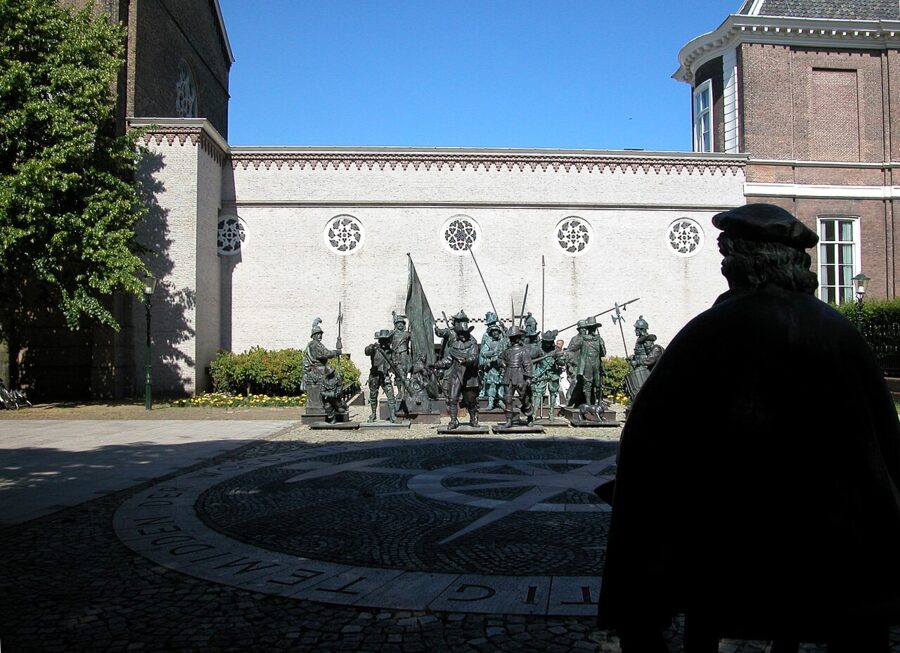

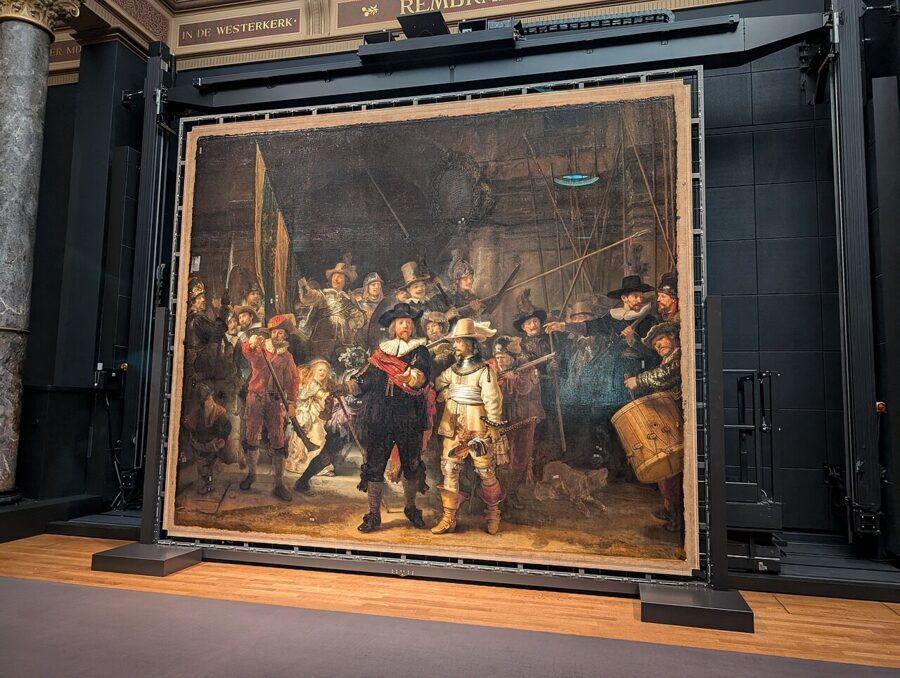
That second stay ended in February 2020. The square’s manager said at the time that talks with the artists about renting or buying the group had not led to a deal, that everything had been settled on good terms, and that the figures would not return. Nothing has replaced them on the lawn. If you came for that photo, the original is about twenty minutes’ walk away: the painting hangs in the Gallery of Honour at the Rijksmuseum, where its restoration has been carried out in public, behind glass.


The buildings around the square
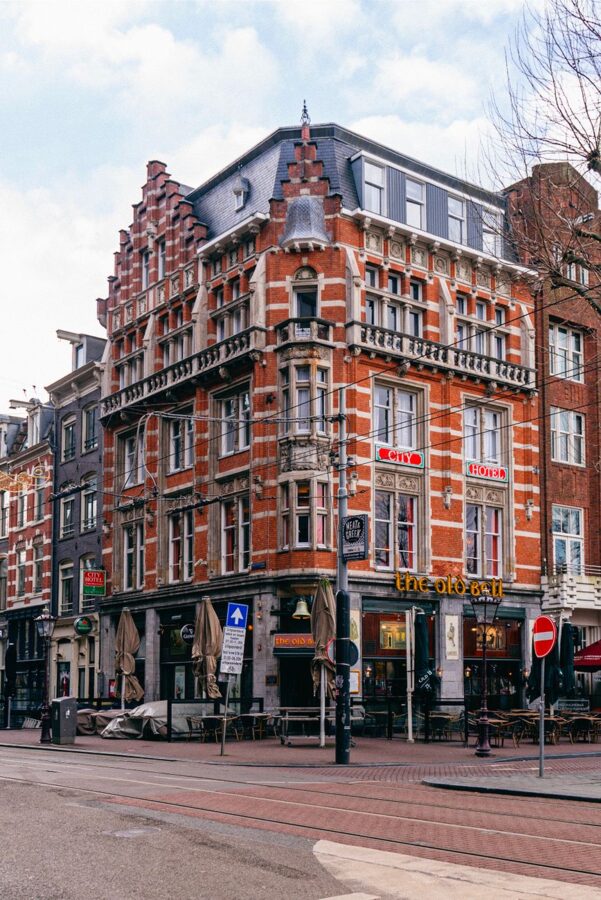
Most of the square’s fronts are cafés at ground level and hotels or offices above, and the buildings are better than the signs on them. A long run of the houses on the square are national monuments. Four are worth knowing by name.
Hotel Schiller
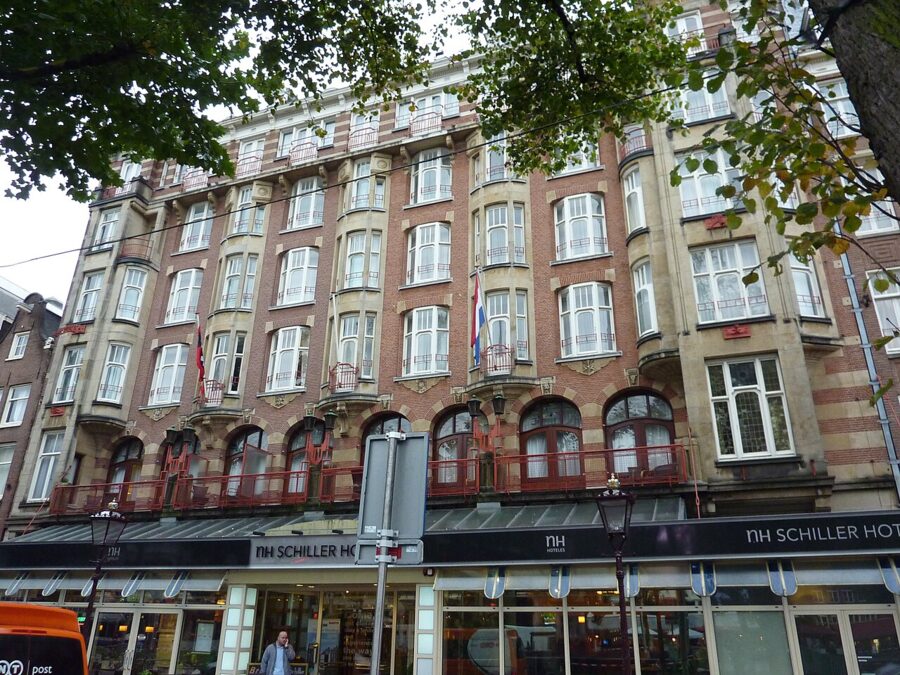
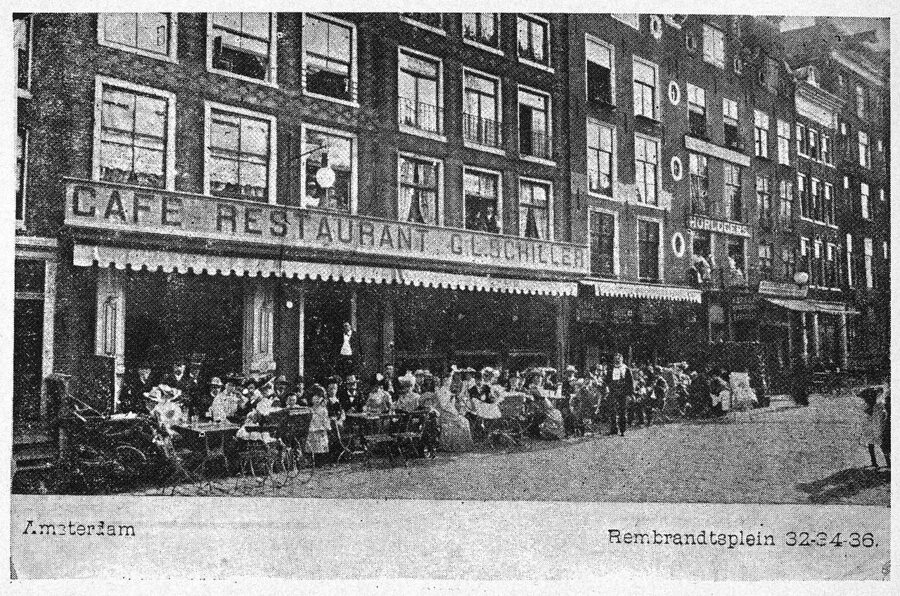
On the south side, at number 26, the red-brick Schiller opened on 6 August 1913 as a café-restaurant, designed by M.J.E. Lippits and N.H.W. Scholte, with an interior that slides between late Art Nouveau, Art Deco and early modernism.
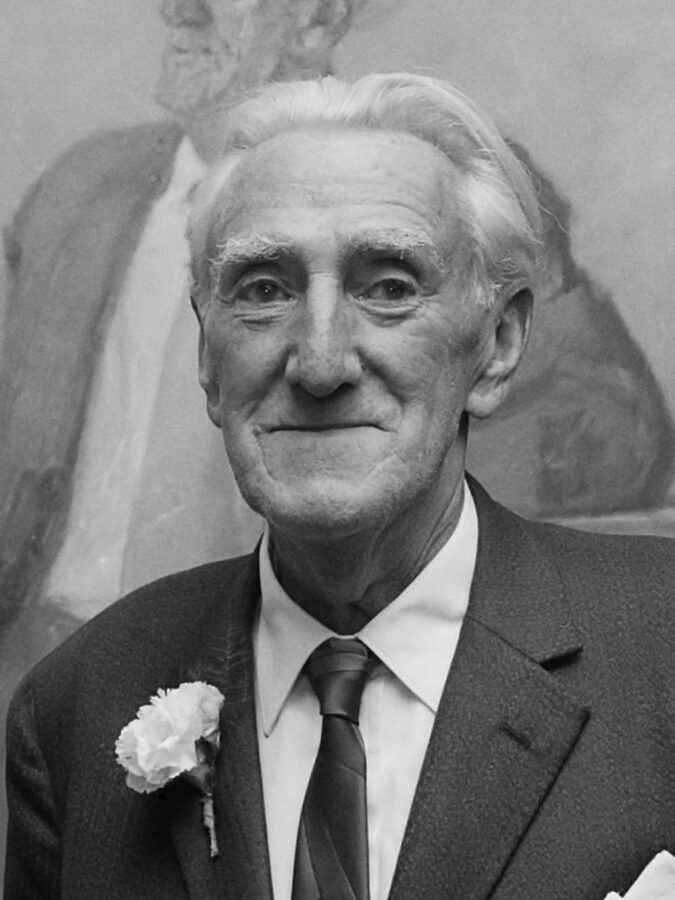
The man behind it, Frits Schiller (1886–1971), was a painter as well as a hotelier, and more than 350 of his portraits, still lifes and city views hang in the building. In the 1920s and 1930s his regulars’ table drew painters such as Jan Sluyters and George Hendrik Breitner, the playwright Herman Heijermans and the cabaret star Louis Davids.


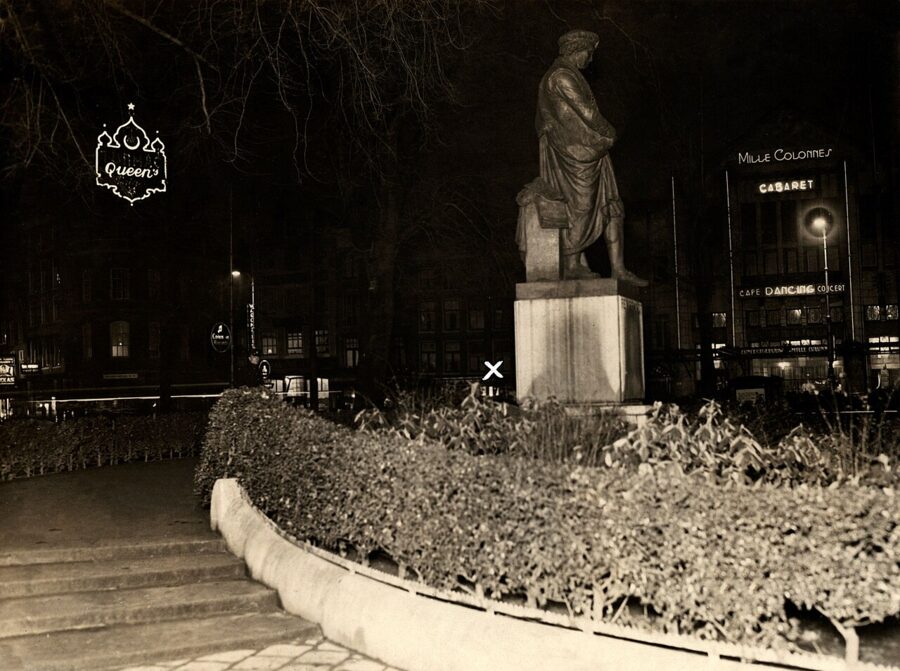
The Schiller’s darkest night was 26 November 1927. The cabaret performer Jean-Louis Pisuisse and his wife Jenny Gilliams had dined there, and as they crossed the square they were shot near the Rembrandt statue by Tjakko Kuiper, a jealous former lover of Gilliams, who then turned the gun on himself. Pisuisse died at the police station on the corner of the Halvemaansteeg, and Gilliams died an hour later in hospital.
Number 17: De Kroon
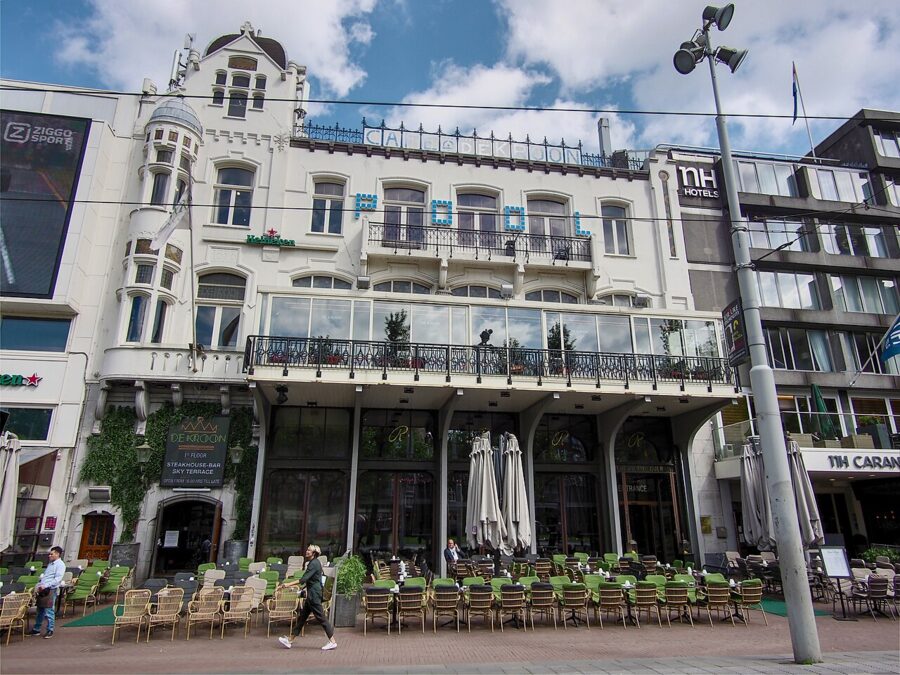
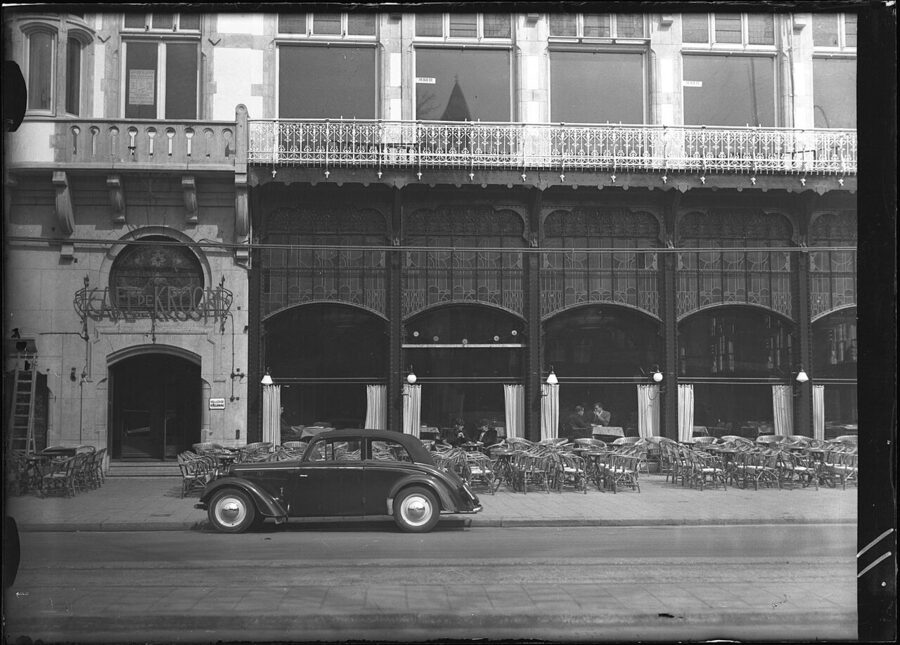
On the north side, the white building at number 17 was designed by Gerrit van Arkel in 1898, the year of Queen Wilhelmina’s coronation, which gave the café its name: De Kroon, the crown. It is the only survivor of the middle of the old northern row, and its first-floor room with the glass conservatory looks straight over the square. As of late November 2026 the De Kroon name is giving way to Regina, an Italian trattoria announced as coming soon at Rembrandtplein 17-1, promising long aperitivo hours and dancing once dinner is done.

The bank, the theater that burned, and Escape
The brick block with the clock tower on the east side was the head office of the Amsterdamsche Bank, later ABN AMRO, built from 1926 to 1932 by the architects Bert and Willem Ouëndag, who brought in H.P. Berlage on the design.
The bank left for the Zuidas, and since 2011 the renovated building has been offices under the name The Bank. It is the reason the square’s eastern side feels like a different city from its western one.
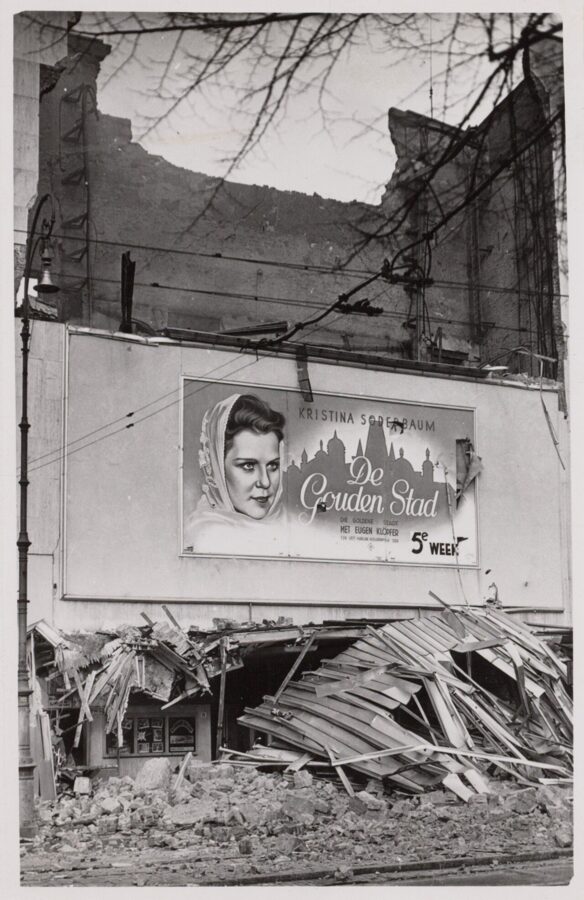
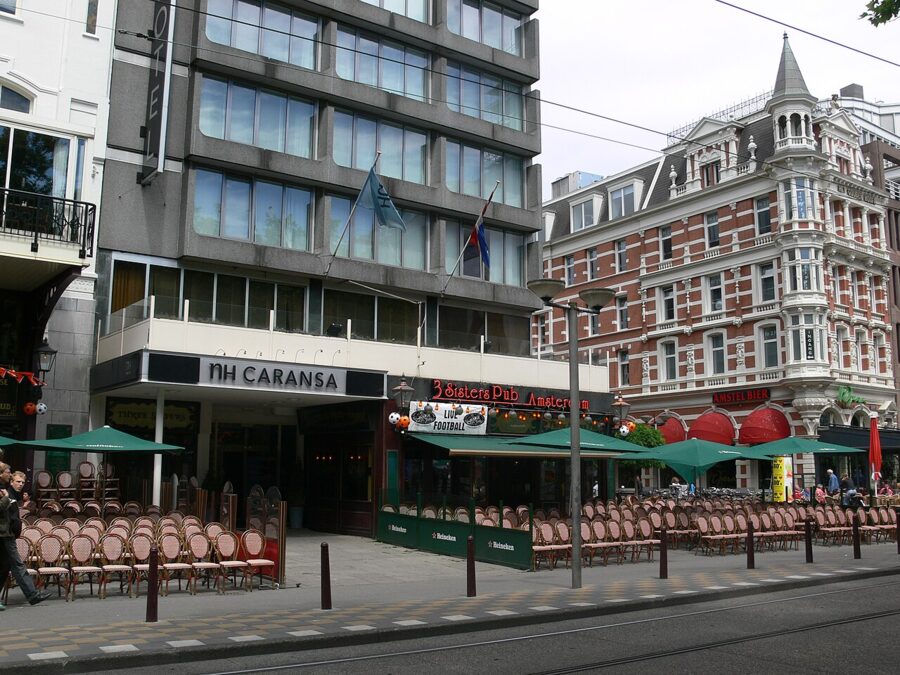
Back on the north side, next to De Kroon at number 19, stood the Rembrandttheater, a variety and operetta house from 1902 that became a cinema in 1919. It burned in January 1943, most likely in an attack by the resistance group CS-6. The NH Caransa hotel was built on the site in the 1970s.

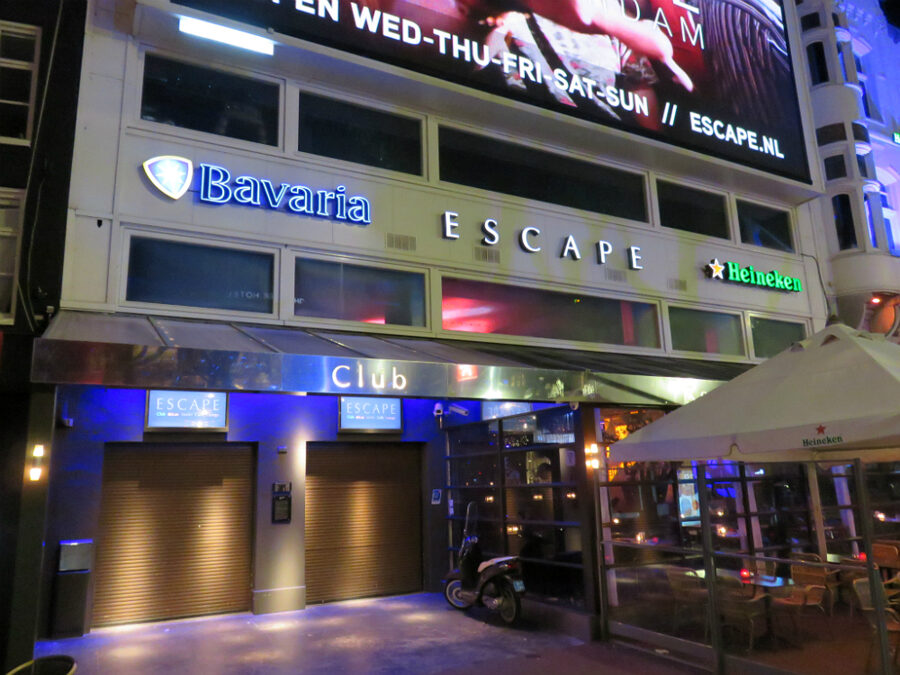
At number 11, where the Café Mille Colonnes once stood, the Rembrandtpleintheater cinema ran from 1966 to 1986, and in 1987 it became Escape, still the biggest club on the square. As of November 2026 it opens at 23:00 every night and closes at 04:00, or 05:00 on Fridays and Saturdays.

Tuschinski, a minute away
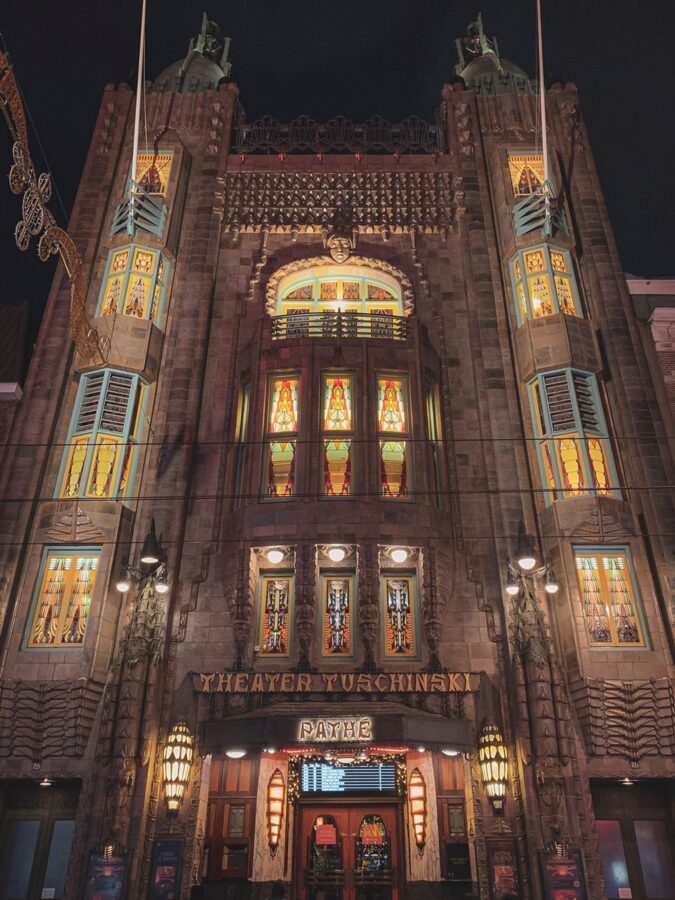
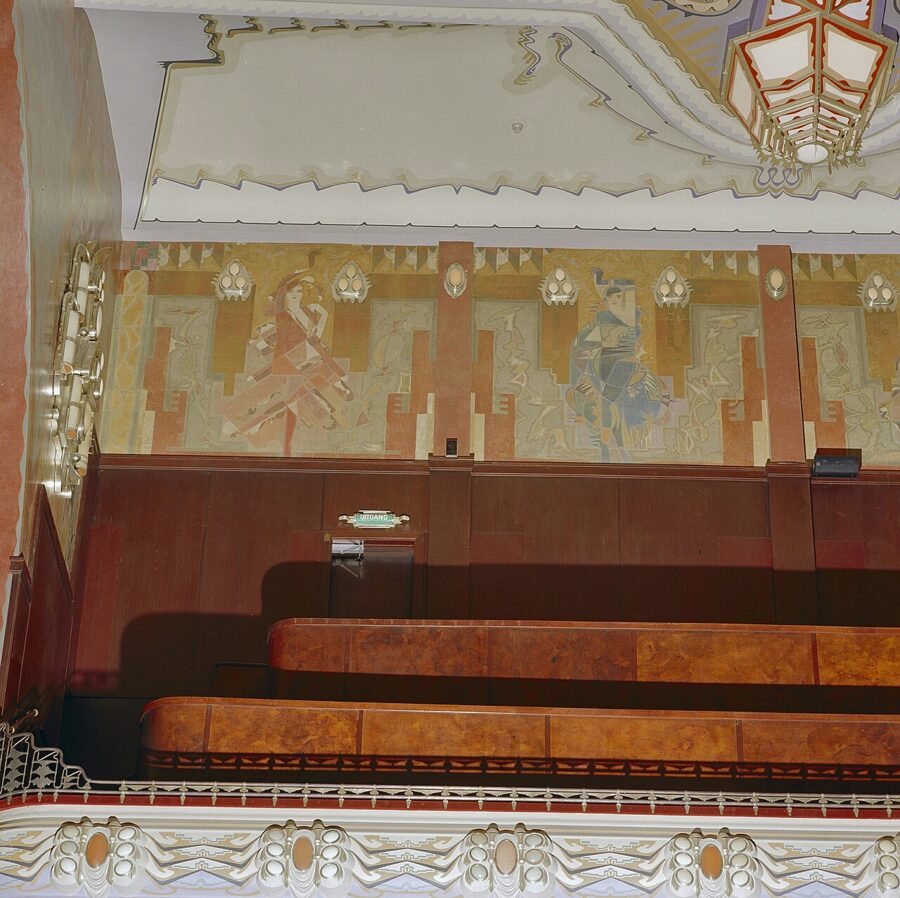
Walk thirty seconds west into the Reguliersbreestraat and you reach the best building in the neighborhood. Abraham Tuschinski, a tailor from Poland who had built up a chain of cinemas in Rotterdam, opened this one in 1921 after two years of construction, to a design by Hijman Louis de Jong. Its towers, tiles and painted interior mix Art Deco, Amsterdam School and a dose of the Orient, and it is still a working cinema run by Pathé as The Royal Theatre Tuschinski, at Reguliersbreestraat 26-34.

Rembrandtplein after dark
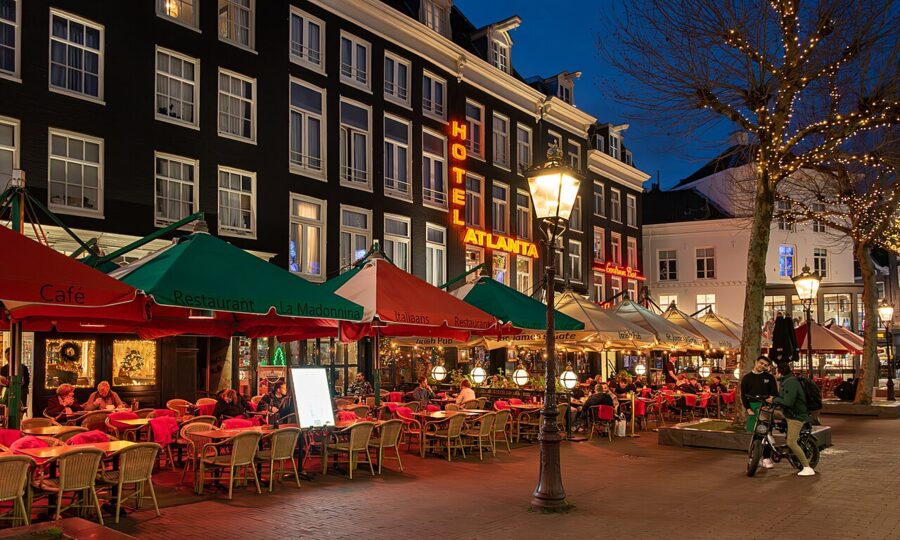
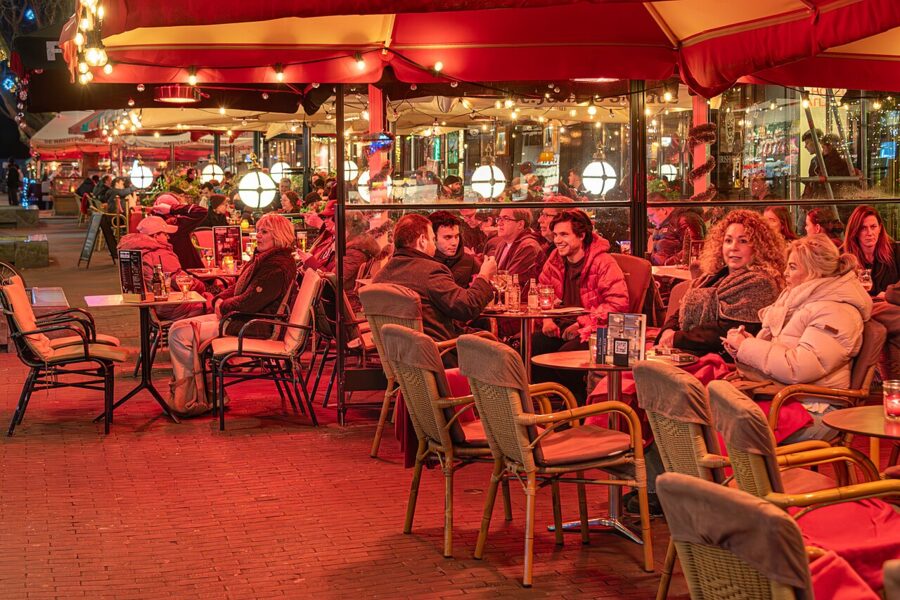
The square works in shifts. In the early evening the terraces are full of people eating and drinking under heaters.
From 11 p.m. the clubs open and the crowd gets younger and louder, and once the terraces are stacked for the night the street belongs to people moving between doors or looking for a taxi. It is mainstream, international and busy on Thursday, Friday and Saturday nights. If you want an underground club, this is not the neighborhood, and the citywide picture is in the nightlife guide.

Two rules catch people out. Drinking alcohol in the street is banned around the square: the alcohol ban covers Rembrandtplein, Thorbeckeplein, the Amstelstraat, the Reguliersbreestraat, the Reguliersdwarsstraat as far as the Vijzelstraat, the alleys between them and part of the Utrechtsestraat, at all hours, with café terraces exempt. And you cannot leave a bike just anywhere: a 2017 traffic order bans parking bikes and mopeds outside the marked spots on the square, the Thorbeckeplein, the Bakkersstraat and the Reguliersdwarsstraat. For cannabis, the rules are the same as anywhere in the city, and the coffeeshops guide covers them.

Compared with Leidseplein, the other going-out square, Rembrandtplein has more big cafés and fewer theaters, and its side streets matter more. The Halvemaansteeg, the alley from the square to the Amstel, is where the crowd thins and you can get to the river in a minute.

Thorbeckeplein
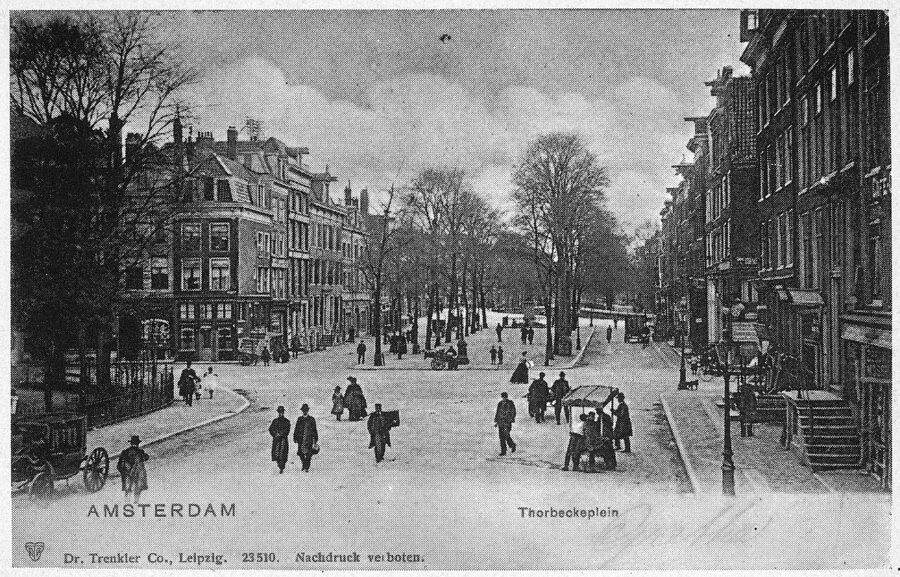
The Thorbeckeplein, about 80 meters long and 30 wide, runs south from Rembrandtplein in line with the Reguliersgracht. It exists because in 1785 the city filled in the stretch of canal between the Herengracht and the Reguliersdwarsstraat. Johan Rudolph Thorbecke, the liberal statesman behind the constitution of 1848, stands on a pedestal at its far end, in a statue by Ferdinand Leenhoff unveiled on 18 May 1876. He faces the canal, not the square, and stories have it he never liked Amsterdam much.
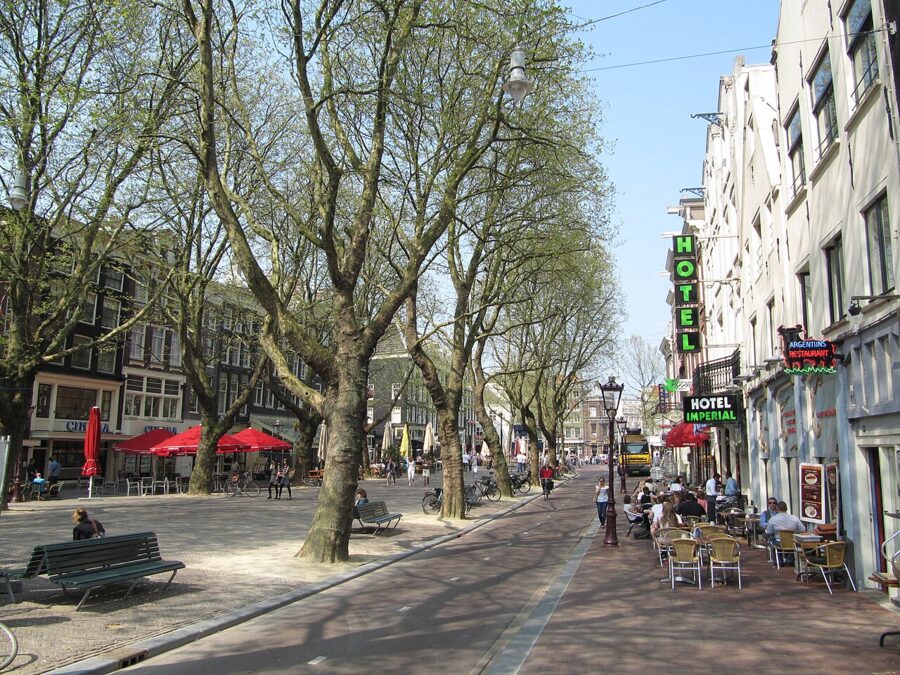

The two statues of 1876 were suspected of being placed partly to push out the annual fair, which was held here. The fair was banned that September, and the riot that followed, the Kermisoproer, demanded that Thorbecke go. He stayed, apart from a few months off for restoration in 2010 and 2011. For 25 years an art market was held on the Thorbeckeplein on Sundays from March to October; in 2011 it moved onto Rembrandtplein.
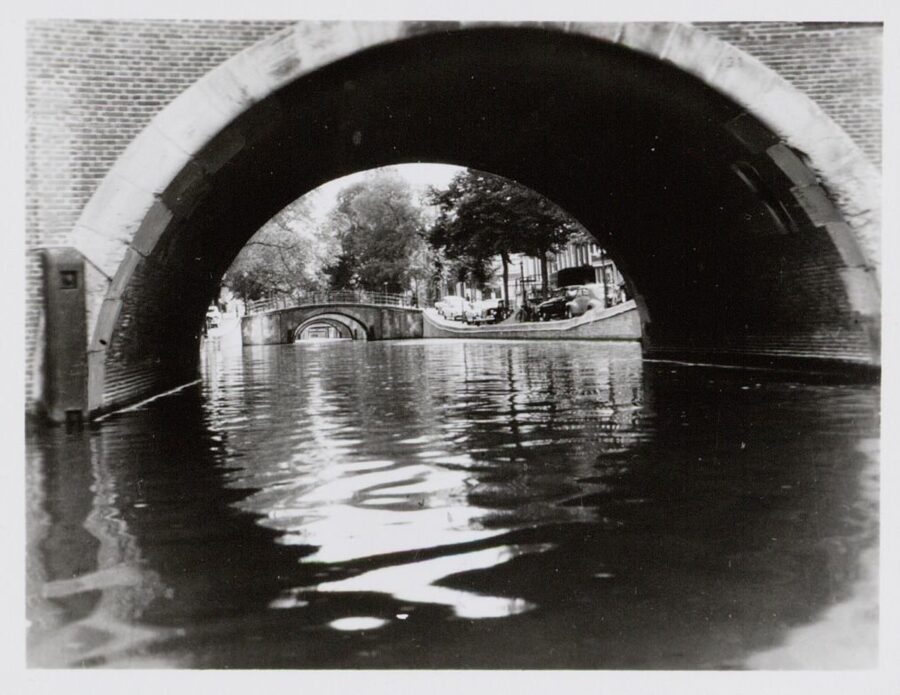
The best thing about the Thorbeckeplein is where it ends. Stand on the Herengracht bridge at its foot and look along the Reguliersgracht and you get the view of bridge after bridge lined up through each other’s arches that Amsterdammers call the Zeven Bruggen, the seven bridges. It is the view many canal cruises slow down for, and from the bridge it costs nothing.
Reguliersdwarsstraat and the LGBTQ+ bars
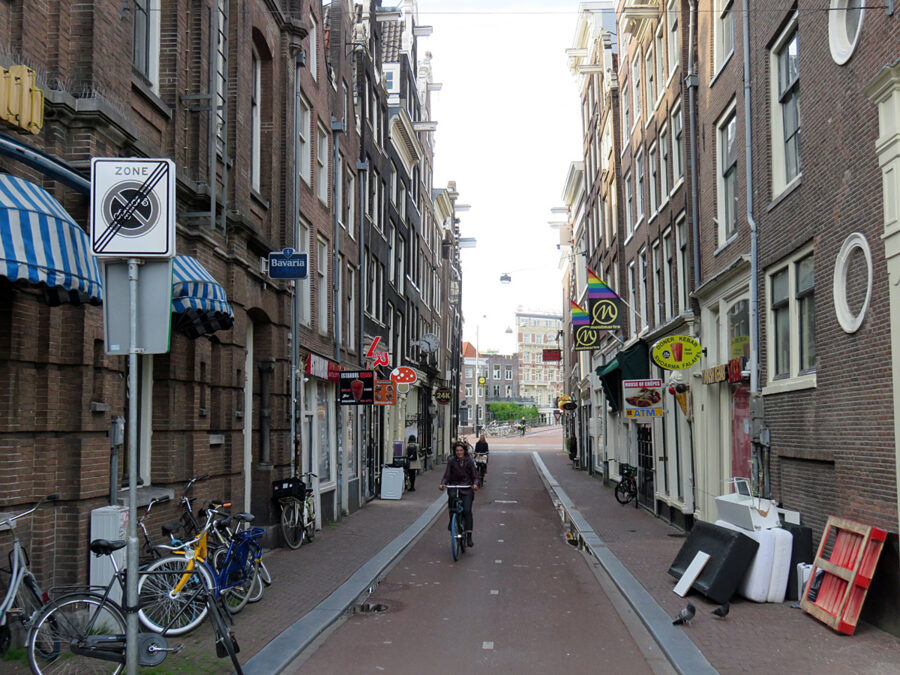
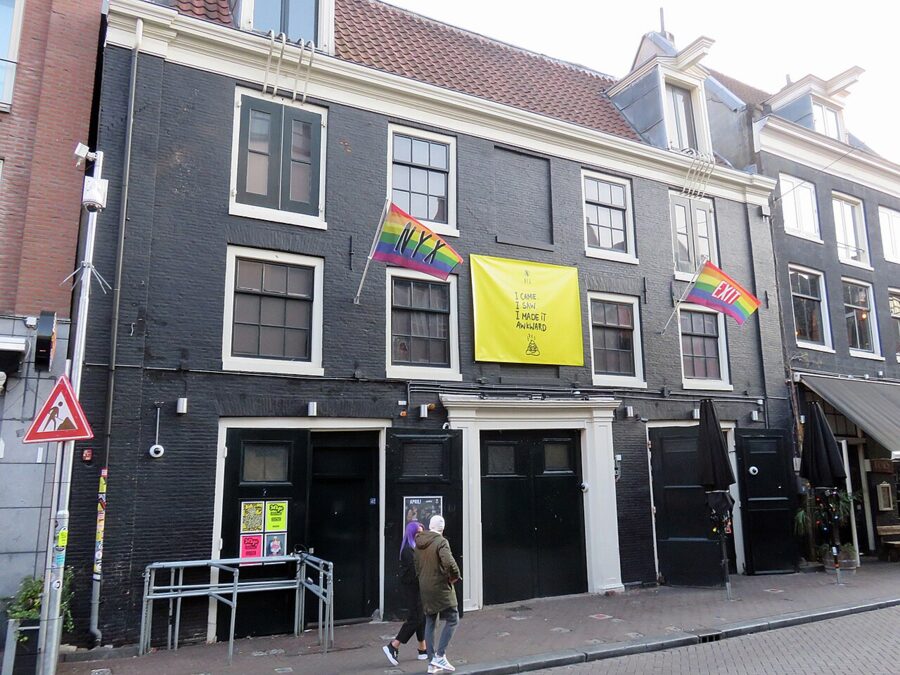
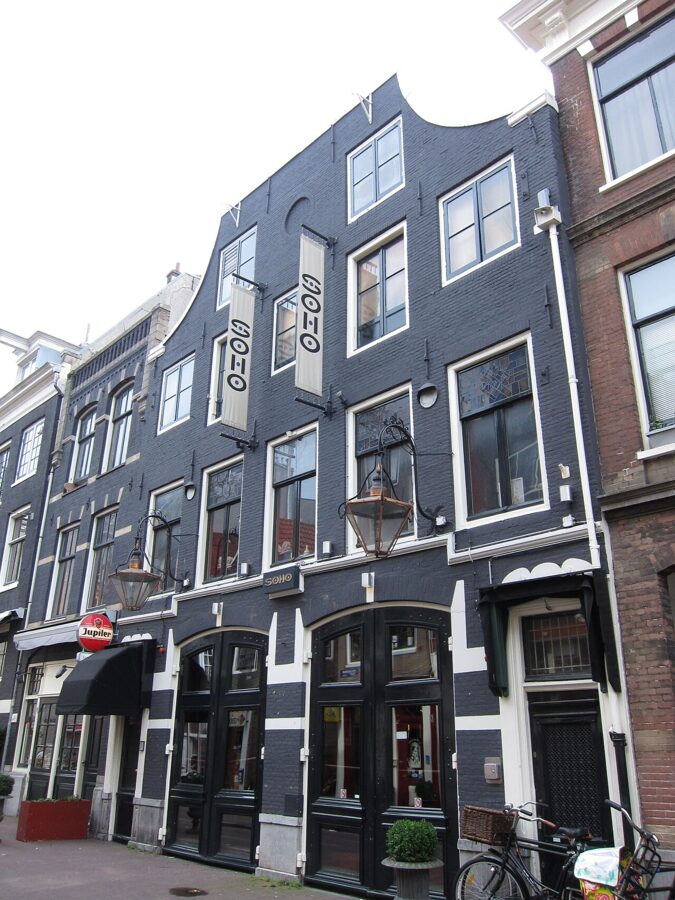
The Reguliersdwarsstraat runs west from the square to the Koningsplein, one block south of the Bloemenmarkt stalls on the Singel, with the Korte Reguliersdwarsstraat as the short branch that joins it to the square. It was laid out in the city expansion of 1585 and named after the Reguliers monastery that stood nearby until 1532. The street’s gay history starts with the café MacDonald in 1963. Coffeeshop Downtown, opened here in 1970, was the city’s first openly gay business, and from late 1979 the street was the center of gay Amsterdam.
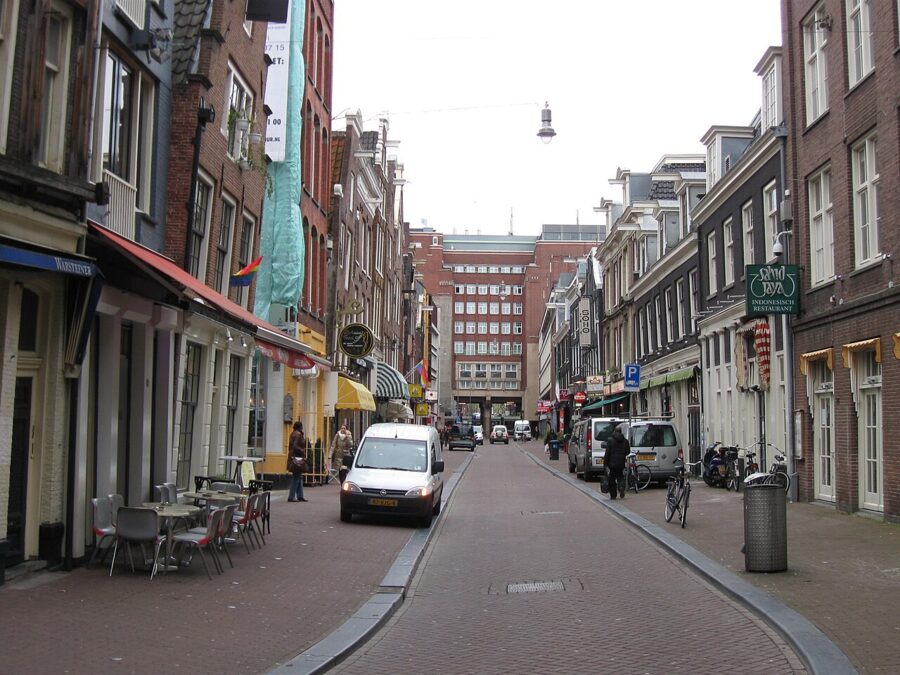

It went through a hard decade. In 2010 a dispute with a brewer ended in the death of the businessman who owned the six big gay venues in the western part, and several of them closed. New operators reopened them in 2011, and in 2012 the former Club Exit at number 42 reopened as Club NYX, the street’s big club, which runs its nights under names such as Nyx op donderdag, Vrijdag is NYX and 3xNYX. The local business association now promotes the Reguliersdwarsstraat as a rainbow street, with flags along the facades and a rainbow path by the Carlton, and during Pride in early August it has its own street parties.


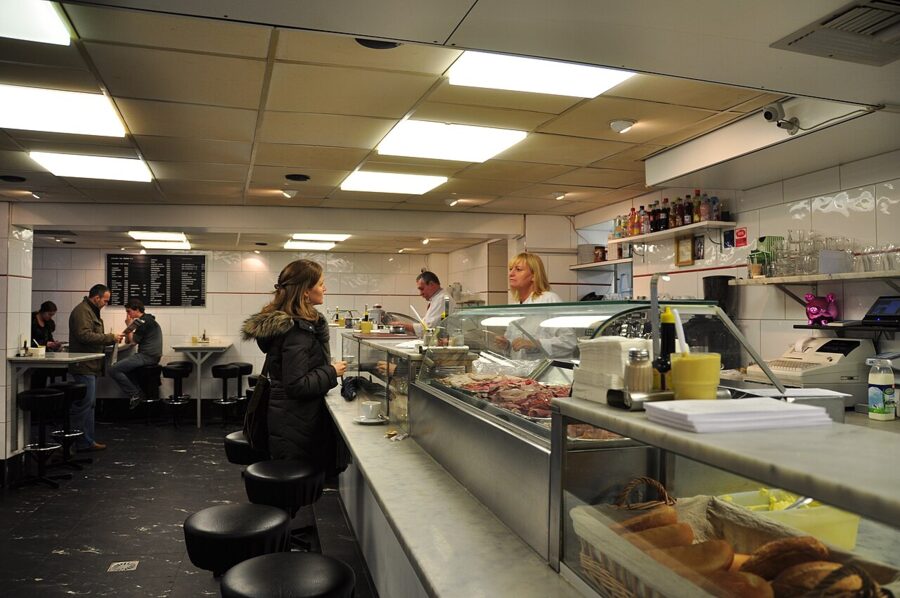
On the short arm, the Korte Reguliersdwarsstraat, Eetsalon Van Dobben has been selling croquettes since 1945. It is a counter with stools, open late (until 02:00 on Friday and Saturday, per its listing as of 2026), and a broodje kroket at the counter is the right end to a night on the square.

Utrechtsestraat for dinner
The Utrechtsestraat leaves the square’s southeast corner and runs straight south for under a kilometer to the Frederiksplein, crossing the Herengracht, the Keizersgracht and the Prinsengracht on the way. Tram 4 runs down the middle of it. It is the antidote to the square: small shops, bakeries and restaurants, people who live here, and almost no neon. If you are going to eat a proper dinner near Rembrandtplein, walk three minutes down this street before you sit down.
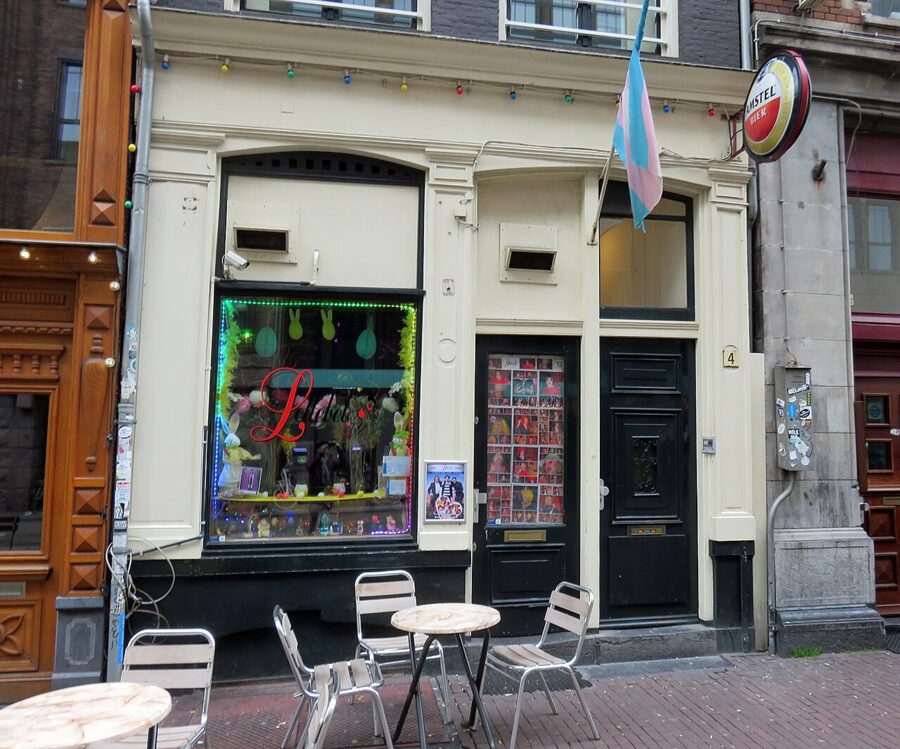
The first stretch still has a foot in the square’s nightlife. At number 4, Lellebel is a small queer bar, open since 1997, with drag shows and comedy at the end of the month and karaoke on Friday and Sunday nights. As of 2026 it opens from 21:00 Wednesday to Sunday, until midnight midweek, 02:00 on Fridays and Saturdays and 03:00 on Sundays.

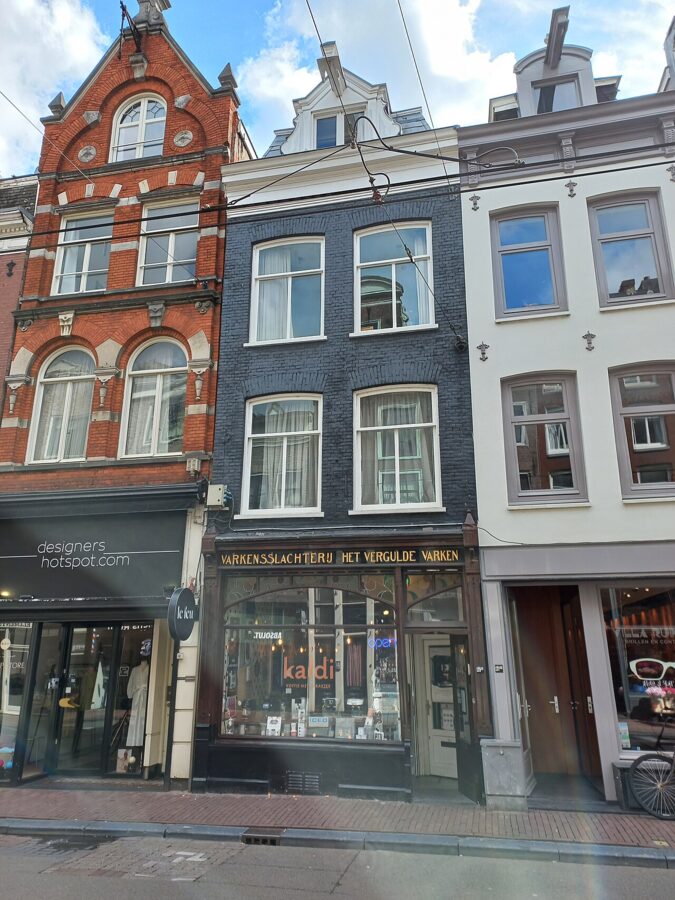
Past the Herengracht the bars thin out and the shops and restaurants take over. The restaurant list turns over fast, so I would rather send you to walk it than name a table that may have changed hands by spring. Look at the shopfronts as you go; several are listed, and number 129 keeps a full Art Nouveau window.

Getting there, when to go and what to skip
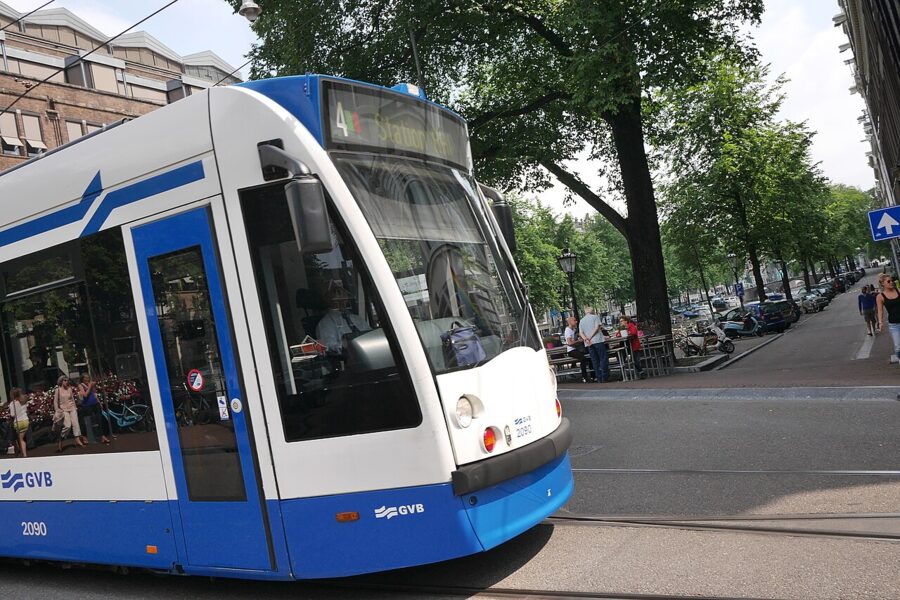
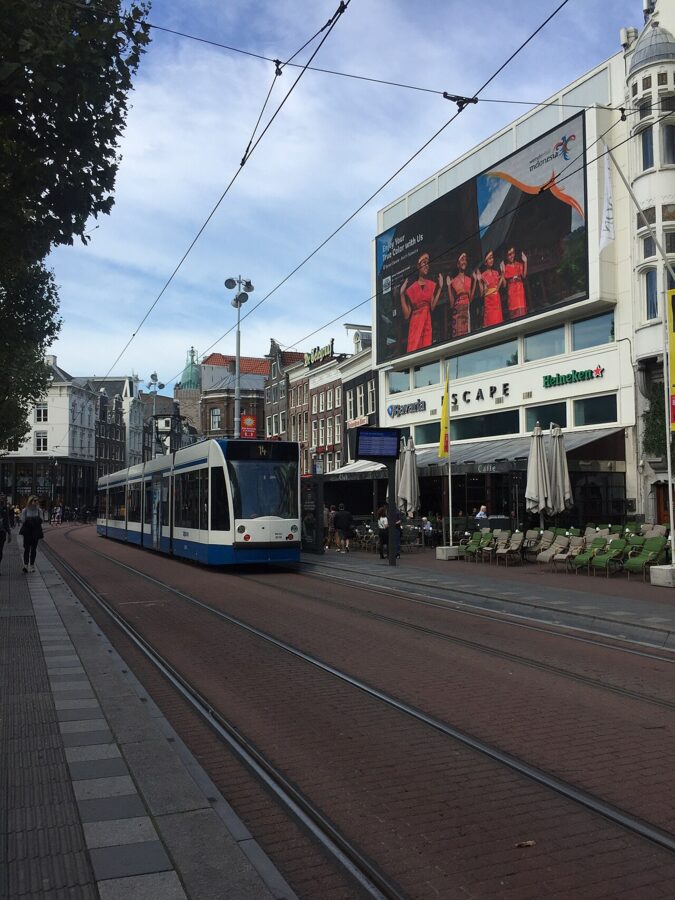
Trams 4 and 14 both stop at Rembrandtplein, under ten minutes from Centraal Station; tap in and out with a contactless bank card. Tram 4 comes up the Utrechtsestraat from the Frederiksplein and Station RAI, and tram 14 comes from Waterlooplein and the east. From the metro, Waterlooplein (lines 51, 53 and 54) is a five-minute walk and Rokin (line 52) slightly more. On foot it is about ten minutes from the Dam and three from the Munt and the flower market.

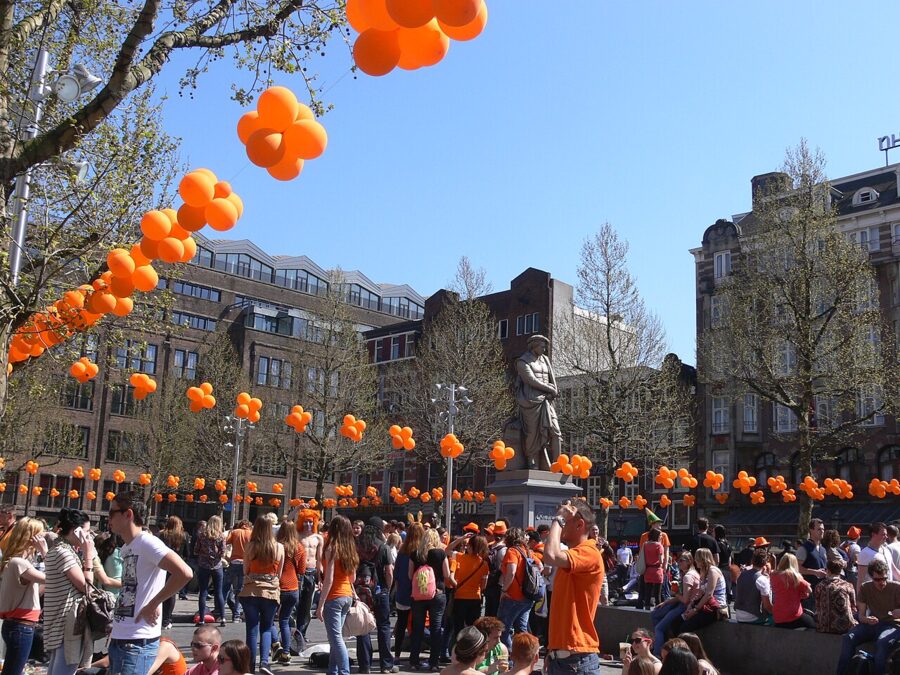
When to go depends on what you want. For the buildings, come in the morning or early afternoon, when the terraces are empty enough to see the facades. For the square at its most Amsterdam, come on King’s Day or a warm Saturday evening. In winter, from mid-November to early January, the rink and the lights make it worth a detour even if you have no plans to skate.
What to skip: eating on the terrace row. You pay for the location and get food that would not survive a side street. Have one drink on a terrace if the sun is out, then eat on the Utrechtsestraat. Skip, too, any plan built around the Night Watch figures; they are gone, and the painting is better.
Nearby, the Rembrandthuis on the Jodenbreestraat shows where he lived and painted, ten minutes east past the Waterlooplein flea market. A few minutes west, by the Munt, Hotel de l’Europe sits on the Amstel. And the walk back toward Centraal takes you through De Wallen, the old Red Light District, in under fifteen minutes.

Take tram 4 or 14 to Rembrandtplein, look at the iron painter on the west side of the lawn, and do not go looking for his militia. Have one drink on a terrace while the sun is on it, walk down the Thorbeckeplein to the seven bridges, and eat on the Utrechtsestraat.