
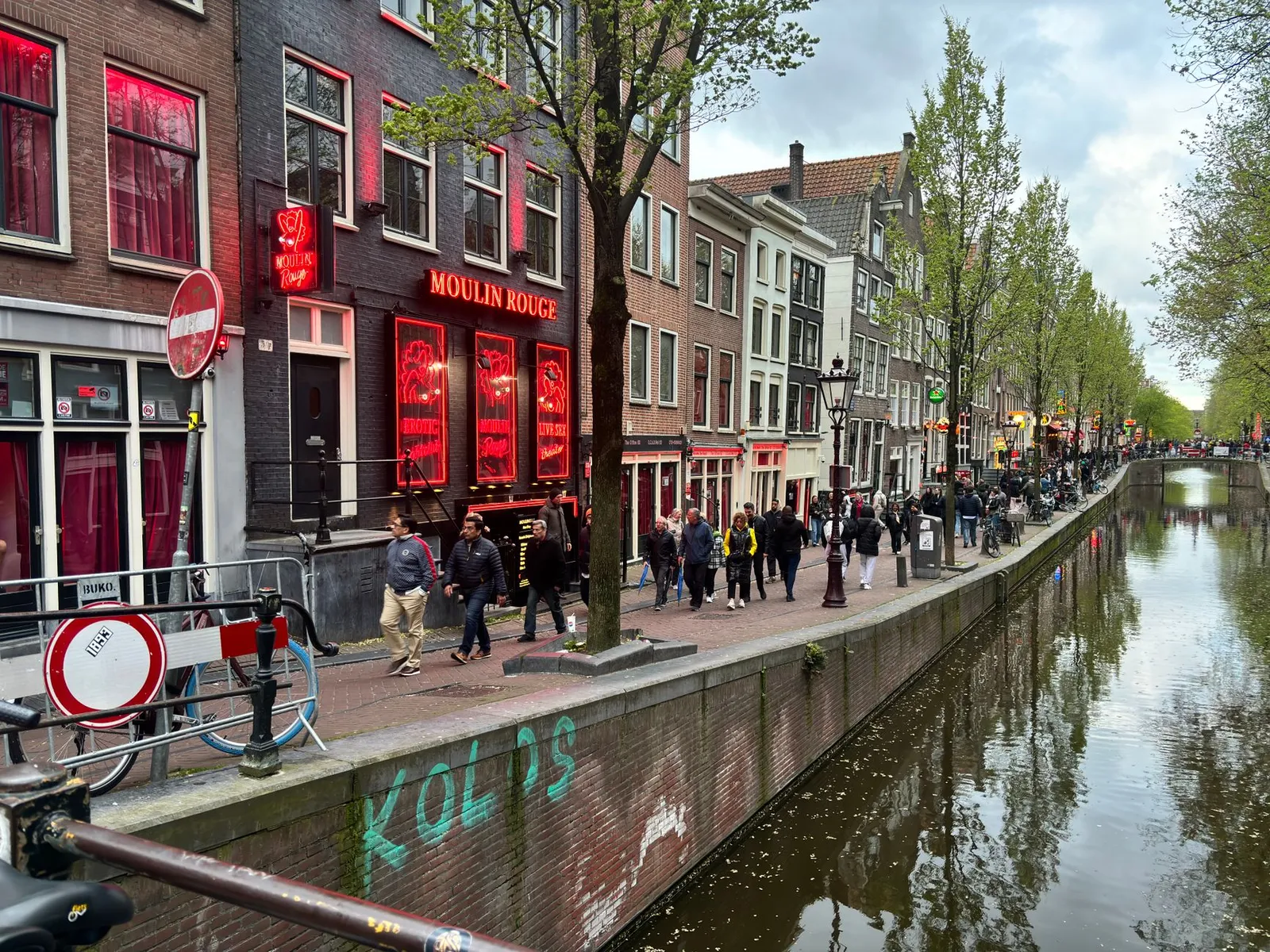
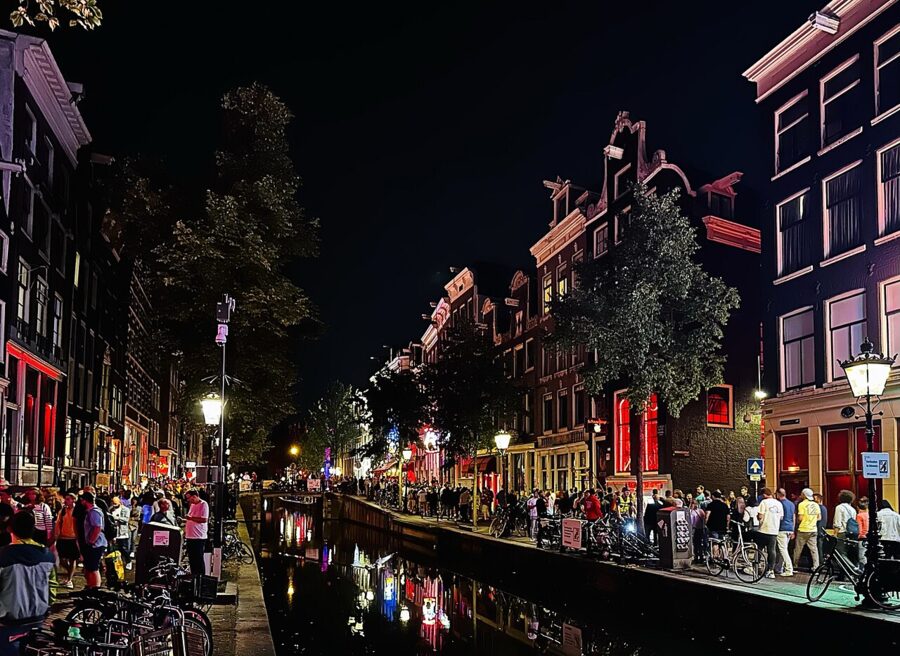
It is half past eight on the Oudezijds Achterburgwal, the canal still holds a little daylight, and the first red lamps are on. In the window of an old brick house a curtain is open, and stuck to the glass at knee height is a small sticker of a camera with a line through it. Half the people walking past have a phone in their hand anyway. That sticker is the rule that matters most here, and the one broken most often.
The rest of the rules have moved around a lot. In April 2023 the city ordered the windows in the core of the district to close at 03:00 on weekend nights instead of 06:00. Ten months later the mayor withdrew the order, because the sex workers it was meant to protect said they were earning less and felt less safe walking home at three in the morning.
In June 2026 the new city government dropped the plan to move part of the trade to a purpose-built erotic center in the south of the city. So the windows stay where they have been for centuries, around the Oude Kerk, and the rules that changed are the ones aimed at you: no joints on the street, no beer on the quay, bars shut earlier, no guided groups past the windows.
My advice fits in a line. Come in the early evening, walk the two canals and the alleys for an hour, go inside one museum or the church, and keep the phone in your pocket whenever there is a window in the frame.
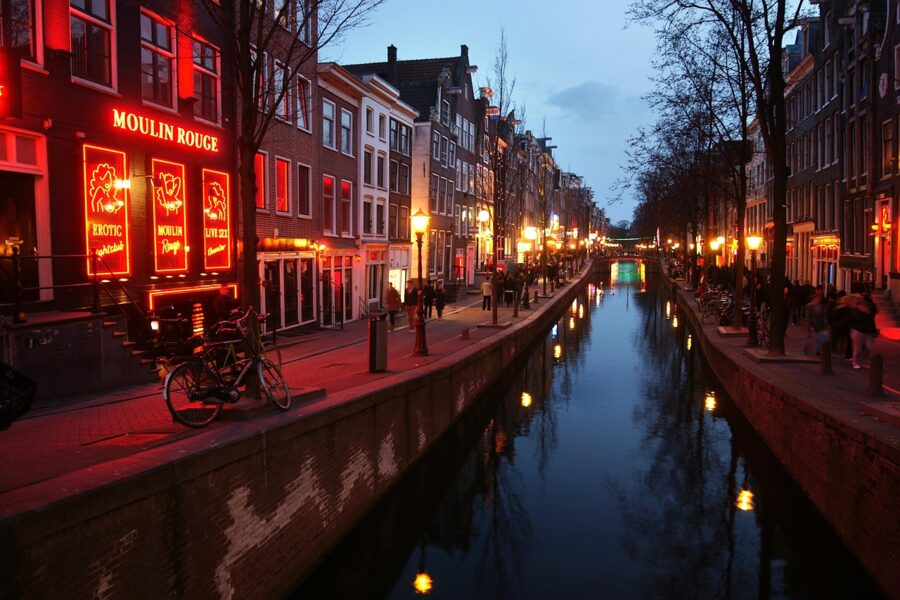
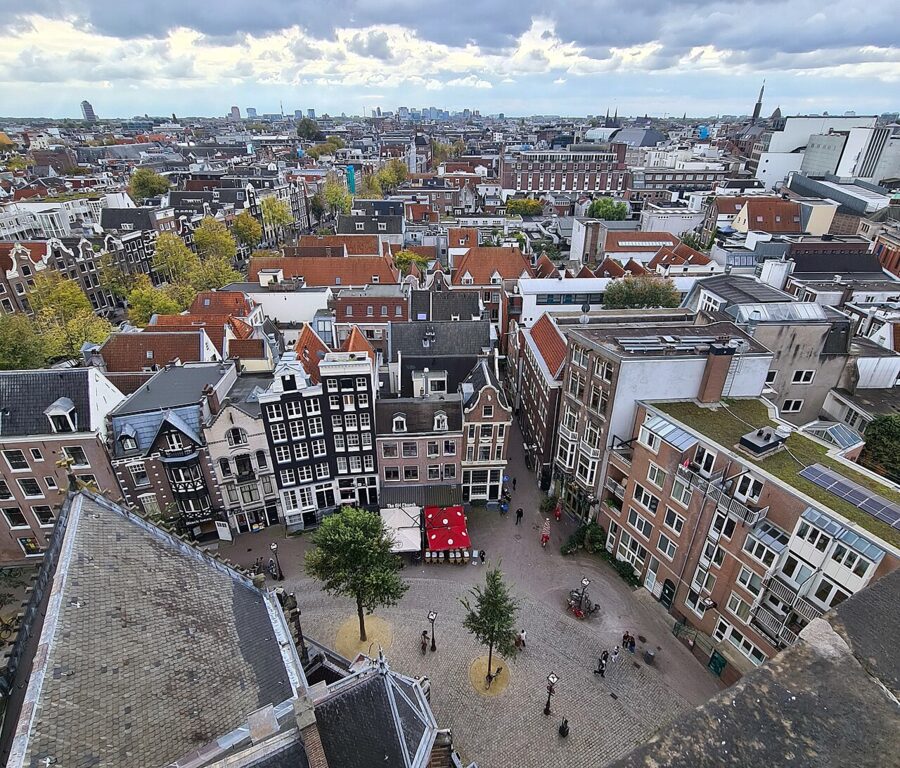
The Red Light District is the window area of De Wallen, the oldest part of the city between Centraal station, the Dam and the Nieuwmarkt. Locals call it the Wallen or the Rosse Buurt (red neighborhood). The streets are public, free and open at every hour, and people live here: there are families, a church still in use, and apartments above many of the windows. The neighborhood’s history, from the sailors’ quarter to the canal houses, has its own guide; this one is about going there now.

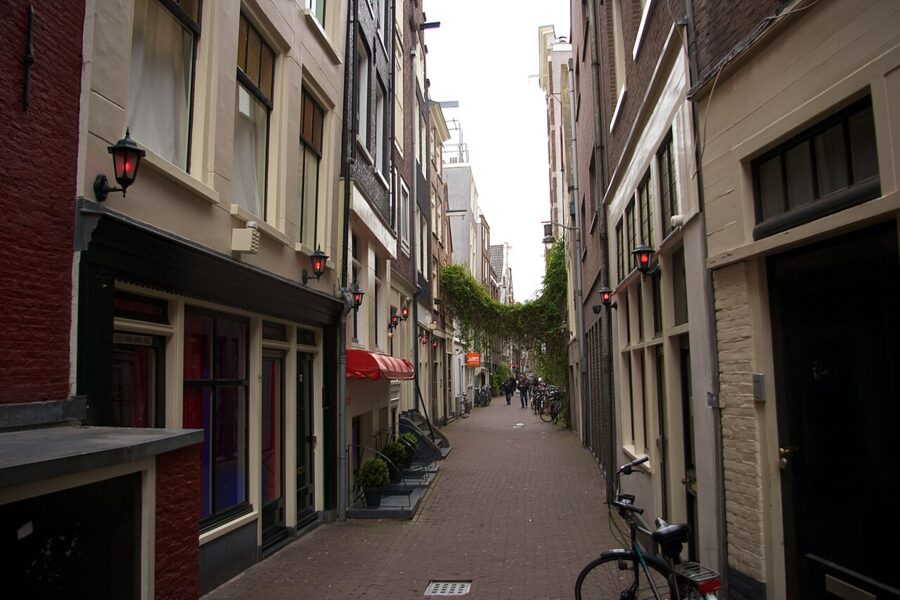
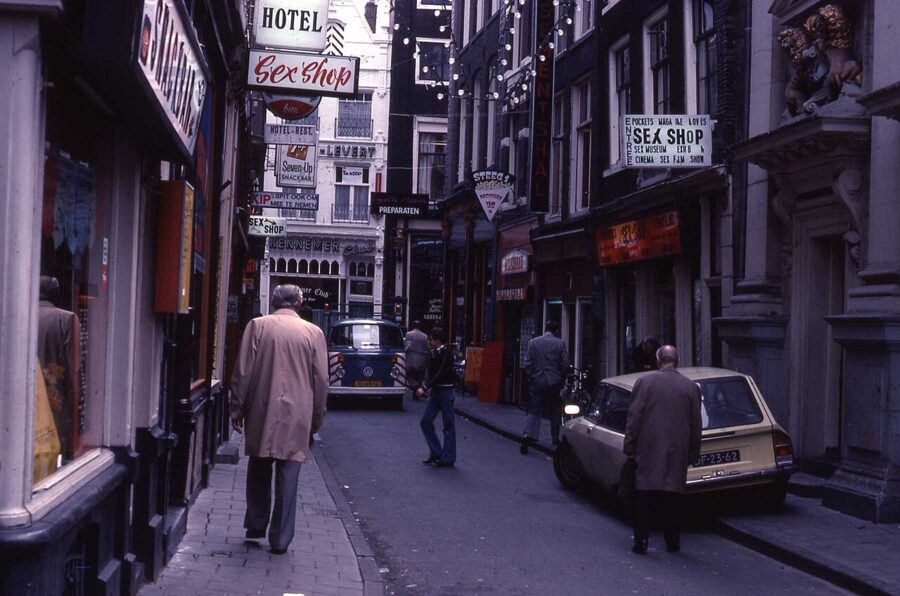
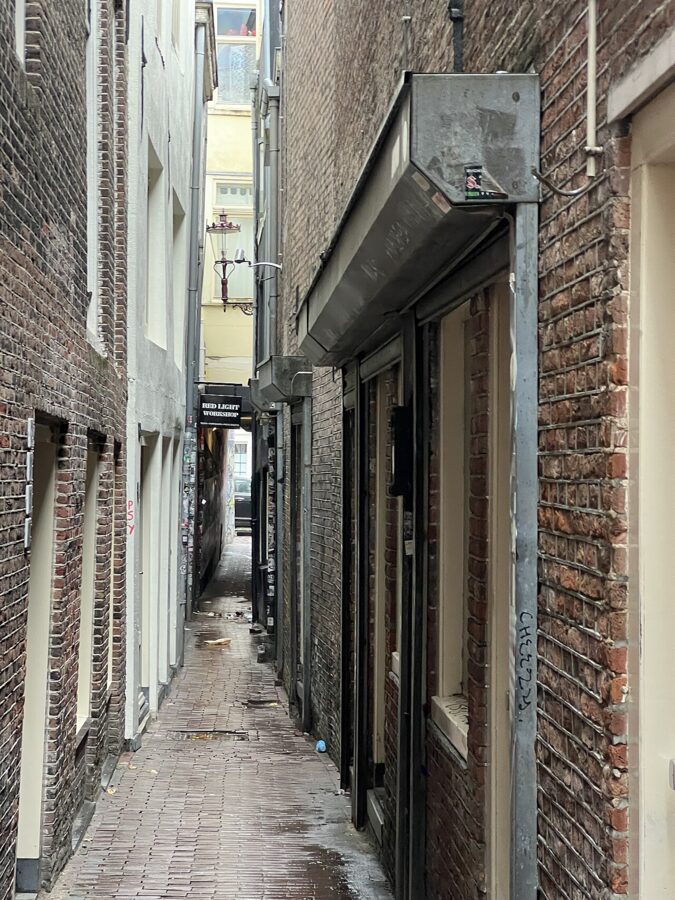
Two canals do most of the work: the Oudezijds Voorburgwal, with the Oude Kerk on its east bank, and the Oudezijds Achterburgwal one block east, where the theaters and sex shops are. The windows sit along both and in the narrow alleys (stegen) that join them. Nothing about the layout is complicated. It takes about fifteen minutes to walk the whole thing end to end, and most people go round twice.

When to go, and how long you need
The windows work in shifts from late morning until the early hours, so there is no closed time for the streets. What changes is the crowd.
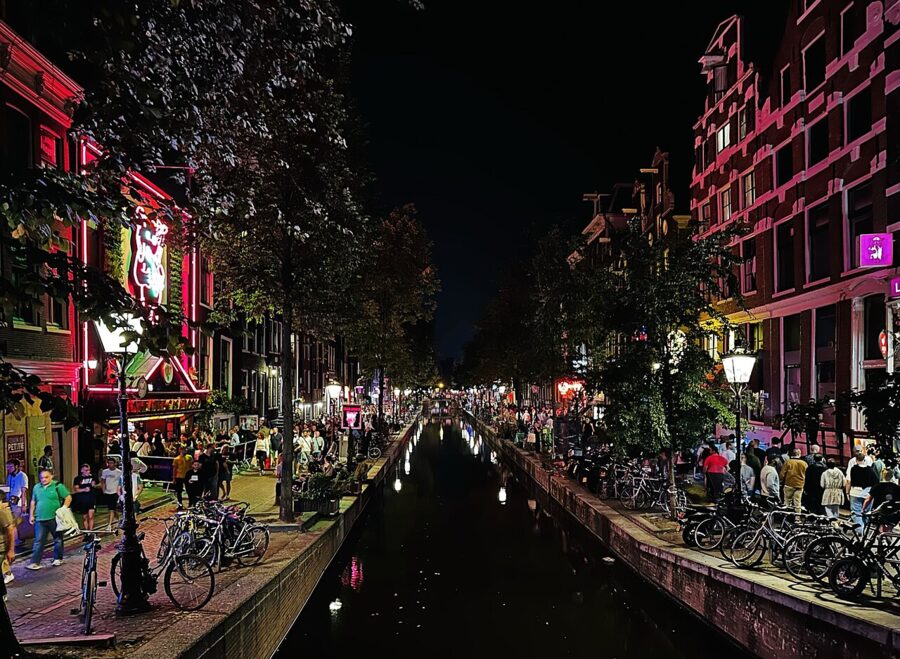
Weekday evenings are the easy option: from dusk until about 22:00 the quays are full but people are walking, not standing. Friday and Saturday after 23:00 it gets heavy.
The canals fill with groups on a night out, the alleys back up, and the mood turns from curious to loud. If you want to see it at its most crowded, that is when. I would not bother.
Late at night, after the bars close, the district empties faster than you would think. The city counted 30 percent fewer people on the streets between 02:00 and 03:00 in 2023 than a year earlier, once the earlier bar closing came in, and the mayor’s own letter to the council describes the area as largely quiet from 02:00.
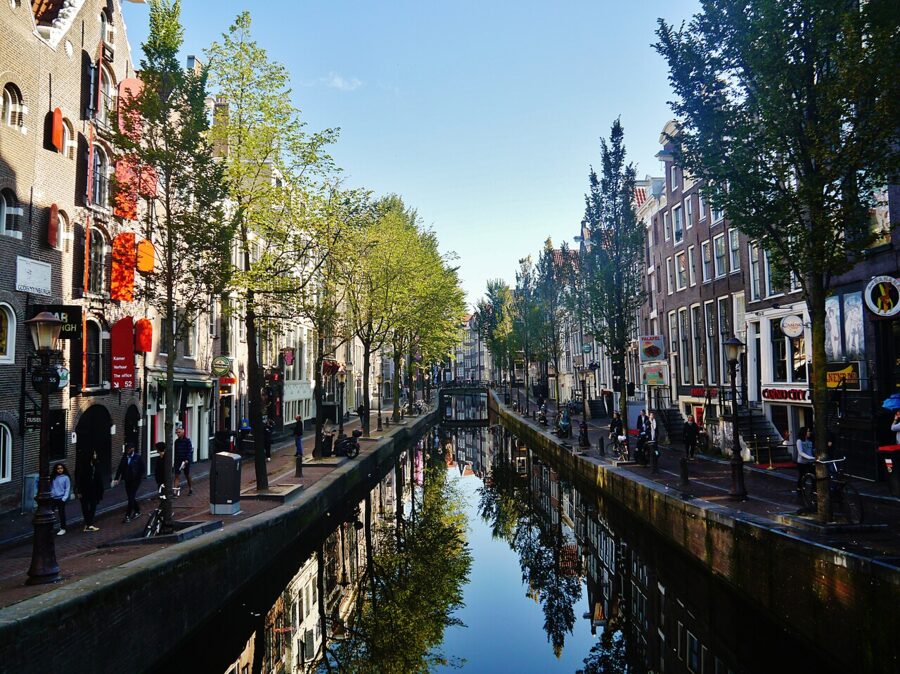

As for time: an hour is enough to walk it once at dusk and see what there is to see. Two to three hours lets you add the Oude Kerk or one of the museums. Make it a whole evening only if you are also eating and drinking in the area, in which case the nightlife guide has better options than the bars on the Achterburgwal.

Should you take a tour?
You cannot take a guided tour past the windows.
Since 1 April 2020 the city has required a permit for any guided group of five or more in the whole of the Centrum district, capped groups at 15, limited them to 08:00 to 22:00, and banned guiding altogether in the areas with windows. The city’s guided-tour rules still stand in that form. Groups of four or fewer fall outside the permit system. Tours still sold under the name stay outside the window streets and send you in on your own afterward.
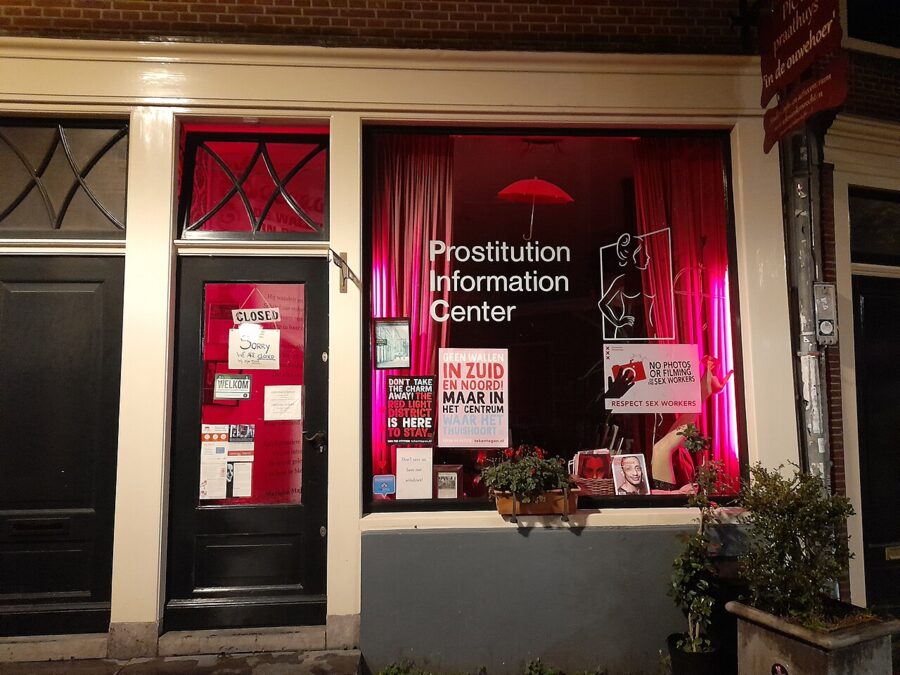
The better way to understand the place is to ask the people who work there. The Prostitution Information Center in the Enge Kerksteeg, beside the Oude Kerk, is run by sex workers and allies. It was founded in 1994 by Mariska Majoor, a former sex worker, and is open Wednesday to Saturday from 12:00 to 17:00, with a Walk ‘N Talk at 17:00 on open days. Ask the questions you would feel awkward asking anyone else; that is what it is for.

The rules, and what breaking them costs
Most of the rules below are city bylaws (the APV) applied to the Wallen, and the fines are on-the-spot. The figures are the city’s own, as of 2025 and 2026.
| Rule | Where and when | Consequence |
|---|---|---|
| No photos or video of the windows or the women in them | The whole window area, any time | The city’s line is simply “not allowed”; in practice a bouncer, a sex worker or the police will make you delete it |
| No smoking cannabis in the street | Red Light District, Nieuwmarkt and the Dam, since May 2023 | €100 (about US$115), after a warning; coffeeshop terraces excepted |
| No drinking alcohol in the street | Most of the city center, including the whole district | On-the-spot fine; €100 for public drunkenness |
| No take-away beer or wine from shops | Thursday and Sunday 16:00 to 03:00, Friday and Saturday 16:00 to 04:00, until 1 April 2027 | Applies to the shop, so you simply cannot buy it |
| Bars close at 02:00, no new guests after 01:00 | Core of the district, weekend nights, until 1 April 2027 | Applies to the bar |
| Public urination, littering, noise | Everywhere | €150 (about US$175) each |
| Guided groups past the windows | Window areas, always | Banned outright |
Photos: the one rule that is enforced by people
The city’s visitor rules are short on this: no photographs or video in the area. There is no fixed fine printed next to it the way there is for a joint, which is why people think they can get away with it. What actually happens is that the woman in the window bangs on the glass, a doorman appears, and you are told to delete the picture while he watches. The sticker on the window is there so no one can say they did not know.
A wide shot of a canal at night with red lamps in the distance is a different thing from a phone pointed at a window, and nobody minds the Oude Kerk tower. But if a window is lit and open in your frame, the answer is no. That includes filming yourself walking past.

Cannabis and alcohol
Since 25 May 2023 nobody, resident or visitor, may smoke cannabis in the street in the old center: the Red Light District, the Nieuwmarkt and the Dam. Signs say “No smoking cannabis in public”, and officers can fine you €100 if you carry on after a first warning. The terraces of coffeeshops are the exception, and inside the shop is fine. The coffeeshop guide covers the tolerance policy (gedoogbeleid), the five-gram limit and the age rule.
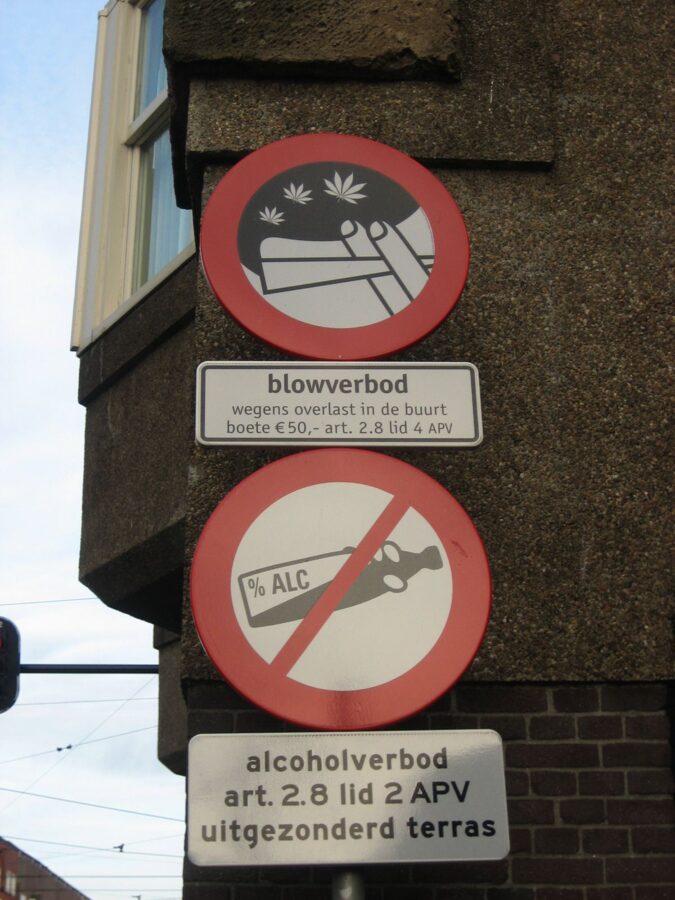

Drinking in the street is banned across most of the center, the Wallen included, and on the bylaw that now runs to 1 April 2027 shops in the district may not sell beer or wine to take away from 16:00 on Thursday to Sunday nights. Spirits go out only in a sealed bag. The idea is to stop the can-in-hand pub crawl along the quays.

Closing times
Bars in the core of the district, which the city draws around the two canals north of the Damstraat and the alleys between them, must close at 02:00 on weekend nights and admit no one after 01:00, under a mayor’s decision valid from 1 April 2025 to 1 April 2027. King’s Night in April is the one exception. Before 2023 many of them stayed open until 03:00 or 04:00.
The windows are different.
The 03:00 closing that started in April 2023 was withdrawn in February 2024, after the city’s own monitoring found sex workers under financial pressure, considering going with clients elsewhere, and being approached and followed on the walk home. The windows went back to the hours in each operator’s licence, which in the core of the district run to 06:00. Plenty of older guides and some signs still say 03:00. They are out of date.
Noise, urine and the rest
The city fines €150 for urinating in public, €150 for littering and €150 for noise, and €100 for being drunk in public. Do not pee in the canal; people do, constantly, and it is the single thing residents complain about most. Repeat offenders can also be banned from the area: the bylaw lets the police order someone out for 24 hours for dealing, pickpocketing, public drunkenness or causing trouble, rising to a month and then three months for people who keep coming back.
The city has run campaigns aimed at the stag-party crowd since 2018, first “Enjoy and Respect” and from 2023 a “Stay Away” video campaign targeted at young British men. The mayor told the council later in 2023 that the second one had made little difference. The rules on the street are what changed behavior.
How the windows work
Sex work is legal in the Netherlands, and a window is a licensed business. The operator who owns or rents the building needs a permit from the city and a business plan the city approves, and the 2026 enforcement strategy spells out what that plan has to cover: an intake interview with every sex worker before she starts, supervision during opening hours, a working alarm in every room connected to help, the national hygiene guidelines, and written rental terms with a signed copy for the worker. The operator must also let her decide her own working hours. She rents the room; the operator is not her boss and has no say in who she sees.
The minimum age for sex work in Amsterdam is 21. Each worker sets her own prices and her own terms, and they are agreed at the door before anything else happens, in cash. She can turn anyone away and does not owe a reason.
If the curtain is closed, she is with a client or on a break. Do not knock on the glass, do not haggle in a group for laughs, and do not stand in front of a window commenting. If you see something that looks like coercion, the city’s advice is to call the police on 0900-8844 (+31 343 578 844 from a foreign phone), or to report anonymously on 0800-7000 from a Dutch number.

The window trade has been shrinking for years. A survey of Dutch towns published in July 2025 found about 1,000 windows left nationally, against about 1,500 in 2010, with fewer than ten cities still allowing them.
Amsterdam’s answer was meant to be the erotic center, an idea the mayor backed from 2019: a building near the RAI convention center for about 100 sex workers, which would let the city close windows in the Wallen. Schools, residents and businesses at the site fought it, D66 dropped it from its election program, and the coalition agreement of June 2026 scrapped it. The new city government says it will look at several small locations instead. For now, the number of windows in the Wallen is not going down.

Staying safe
The district is one of the most watched places in the city, with police, city enforcement officers and doormen everywhere, and violent crime against visitors is rare. The problems are smaller and more predictable.
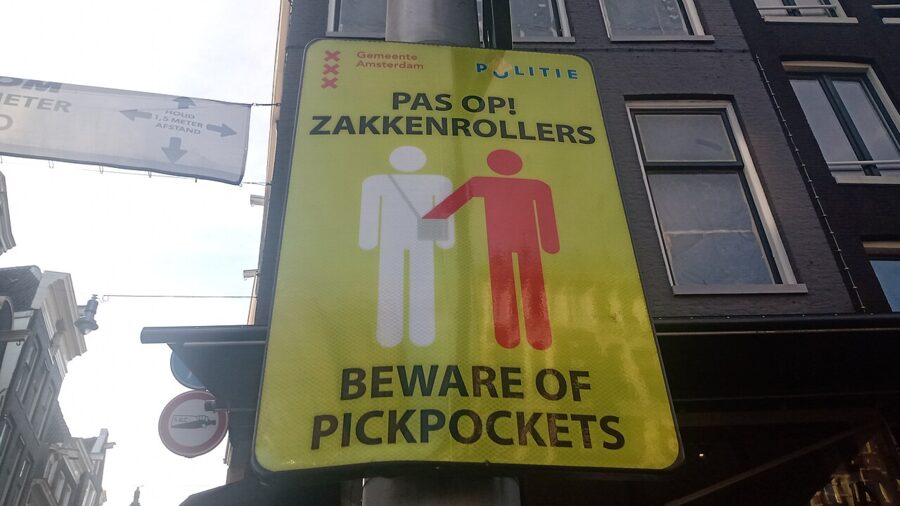
- Pickpockets. They work the crowded alleys and bridges on busy nights, especially where a crowd stops. Front pocket for the phone, zipped bag in front of you, and be wary of anyone who bumps into you or asks for directions with a map spread out.
- Street dealers. Someone murmurs “coke, ecstasy” as you pass. Keep walking. What they sell is often fake, sometimes something more dangerous than what they claim, and the bylaw now lets police target buyers as well as sellers: being in the street with the evident aim of buying drugs, real or fake, is itself an offense.
- Stolen bikes. A man offering a bike for twenty euros is selling a stolen one, and buying it is a crime too.
- Your own night. Mixing alcohol and cannabis is what puts most visitors on the curb. If someone collapses, call 112; the city’s advice is that people are not prosecuted for drug offenses after going to an emergency department.

Women walking alone are fine in the early evening. Late on weekend nights, as anywhere with drunk groups, it is less pleasant than dangerous. In an emergency, call 112.
The other two window areas
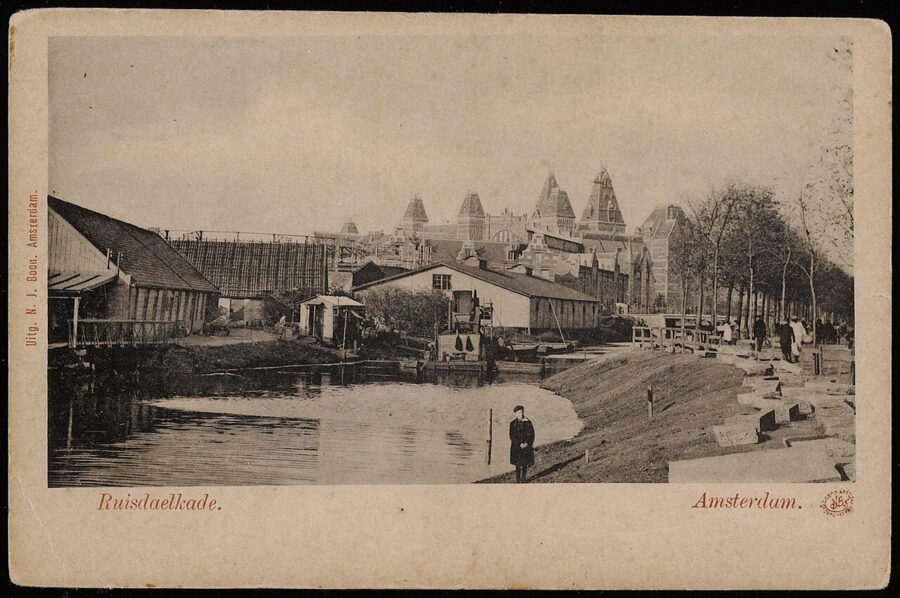
The Wallen is the largest window area but not the only one. The city’s own planning papers list two more: a smaller cluster in the old lanes around the Singel, west of the Dam, and the Ruysdaelkade in De Pijp, a row of windows on the quay along the Boerenwetering canal, a short walk from the Rijksmuseum. Both are quiet working streets with none of the theaters, crowds or bars. There is nothing to see there, which is the point, and nothing that would justify a detour.
What else is worth seeing
Most people walk past the best things in the district on their way to the windows. Here they are in the order you meet them, with the prices and hours as of November 2026.
The Oude Kerk
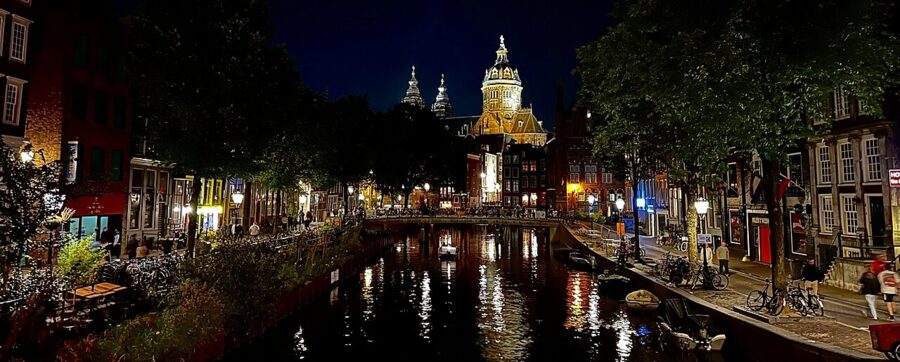
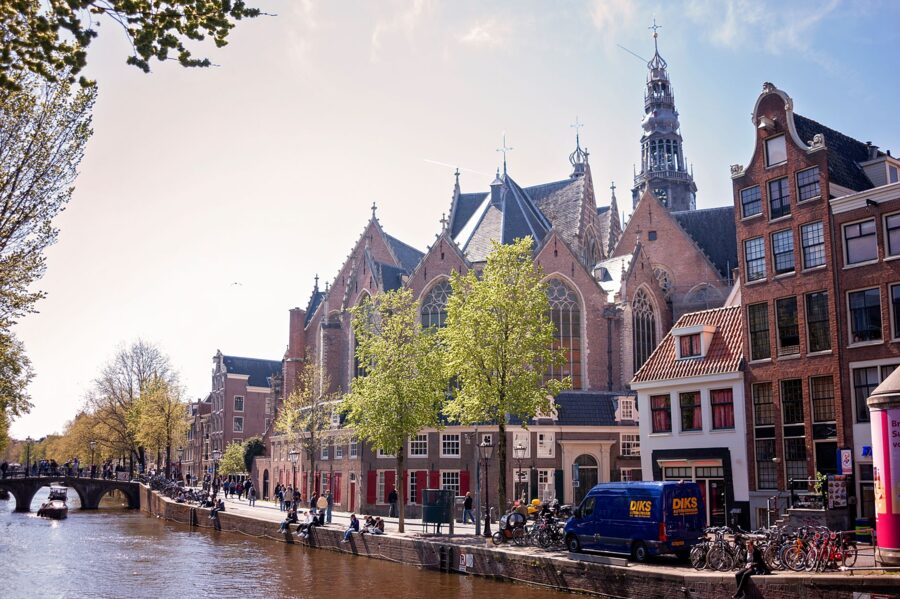
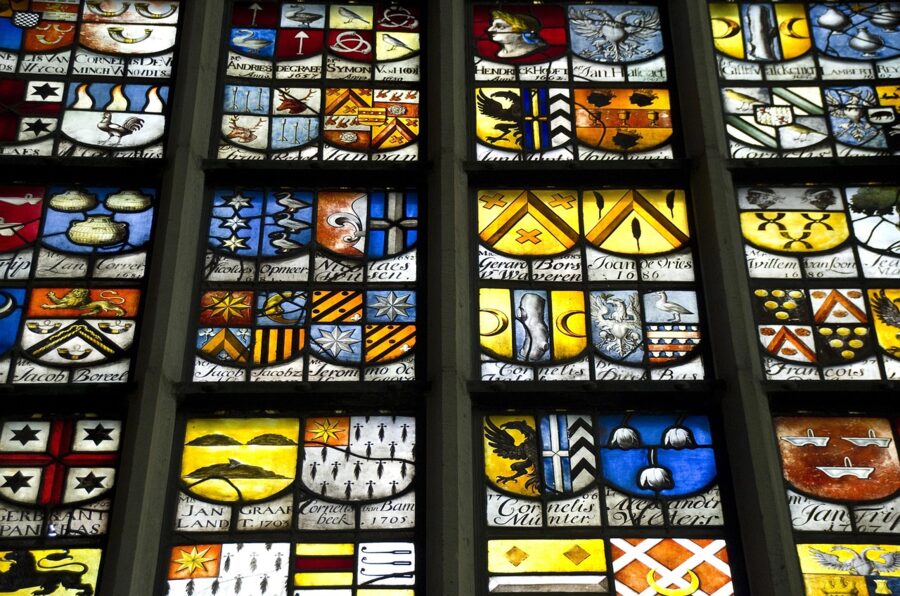
The Old Church is the oldest building in Amsterdam, consecrated in 1306, and it stands in the middle of the window area, with windows around its square. Inside it is wide and bare in the Protestant way, with a painted wooden vault, tombstones across the floor (Rembrandt’s wife Saskia is buried here) and contemporary art installed in the nave; the current show, Mire Lee’s Vomit My Blessing, opened on 13 November 2026 and runs into March 2027.
It is open Monday to Saturday 10:00 to 18:00 and Sunday 13:00 to 17:30. Admission is €14.50 (about US$17), €7.50 for students and 13 to 17s, free for under-13s and with the Museumkaart or I amsterdam City Card. The church plus tower costs €22 (about US$25). It closes on 27 April and 25 December, and for a few days between exhibitions.
Ons’ Lieve Heer op Solder
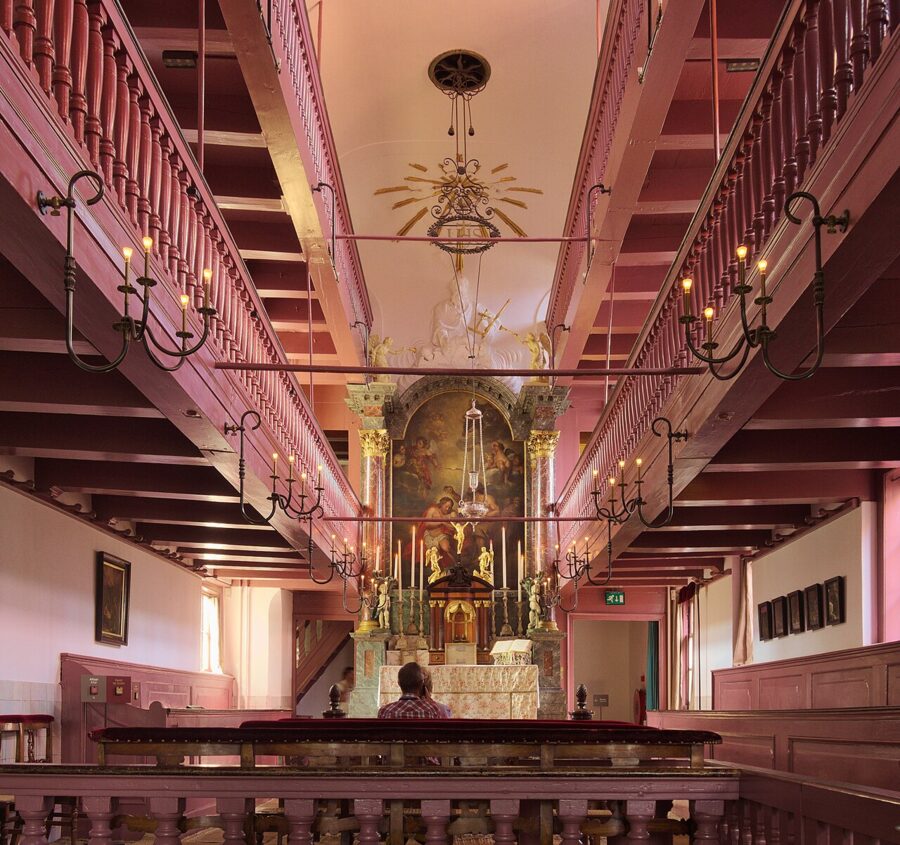
A few minutes north on the Oudezijds Voorburgwal, at number 38-40, is the best museum in the district and one of the best small ones in the city. After 1578 Catholic worship was banned in public, but private house churches were tolerated, and in 1661 a merchant named Jan Hartman bought this canal house and the two behind it and built a church for about 150 people across the top floors. Worshippers came in from the alley.
It is open daily 10:00 to 18:00 (11:00 on the first Sunday of the month from September to June), and tickets are €18 (about US$21), €7.50 for ages 5 to 17, free with the Museumkaart. Book ahead. The stairs are steep.

The museums about the trade
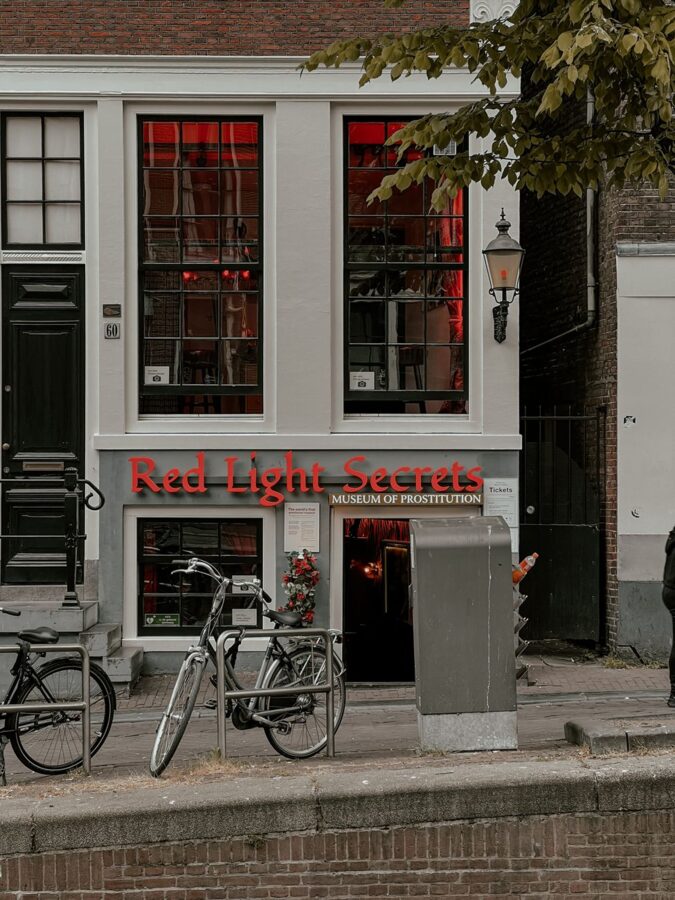
Red Light Secrets, the Museum of Prostitution at Oudezijds Achterburgwal 60, is set in a former brothel with the working rooms kept as they were, audio stories narrated by a woman who worked in the district for more than 15 years, and a window you can sit in to see the street from the other side. It is open daily from 11:00 to 01:00. It is more show than the PIC, but the window is worth the ticket.
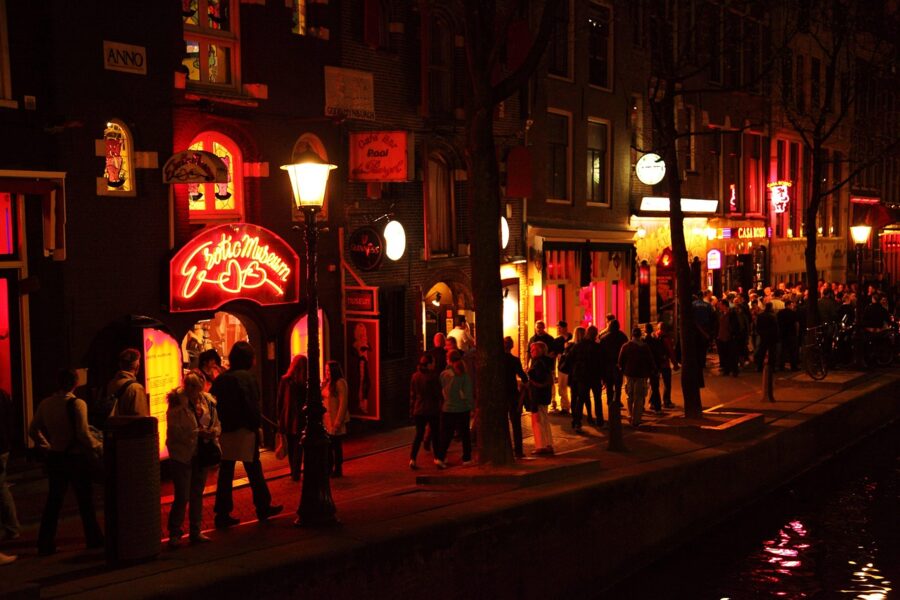
The Erotic Museum on the same canal is a few floors of erotic art and curiosities in a canal house, and the Sex Museum on the Damrak is the bigger one, on your way in from the station.
The shows
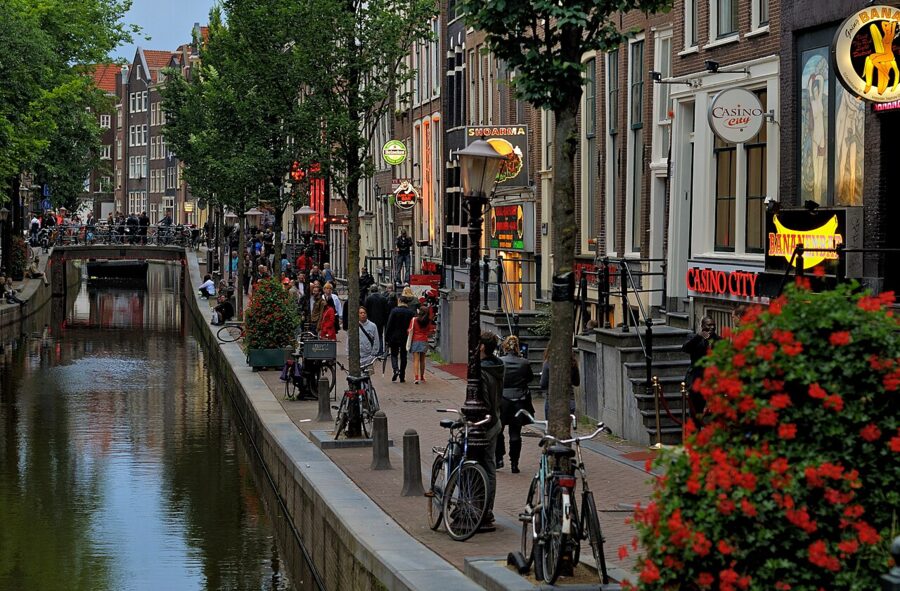
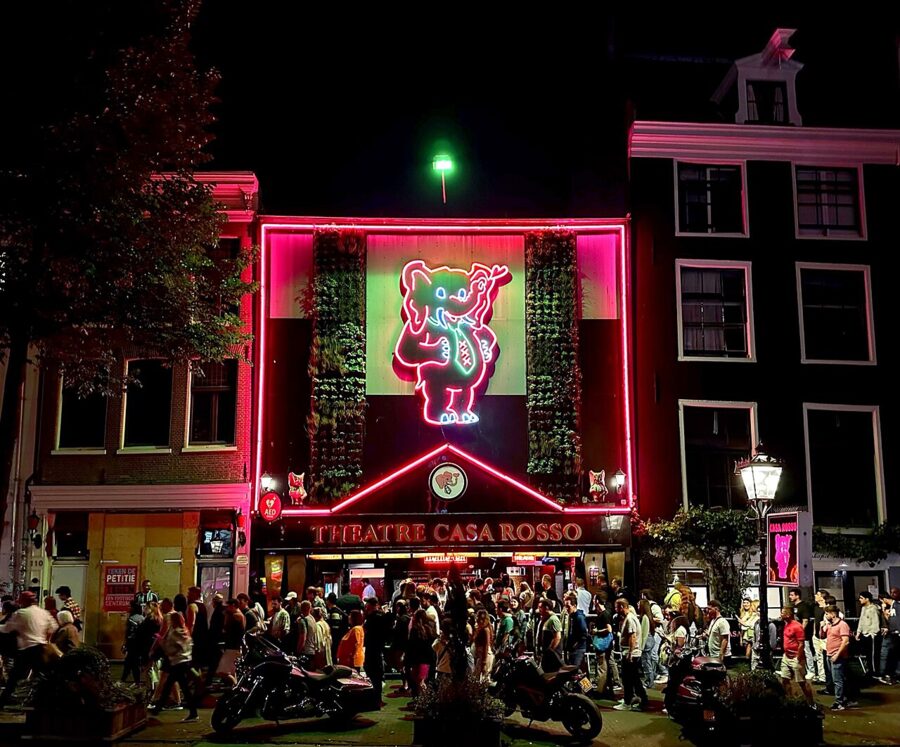
Casa Rosso is the theater with the pink neon elephant on the Achterburgwal, the best-known live show in the district. The Bananenbar and the Moulin Rouge are on the same canal. Phones stay away inside all of them; the rule is the same as on the street.

The Condomerie and the Warmoesstraat
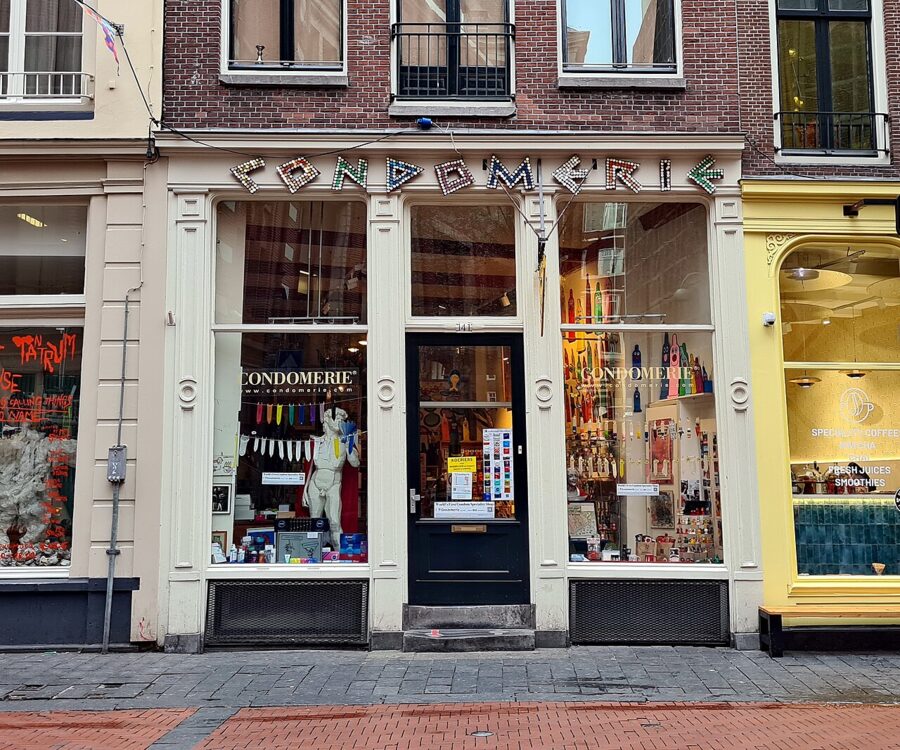
The Condomerie at Warmoesstraat 141 opened on 1 May 1987 and calls itself the world’s first condom specialty shop. It sells the serious stock (sizes, latex-free, lubricants, STI tests) alongside the novelty condoms people buy as souvenirs. The shop’s own site lists the range. The Warmoesstraat it stands on is the district’s old western street, with bars, leather bars and smartshops, and the triple-X crosses of the Amsterdam coat of arms on every bollard, which have nothing to do with what is sold around them.


Getting there, and a route
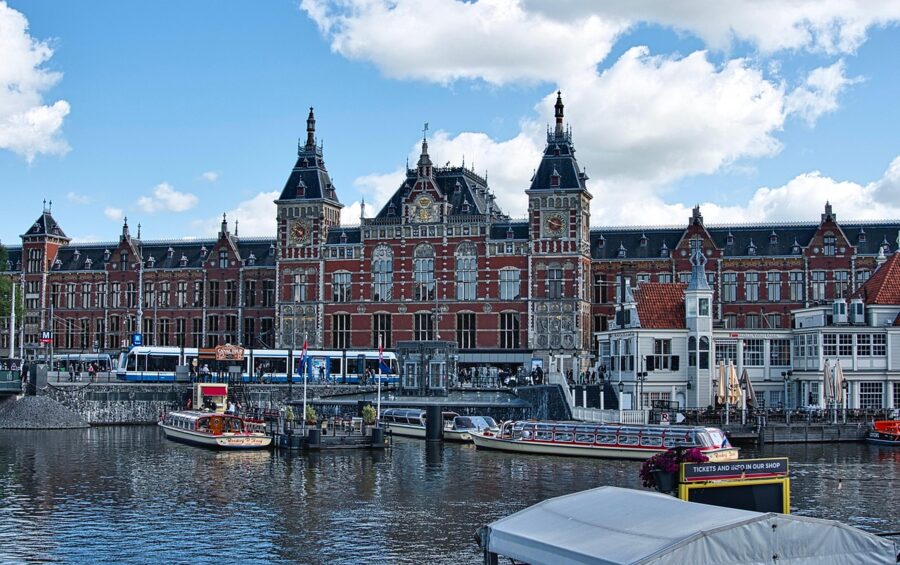
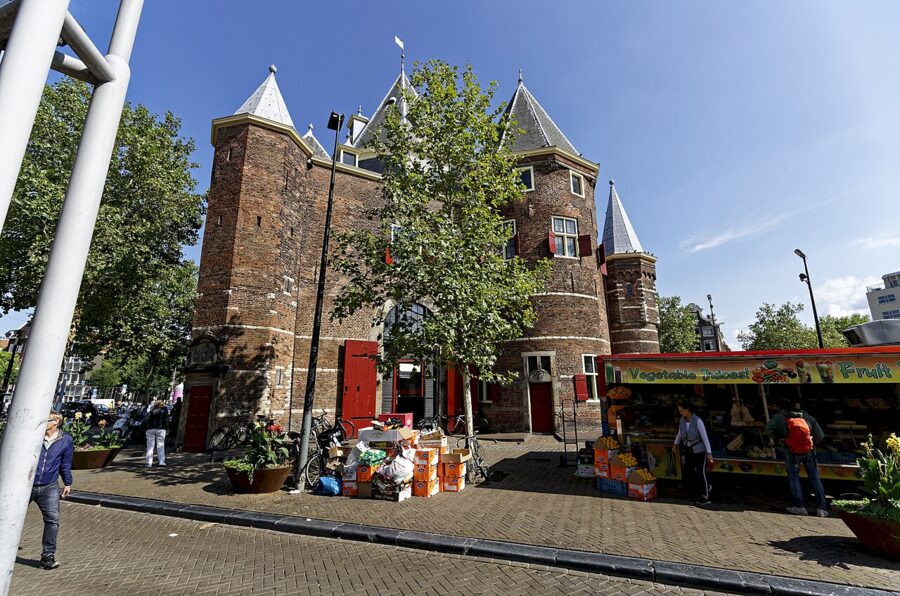
From Amsterdam Centraal it is about ten minutes on foot: cross to the Damrak, turn left into the Warmoesstraat or the Oudebrugsteeg, and you are in. The Nieuwmarkt metro station, one stop from Centraal, comes up at the east edge of the district by the Waag. Trams to the Dam stop leave you five minutes west. Do not drive; the quays are narrow and parking in the center is expensive.
A route for an hour at dusk, roughly north to south:
- Warmoesstraat from the station end, past the Condomerie at number 141.
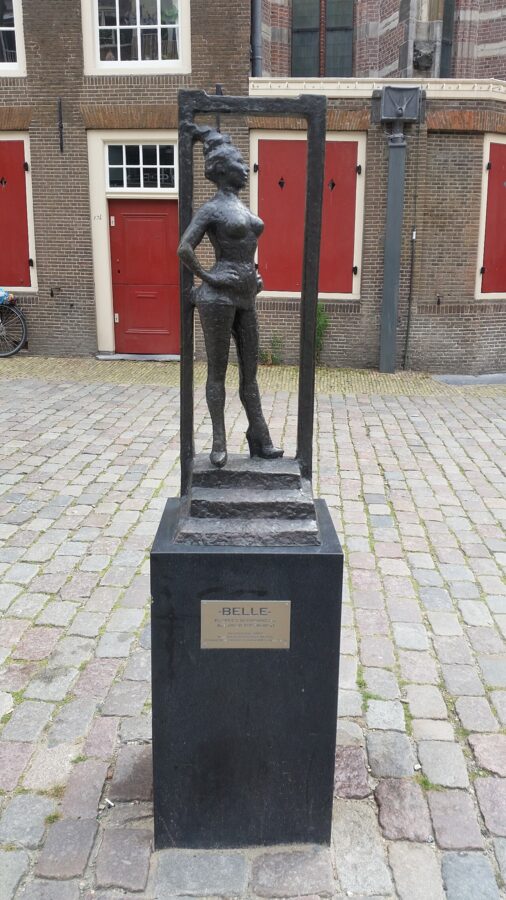
- East to the Oudekerksplein: the Oude Kerk, the Belle statue and the PIC in the Enge Kerksteeg.
- North along the Oudezijds Voorburgwal to number 38-40, Ons’ Lieve Heer op Solder (by day), then back south.
- Through one of the alleys to the Oudezijds Achterburgwal: Casa Rosso, Red Light Secrets, the Erotic Museum, the Moulin Rouge.
- South to the Damstraat and out to the Dam, or east to the Nieuwmarkt for food and the metro.

For dinner, skip the snack bars on the Damstraat. The Zeedijk and the Nieuwmarkt, at the north and east edges of the district, have the Chinese and Southeast Asian places locals use, and the Waterlooplein is one metro stop further if you want the flea market by day. For a later drink with less noise, the Rembrandtplein is fifteen minutes south on foot.

Come back to that sticker on the window. Walk the Achterburgwal once at dusk, go into the Oude Kerk in the morning, buy your drink in a bar instead of a shop, and leave the phone in your pocket every time a red lamp is in front of you.