
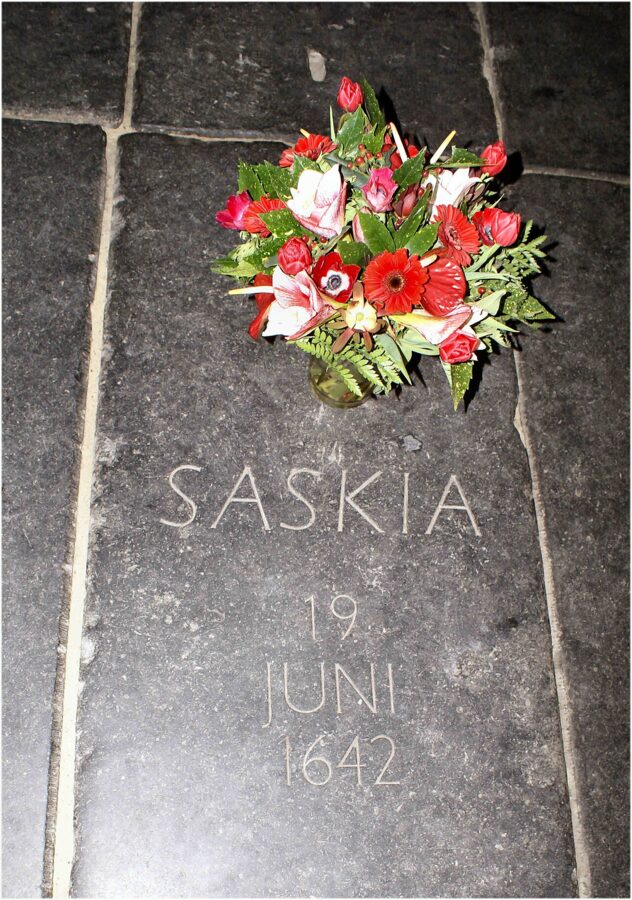
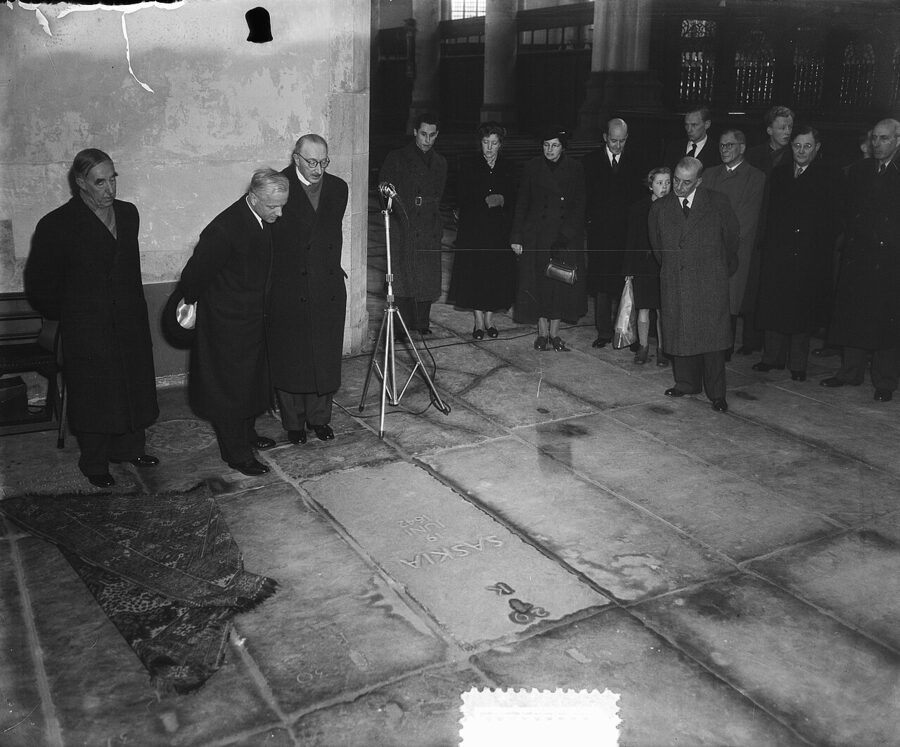
At 8:39 on the morning of 9 March, a bar of sunlight comes through a window of the Oude Kerk and lands on a plain gray floor stone. Cut into it are one name and a date: Saskia, 19 Juni 1642. The people who booked the church’s sunrise breakfast gather around it in their coats, a Rijksmuseum curator talks about Rembrandt’s family, and a few minutes later the light has moved on.
The rest of the year that stone is one of more than 2,000 in the floor, and you walk over it with everyone else. Around 60,000 people were buried under this church between the thirteenth century and 1865, which makes the oldest building in Amsterdam also one of its largest graveyards. Outside the door, on the same square, the curtains of working windows start opening from late morning.
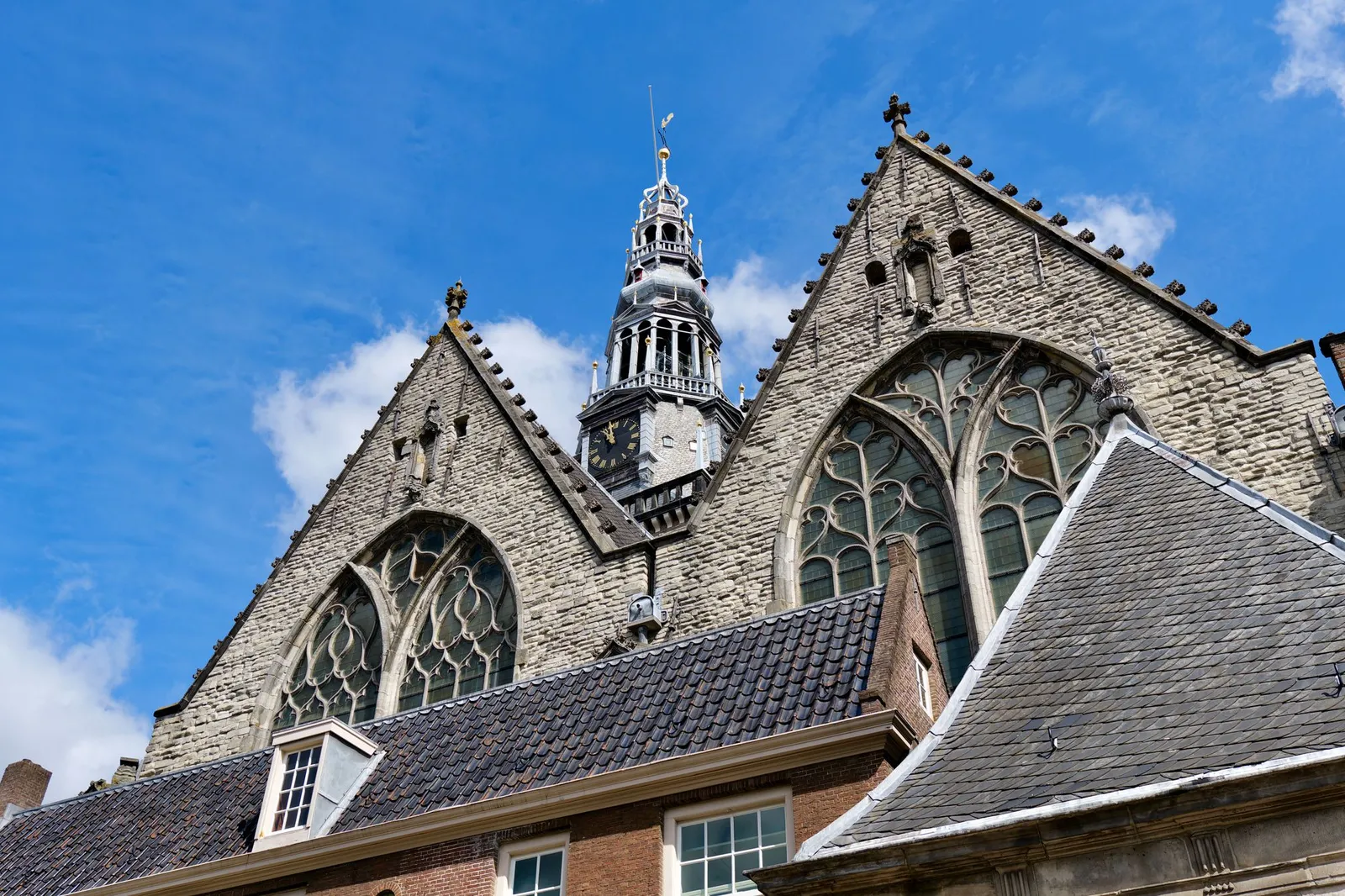
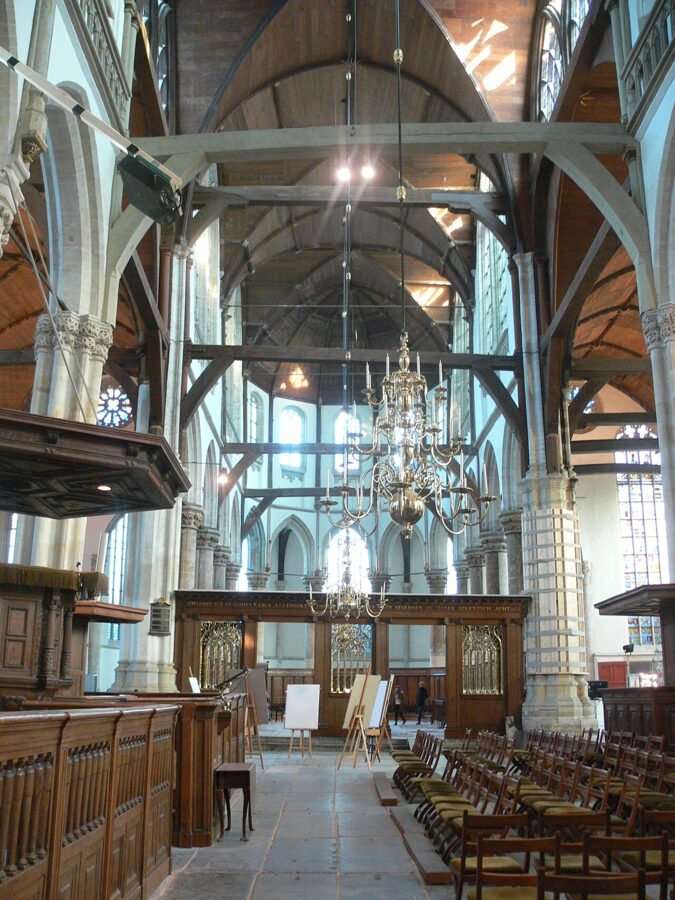
That combination is the reason to go. The Oude Kerk is a stripped Gothic hall church with a painted wooden roof, a Baroque organ that turned 300 this year and a program of contemporary art that fills the nave twice a year. A ticket costs €14.50 (about US$17) as of November 2026, the visit takes under an hour, and from late April to the end of October you can add the tower.

Tickets, hours and the best time to go
The Oude Kerk is open every day, but Sunday starts late because the building is still a working Protestant church: the congregation holds a service at 11:00 and a vesper at 18:00. Do not plan a Sunday morning visit. Weekdays before noon are the calm hours, and the church itself says Tuesday and Wednesday are the quietest days.
| What | As of November 2026 |
|---|---|
| Hours | Monday to Saturday 10:00–18:00; Sunday 13:00–17:30 |
| Closed | 27 April (King’s Day), 25 December, and a few days when exhibitions change over; 24 December closes at 17:00 |
| Adult | €14.50 (about US$17) |
| Students and ages 13–17 | €7.50 (about US$9) |
| Ages 0–12 | Free |
| Free entry with | Museumkaart, I amsterdam City Card, Stadspas, ICOM card, the church’s own Friends Pass |
| Church plus tower (tower season only) | €22 (about US$26) adult; €7.50 with a Museumkaart or City Card |
| Payment | Card and phone only; no cash anywhere, shop included |
Those are the figures on the church’s opening hours and admission page; the church’s FAQ page still shows lower, older prices, so go by the price page. Tickets are sold online and at the desk inside the door. Online tickets carry a time slot, but you can arrive any time on the date printed. Paid tickets cannot be cancelled, only moved to another day.
The ticket includes a free audio tour in Dutch, English, German, French, Spanish and Italian and a printed booklet. Follow the highlights and you are done in about 45 minutes; give it an hour and a half if the current exhibition interests you.
Photos are allowed without flash. There is no cloakroom, food and drink stay outside, and the main hall is largely wheelchair accessible, though the historic side rooms are not. A companion of a disabled visitor goes in free.

Seven centuries in one building
A chapel on a mound by the IJ
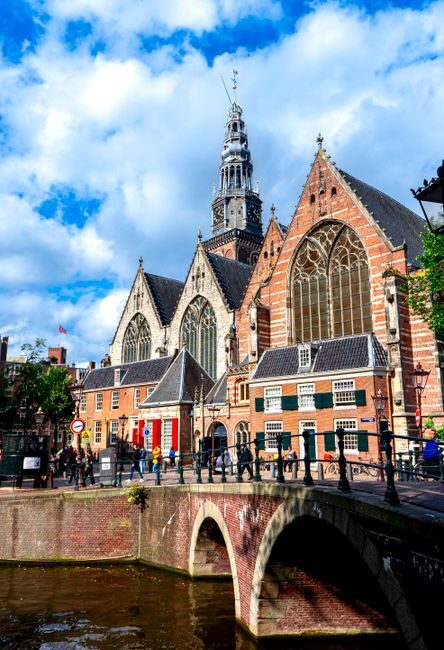
Where the Amstel met the IJ, the river dropped its clay and built up low banks. In the thirteenth century the first people of Amsterdam put a small wooden chapel on one of them, with a cemetery around it, and the church’s own account dates that chapel to around 1250. The stone building that replaced it was consecrated on 17 September 1306 by the Bishop of Utrecht and dedicated to Saint Nicholas, patron saint of sailors, which in a harbor town was the obvious choice.
For a century it was simply the church of Amsterdam. Then the town outgrew it, a second parish church went up on the other side of the Damrak, and when that one was consecrated in 1409 people started calling it the Nieuwe Kerk, the New Church, on what is now Dam Square. Saint Nicholas’s became the Oude Kerk, and the whole eastern half of the medieval city became the Oude Zijde, the old side. That is where De Wallen gets its official name.
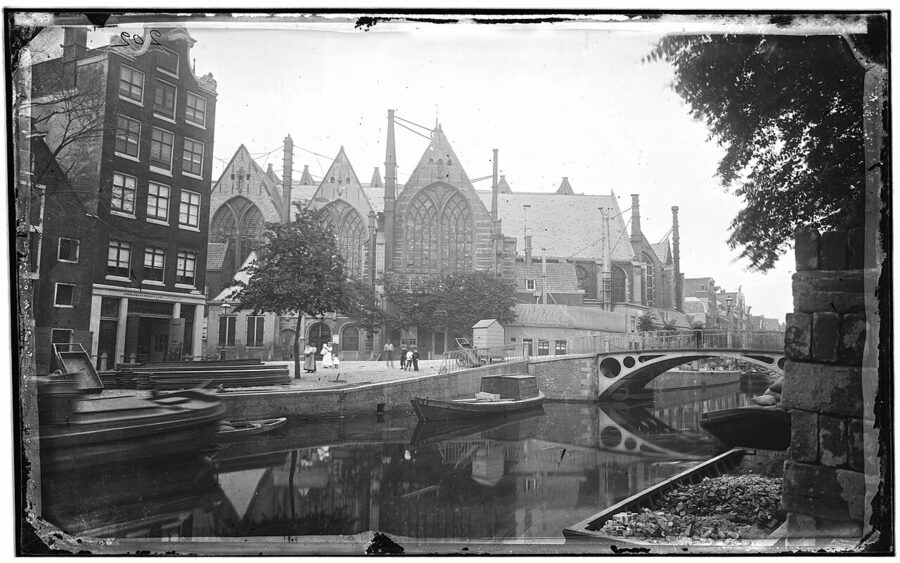
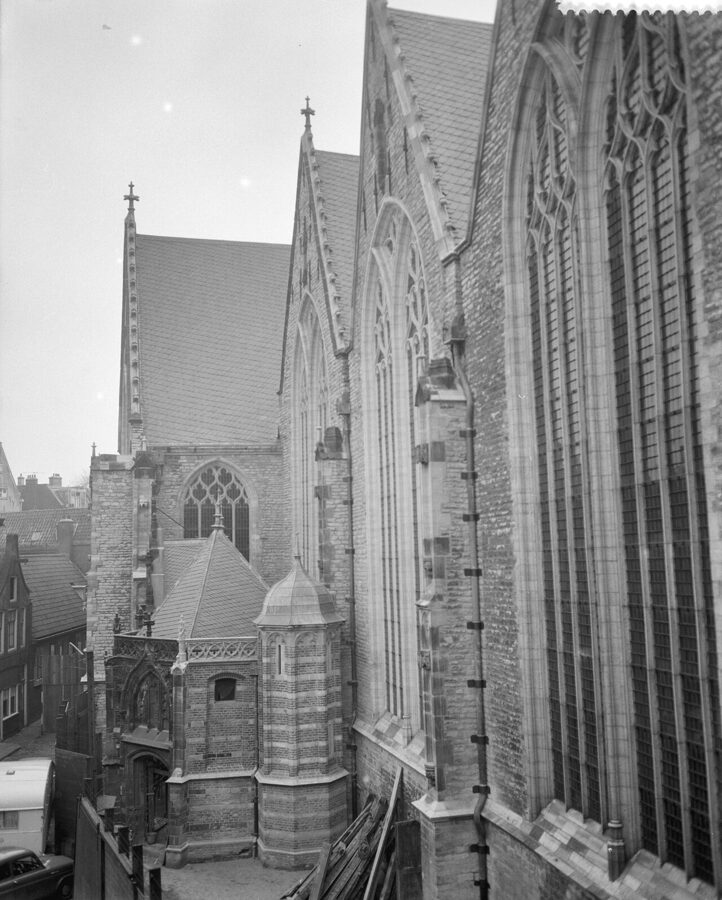
The church grew in stages for 250 years. Aisles were widened until they matched the nave, a choir and ambulatory were added at the east end, chapels sprouted on both sides, and in the sixteenth century the nave was raised with a clerestory to let in more light. The Lady Chapel, the last big addition, went up in 1552. The result is a hall church covering about the area of half a football field, unusually wide for its height, which is exactly what you feel when you walk in.
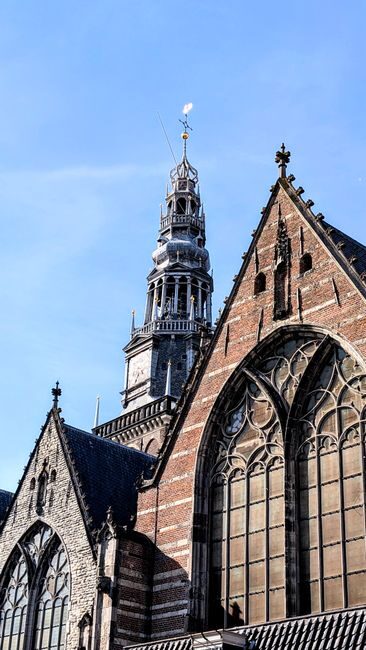
The national monuments register lists it as rijksmonument 3990, a Gothic church of the fourteenth to sixteenth centuries, registered on 27 August 1970.
1566, 1578 and the empty church
In August 1566 the iconoclasm that swept the Low Countries reached Amsterdam, and the Oude Kerk lost altars, paintings and statues to the crowd. Worse came on 26 May 1578, when the Catholic city council was deposed in the Alteratie and Amsterdam turned Protestant. What was left of the Catholic church was taken out: statues smashed, altars removed, images painted over, the church silver stolen or melted down.
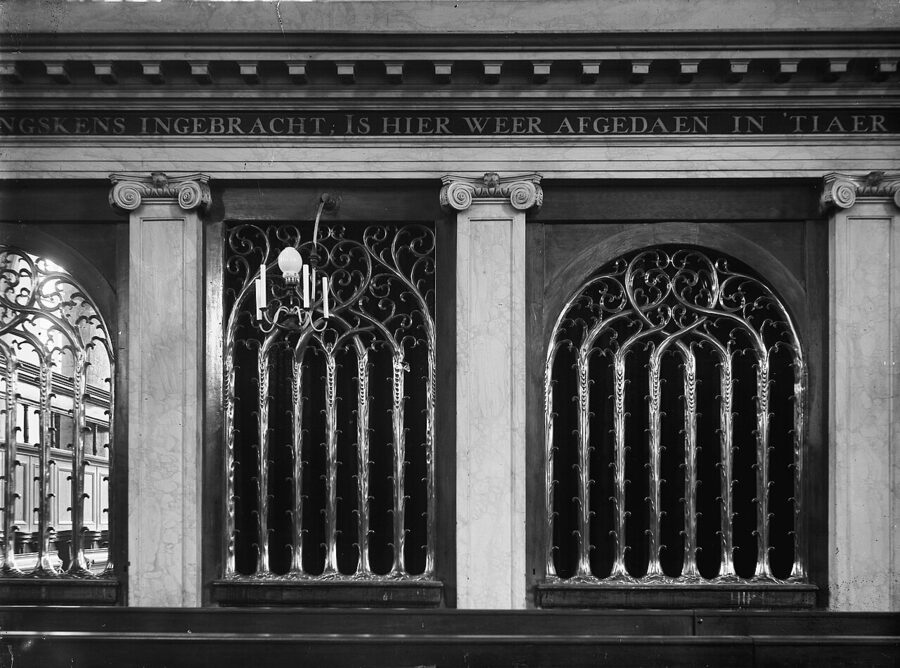
The new owners said so in writing. Over the choir screen runs an inscription in old Dutch which the church translates as “The misuse, gradually brought into God’s church, was here again undone in the year seventy-eight.” From then on the building was for preaching, and it still is.

Being empty made the Oude Kerk useful. Fishermen mended nets and sails in it, merchants did business in the aisles until the city gave them an exchange in 1611, couples signed marriage registers in a side room, and for centuries the city’s most important papers were locked in the Iron Chapel. Among them was the toll privilege of 27 October 1275, the oldest surviving document to name Amsterdam, which is why the city celebrates its birthday on that date. The documents moved to the city archives in 1892.
Closed in 1951
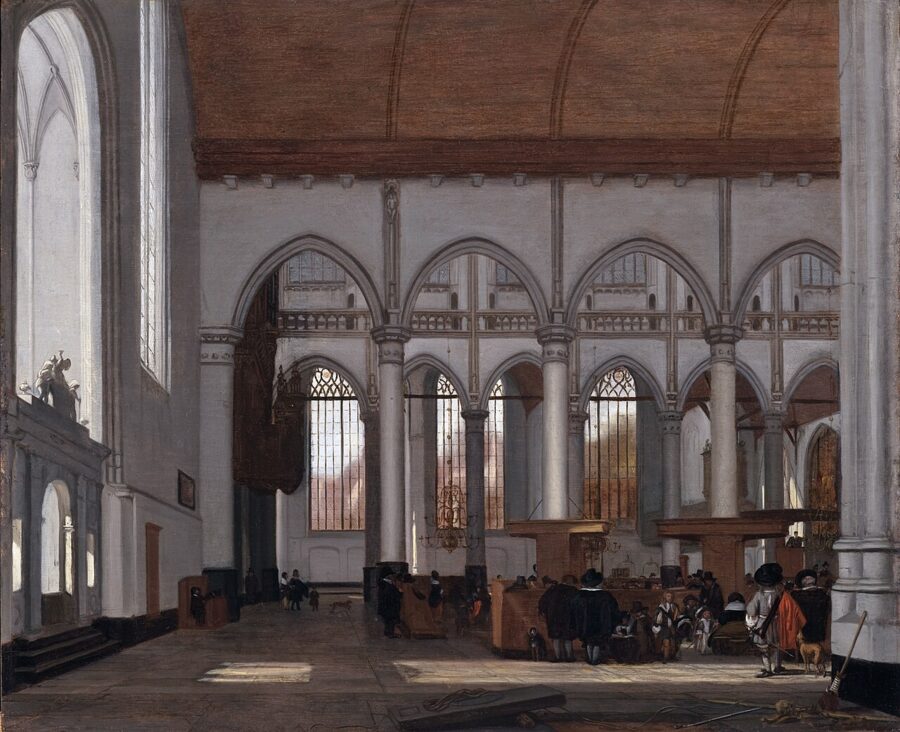
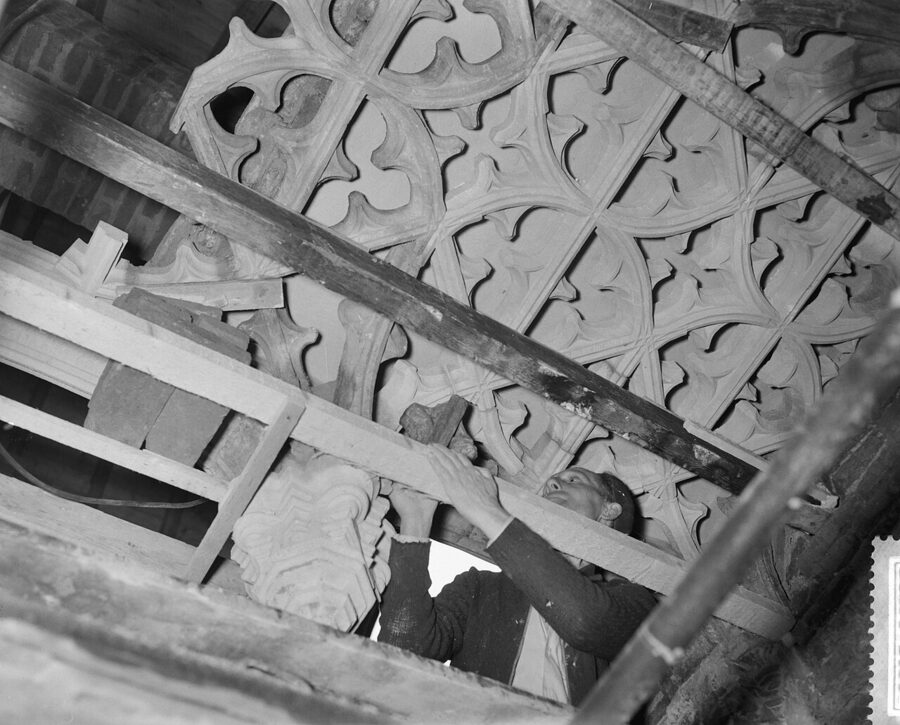
Building a big church on soft ground has a price, and in 1951 the Oude Kerk was shut because its foundations were failing. The restoration that followed ran for more than two decades. It also produced the biggest surprise in the building’s history: in 1956, when restorers began stripping the layers of paint from the wooden vaults, they found medieval paintings underneath that nobody had known existed. The church reopened fully restored in 1979, and restoration has never really stopped since.
What to look at inside
The painted wooden vault
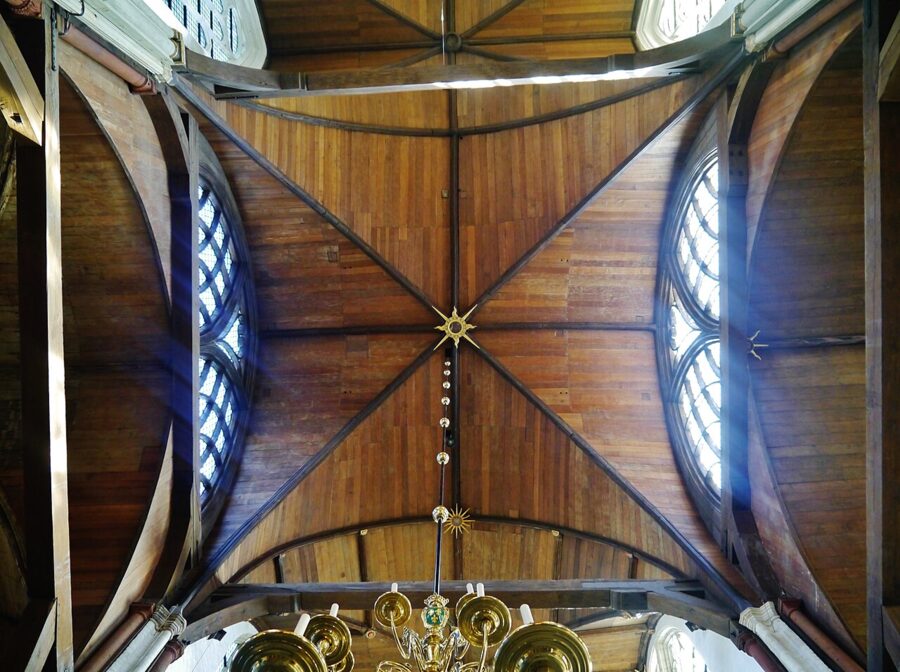
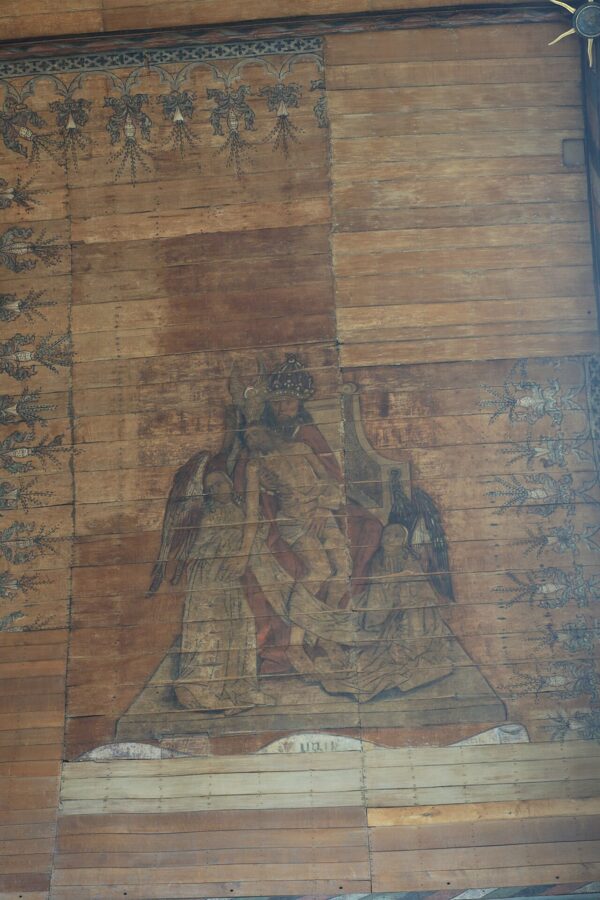
Start by looking up. The roof over the nave, aisles and chapels is a series of wooden barrel vaults, planks laid on curved ribs, and on many of the boards you can make out paintings from around 1500: saints, Bible scenes, coats of arms and the marks of the guilds that paid for them. The church’s open archive entry on the ceiling paintings describes the 1956 find.
The paint is faded and patchy, and that is part of the point. These are the images the Protestants could not reach with a ladder in 1578, and later simply covered.

The wood is also part of the sound. The church is known for its acoustics as much as for its organs, and it builds a whole music program on them.
The floor of graves
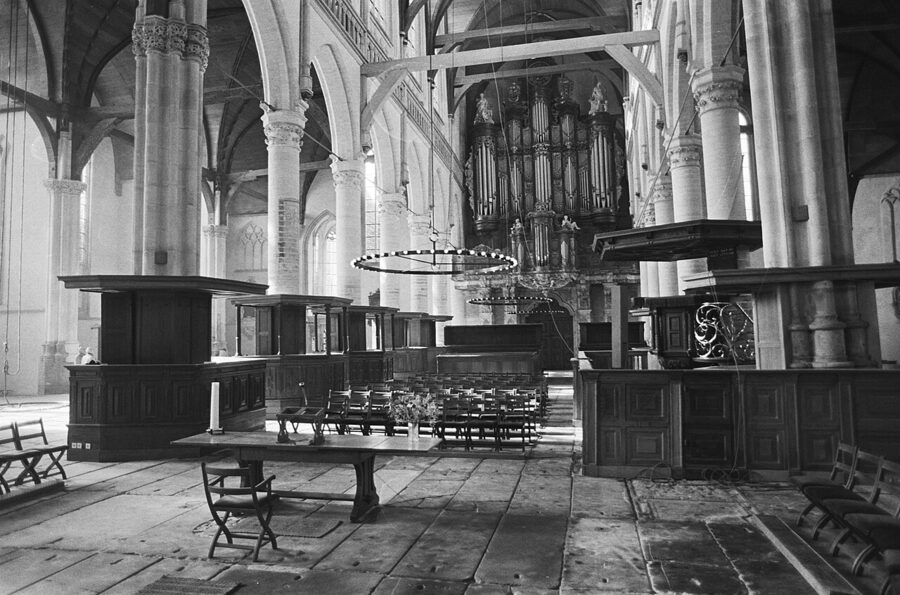
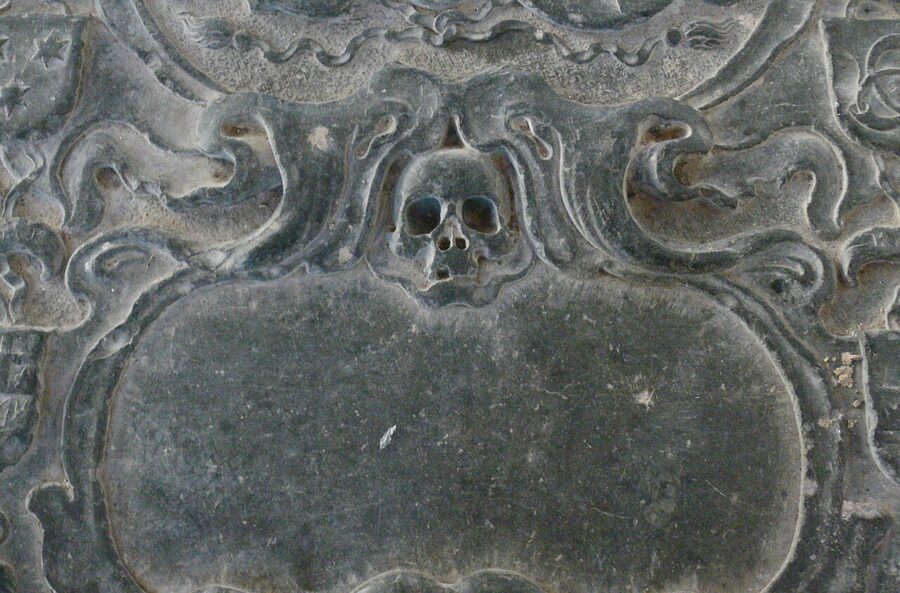
Then look down. The church was built on a cemetery and kept burying people inside it until 1865, so the floor is almost entirely gravestones: more than 2,000 of them over roughly 60,000 burials. Mayors, merchants, seafarers and artists lie here, and many stones carry nothing but a number, a family mark or a carved skull. Graves were bought, sold and reused, as Rembrandt’s own story shows.

The grave most people look for is Saskia Uylenburgh’s. She came from a wealthy Frisian family, married Rembrandt in 1634 (he signed the marriage notice in the church’s Mirror Room), modeled for many of his paintings and had two sons baptized here, one of them Titus. She died of tuberculosis at 29 and was buried on 19 June 1642.
The church’s record of the grave places it as number 29 in the Weitkoperskapel, near the small transept organ on the north side. Rembrandt bought the grave, and in 1662, broke, he sold it to pay for the burial of Hendrickje Stoffels.
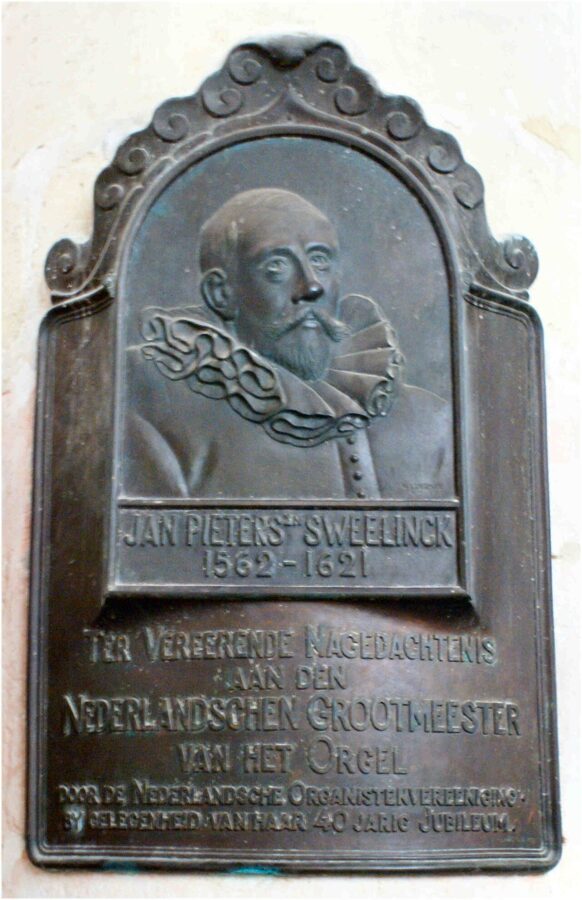
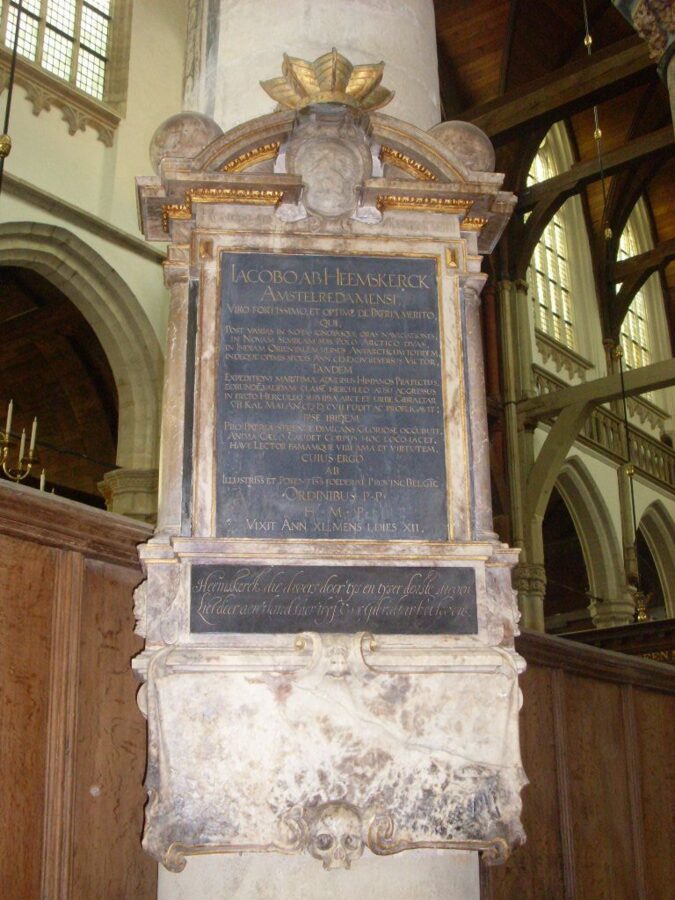
Jan Pieterszoon Sweelinck, the composer who was organist here for more than forty years and died in 1621, lies under stone 99 in the choir ambulatory, with a bronze memorial on the wall. The admiral Jacob van Heemskerck, who wintered with Willem Barentsz on Novaya Zemlya in 1596 and 1597 and was killed fighting the Spanish fleet off Gibraltar in 1607, has a full wall monument. In the Lady Chapel lies Jacob Matroos Beeldsnijder, son of a senior official in Suriname and an enslaved woman, freed by his father in 1781; as far as the church knows, he is the only Black person buried in the building.

The church does not hide the money behind some of these stones. Its own history notes that the building grew partly on the profits of the trading companies of the Golden Age, and that families named on its windows, graves and panels were involved in slavery. That thread runs through several of its recent art commissions.
The stained glass
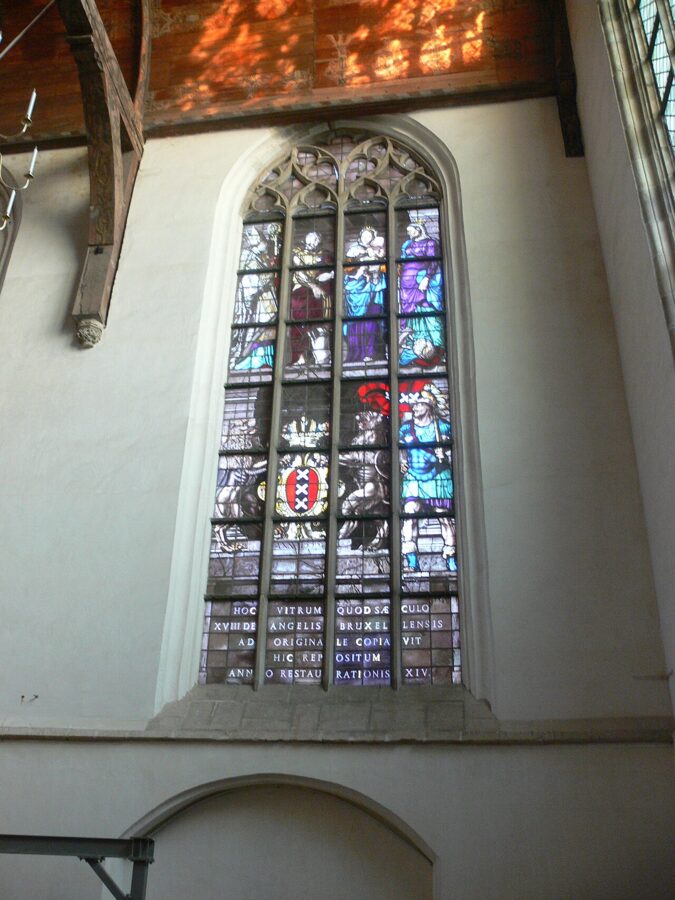
Most of the medieval glass went in the sixteenth century, but the windows of the Lady Chapel survived, possibly because the chapel was out of the way. They date from 1555, and the east window, designed by Dirck Crabeth of Gouda, shows the death of Mary. After 1578 the haloes of the saints were removed so they would no longer read as saints, which is the kind of edit you only notice once someone points it out.
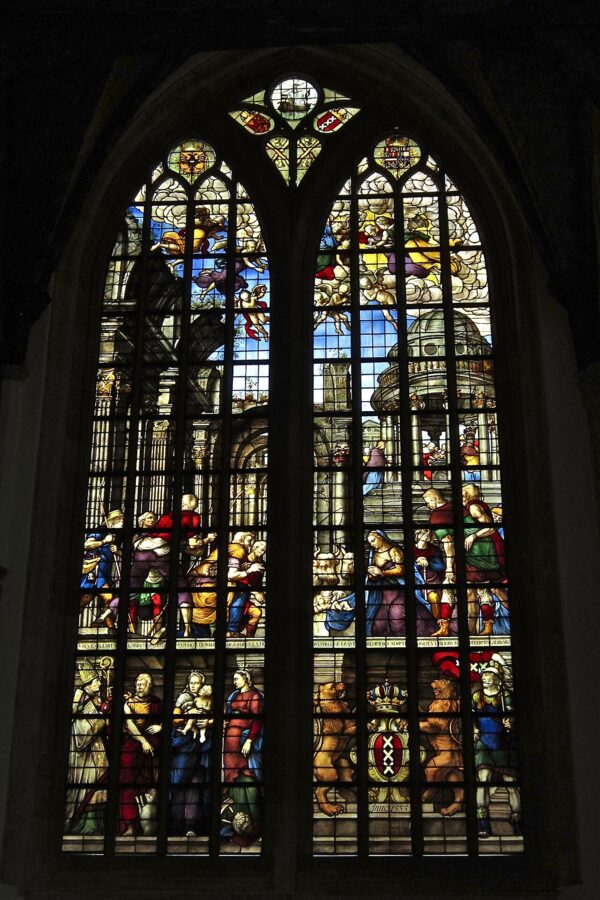

The church’s restoration page tells that story, and the reinstalled windows are why the Oude Kerk can be seen without scaffolding for the first time in years. Elsewhere, later windows carry the painted coats of arms of Amsterdam’s mayors. The children’s trail handed out at the entrance sends young visitors hunting for them.

The organs
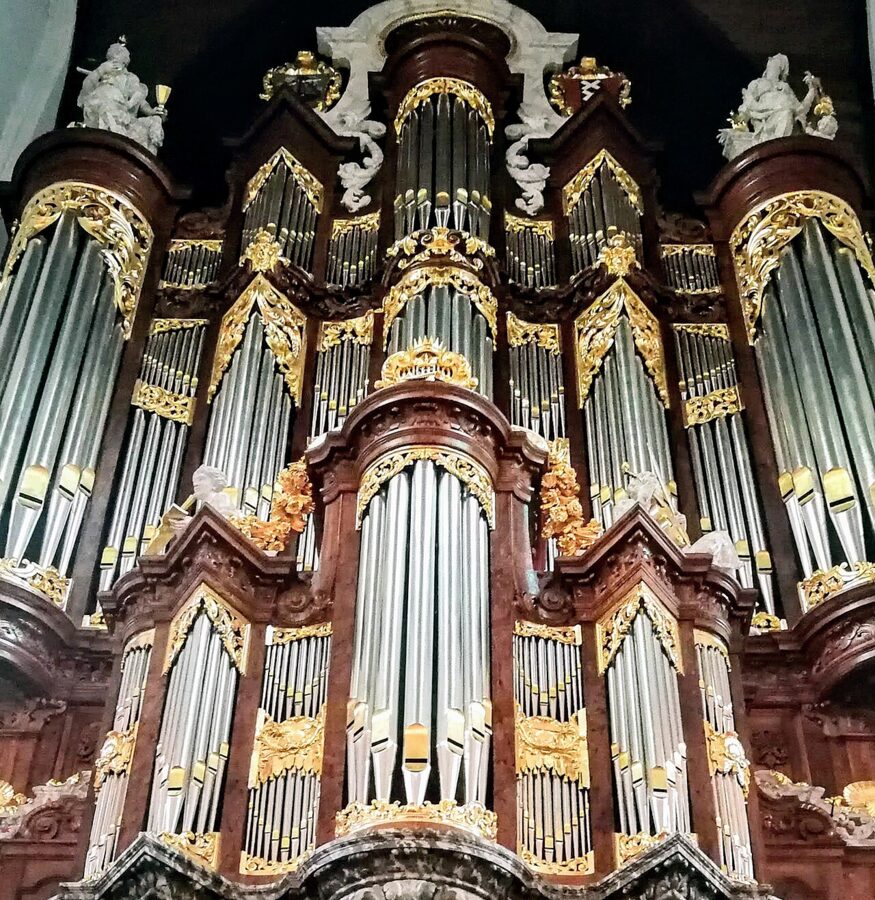
The great organ on the west wall was built by Christian Vater of Hamburg from 1724, inspected on 30 September 1726 and played for the first time that October, which is why the church spent 2026 celebrating its 300th year. It replaced the earlier instrument Sweelinck had played. Within a few years it had to come down again, because the church tower was subsiding badly, and when Johann Caspar Müller put it back he enlarged it, so it carries both names.
Later hands changed it again. In 1869 and 1870 C.G.F. Witte gave it new keyboards and action and altered its pitch and voicing for Romantic music, and that rebuild started a long Dutch argument about how far a historic organ should be restored.
The firm Reil restored it between 2015 and 2019, keeping as much as possible of every century’s work, and it has been back in use since May 2019. The resident organist is Matteo Imbruno.

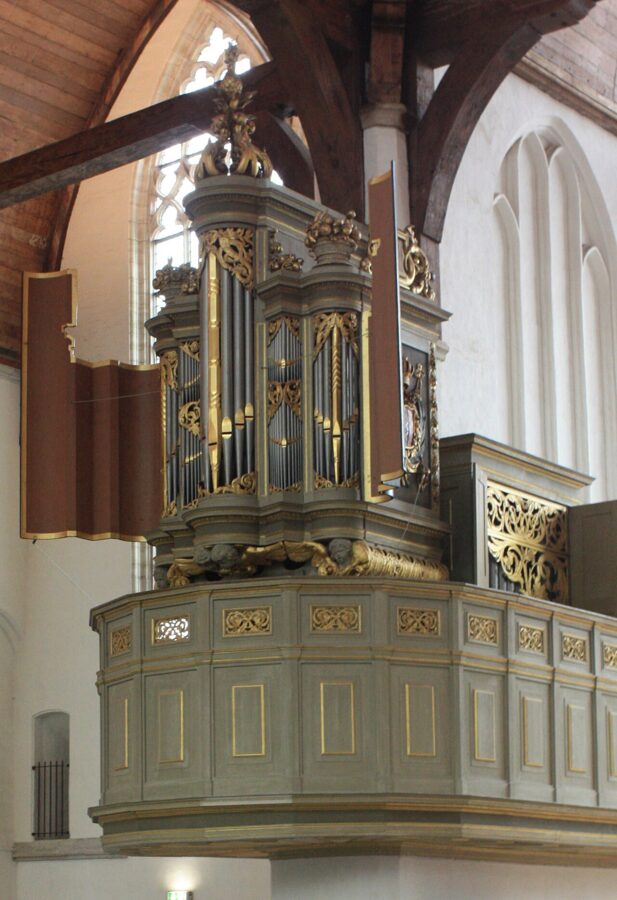
The smaller organ in the transept, the one above Saskia’s grave, is a 1965 instrument built inside an older case. Both are used in the Monuments concert series, which brings in organists from the Netherlands and abroad, and in the Silence morning concerts.

Choir stalls and side rooms
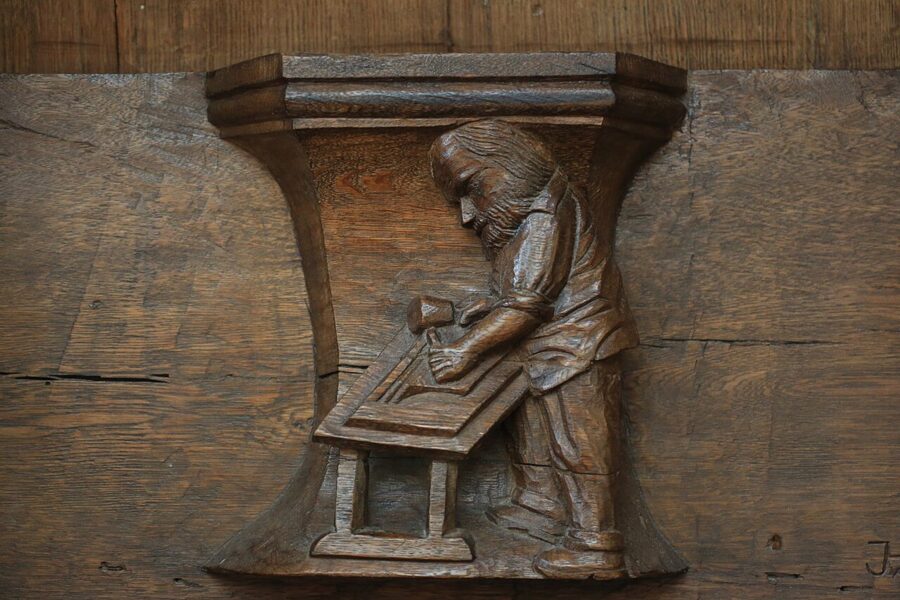
In the choir, look under the seats of the oak stalls. The misericords, the small ledges the clergy leaned on during long services, are carved with small figures and scenes of everyday life. The stalls are among the few pieces of the Catholic church’s furniture that came through 1578.

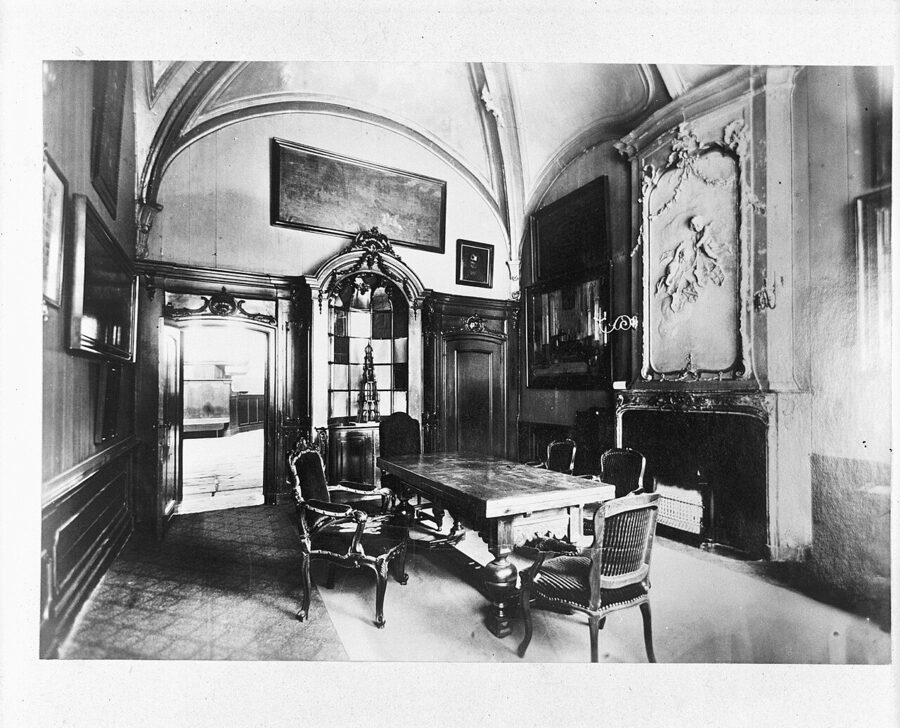
Around the church are period rooms with objects from the archive. The Mirror Room, where Rembrandt signed his marriage notice, is lined with eighteenth-century painted wall hangings of flowers and birds, restored in public and reopened in February 2023. The Church Warden’s Office has an Emanuel de Witte view of the nave.

The Iron Chapel, empty since 1892, now holds Navid Nuur’s NN XXX: one hundred earthenware vases rolled along the facades and bridges of the city and glazed with ash, canal silt and shells from the IJ.
One vase leaves the chapel every 27 October for auction, and the money pays for future art commissions until 2125. The first sold in 2025 for €13,001 (about US$15,000); bidding on the second closes on 5 December 2026 at 17:00.
The art program, and what is on now
The Oude Kerk has become one of the city’s serious places for contemporary art. It commissions two large new works a year from artists who make them for this building, and past commissions include Meredith Monk, Ibrahim Mahama, Christian Boltanski and Kimsooja.
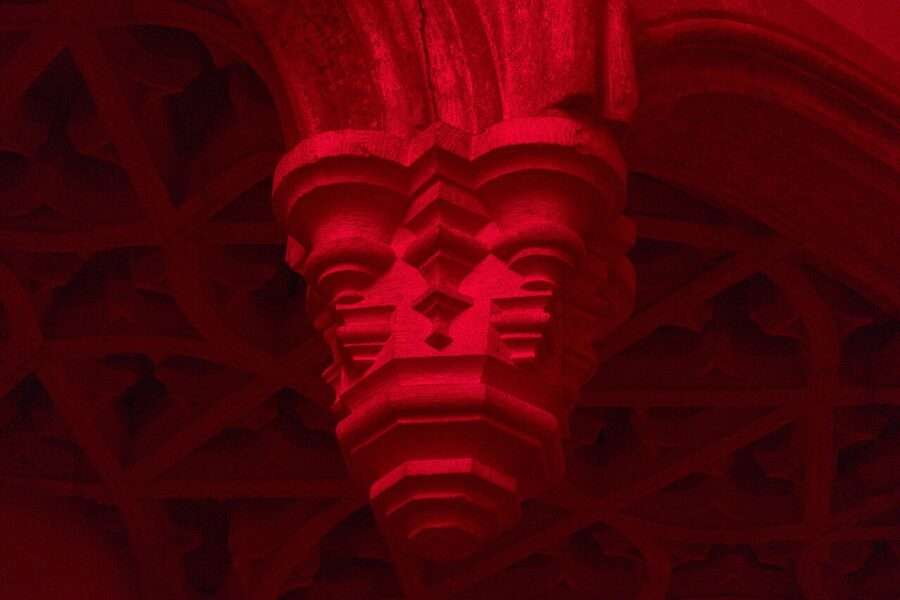
A few pieces have stayed. In the Holy Sepulchre chapel, the Italian artist Giorgio Andreotta Calò’s window of 2018 floods the room with red light. It is meant to recall the church’s Catholic past, and it is hard not to think of what is outside the door.

Until 7 March 2027 the nave holds Mire Lee: Vomit My Blessing, five works by the South Korean artist born in 1988, who made the Hyundai Commission for the Turbine Hall at Tate Modern in 2024. She builds moving structures out of silicone, steel, motors and liquids, and here they are spread through the church like skin and organs, so the building itself starts to feel like a body. Lee calls the work sensual and unsettling, and in a church whose floor is a graveyard the idea fits. Check the closing date before a March visit: the church lists both 7 and 14 March.
Free 15-minute walk-in tours of the show run every Saturday and Sunday, in Dutch at 14:00 and in English at 15:00, with no booking needed beyond a valid ticket. Register at the desk before the start.
Music is the other half of the program. The Silence series puts a morning concert in the church on the first Friday of each month at 8:00, with the audience free to walk around the building as Sweelinck’s listeners once did; the next one, Silence #74, is on 4 December 2026. The Sound Walk between 23 and 27 December has the resident organist at the Vater-Müller organ for 45 minutes on four afternoons while you walk through the exhibition, free with admission. The church is closed on Christmas Day.
Climbing the tower
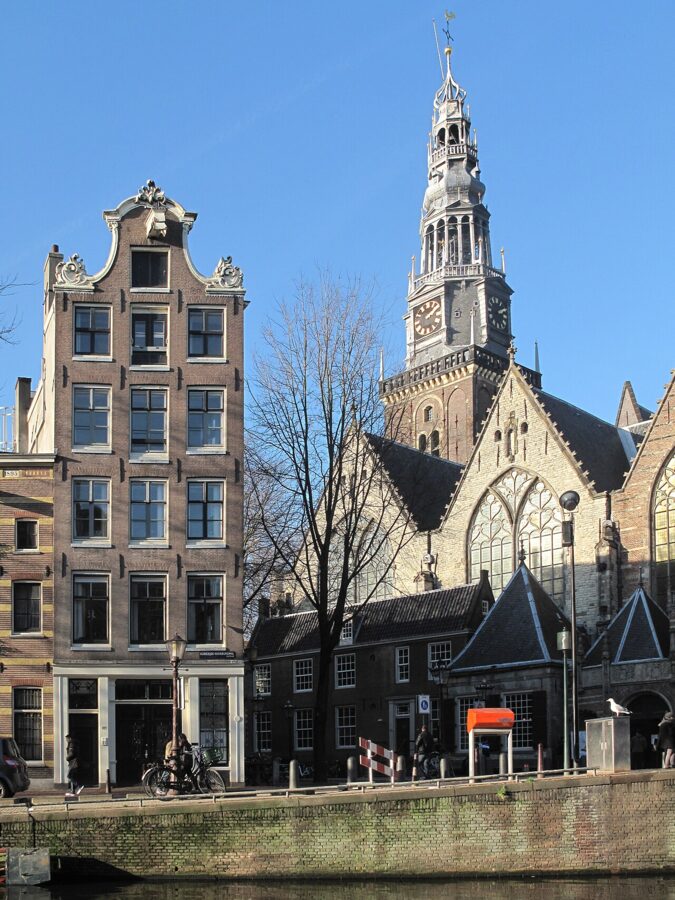
At 67 meters, the tower is the oldest viewpoint in the city. The first tower was finished in 1325 at about half today’s height. Bells were hung in 1510, the tower was raised about half a century later because the higher nave was swallowing both the view and the sound, and it reached its present form in the 1730s, after the subsidence that forced the organ down.
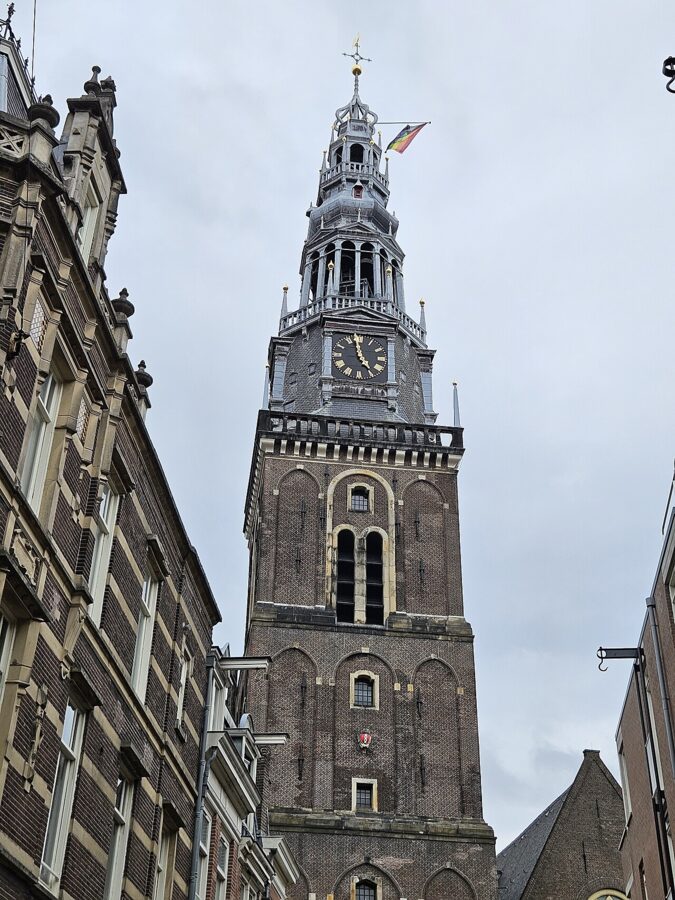

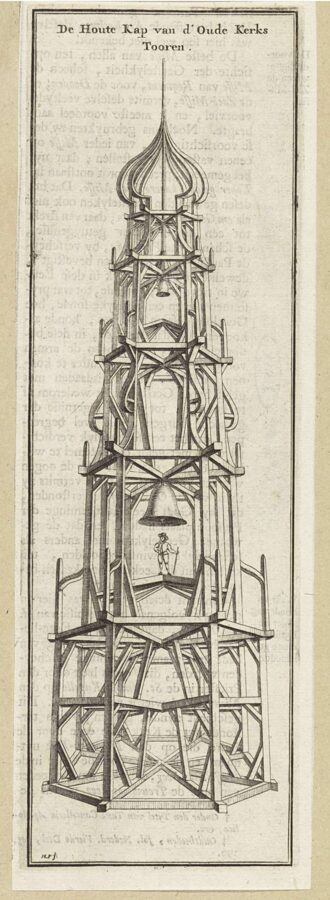
Climbs are guided only, from late April to the end of October, Wednesday to Sunday. On Wednesday to Saturday tours start at 13:00, 14:00, 15:00 and 16:00; on Sunday each start is half an hour later. In 2026 the season ran from 25 April to the end of October, and the dates for 2027 had not been published as of late November. The tower ticket is only sold with church admission: €22 for an adult, €7.50 if your Museumkaart or City Card already covers the church, and children under six are not allowed up.
The tower visitor conditions are worth reading before you buy: 155 steps, narrow rooms, steep stairs, a minimum height of 1.20 meters and sensible shoes. Places per tour are limited, so book a slot ahead on summer weekends.
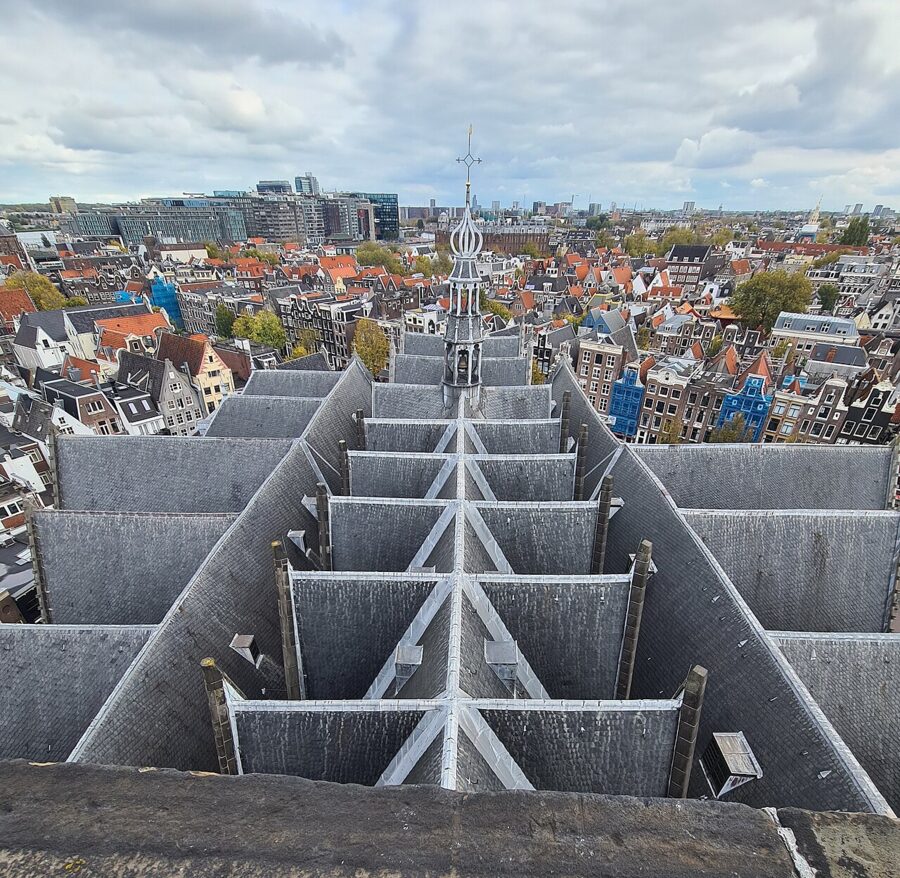

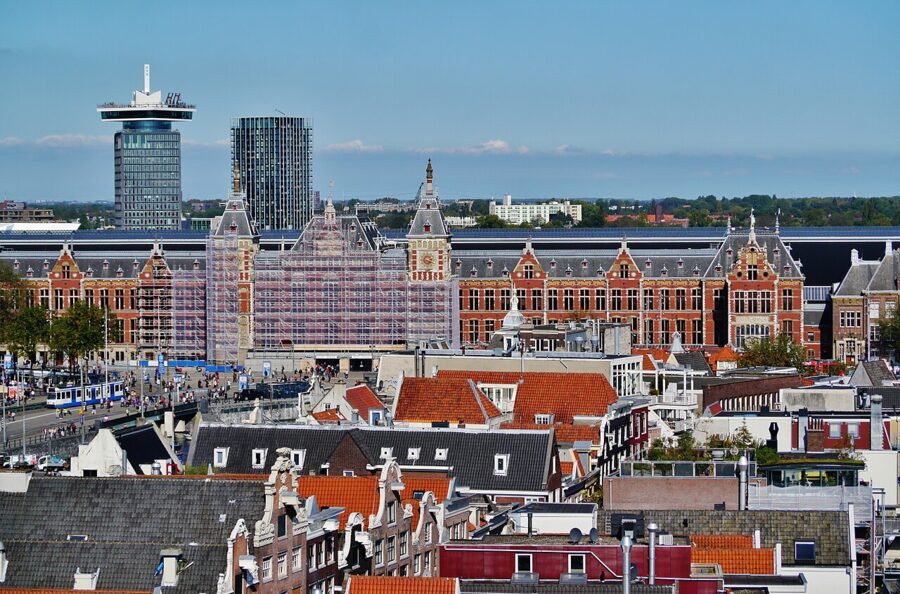
Is it worth the extra €7.50? Yes. It is the best view over De Wallen there is, it takes in Centraal, the IJ and the Waag on the Nieuwmarkt, and it is the one place in the district where pointing a camera at the rooftops bothers nobody.

The square around the church
The Oudekerksplein is not really a square but a ring of narrow pavement around the church, lined with small houses, and some of their ground floors are working windows. Nowhere else in Amsterdam puts a church door and a red-lit window so close together, and the pairing is the picture of De Wallen every photographer wants. It is also the picture you are least welcome to take.
The rule is simple: no photos or video of the windows or the women in them. Sex workers and the doormen enforce it themselves, and quickly. Shooting the church tower, the canal or the statue is fine; a phone pointed at an open, lit window is not, and that includes filming yourself walking past. The full set of rules, fines and manners for the area, from the street cannabis ban of 25 May 2023 to the bar hours, is in the Red Light District guide.
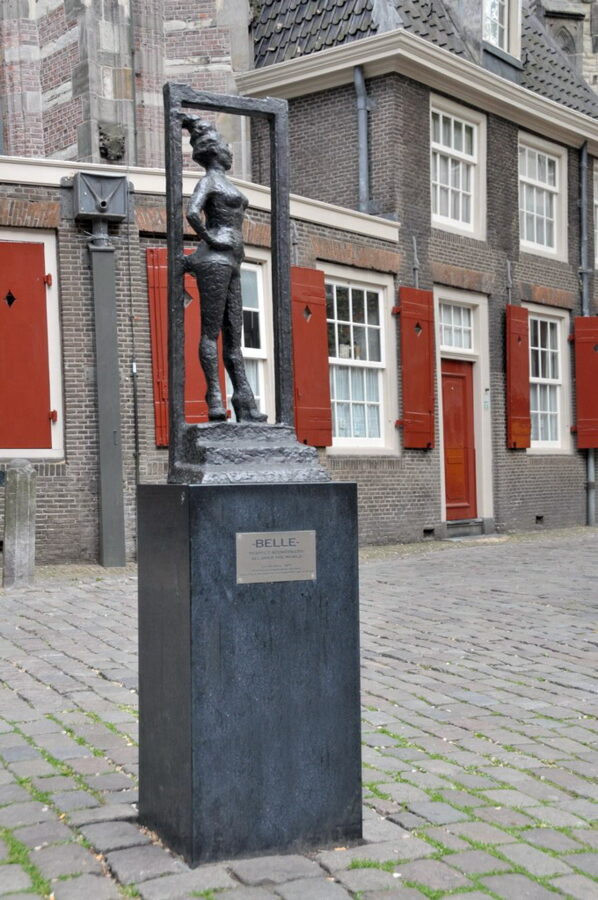
Two things on the square answer the windows. Belle, a bronze of a woman standing in a doorway with her hands on her hips, was made by Els Rijerse at the request of Mariska Majoor of the Prostitution Information Centre and unveiled in 2007. Her plaque reads “Respect sex workers all over the world”, and she is the one figure in a window frame here you may photograph.

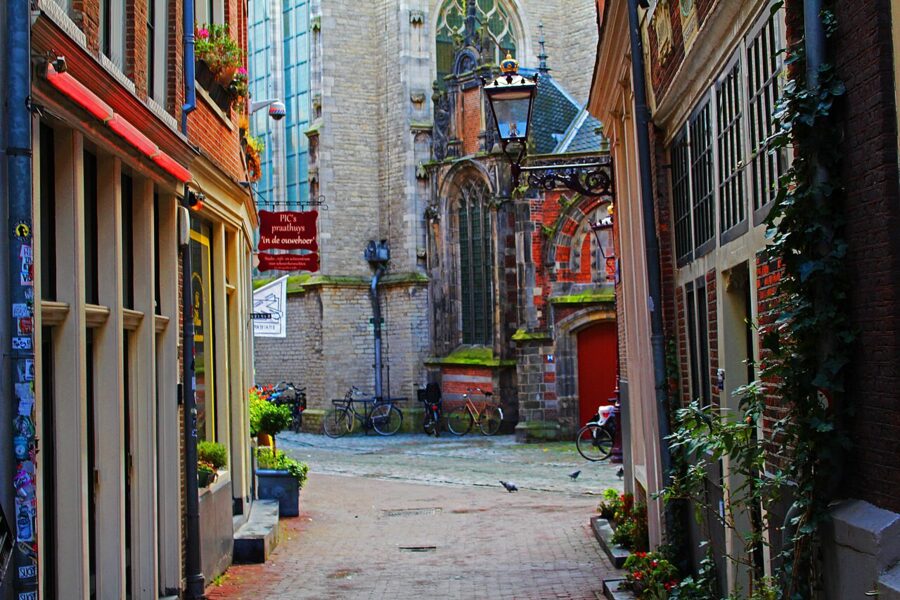
The other is the Prostitution Information Centre itself, at Enge Kerksteeg 3, the alley off the square. It is open Wednesday to Saturday from 12:00 to 17:00 as of November 2026, with a Walk ‘n Talk at 17:00 on open days, and it is the place to ask the questions you would never ask through glass. Visit the church in the morning and the PIC after lunch and you have the two halves of the square.

For a coffee, the church’s own café, De Koffieschenkerij, is in the former sacristy at Oudekerksplein 27, with a courtyard garden that is the calmest seat in the district. It opens daily from 09:00 to 18:00, and an Oude Kerk ticket gets you 10 percent off drinks. The museum shop by the entrance keeps church hours and needs no ticket.
Getting there, and what is next door
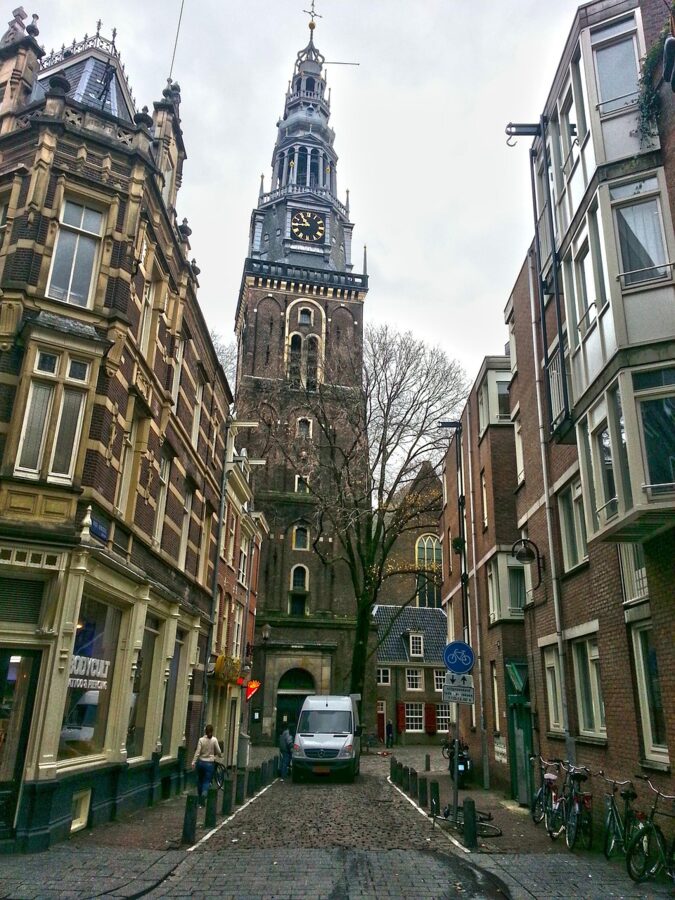
The Oude Kerk is an eight-minute walk from Amsterdam Centraal. Cross the Prins Hendrikkade, follow the Oudezijds Voorburgwal south from its head at the Zeedijk end, and the tower is in front of you the whole way. The entrance is on the Oudekerksplein, between the Warmoesstraat and the canal.

By metro, lines 51, 53 and 54 stop at Nieuwmarkt, five minutes’ walk east, and line 52 stops at Rokin, a similar walk west.
Trams stop at Dam and at Nieuwezijds Kolk, both a few minutes away on foot; GVB reshuffled its routes in March 2026, so check the line number in the app. The church’s directions page also lists the Culture Ferry, a small boat route through the eastern center that stops here, with tickets sold separately. Do not drive. If you must, the nearest garage is the Q-Park under the Bijenkorf, entrance at Beursplein 15.
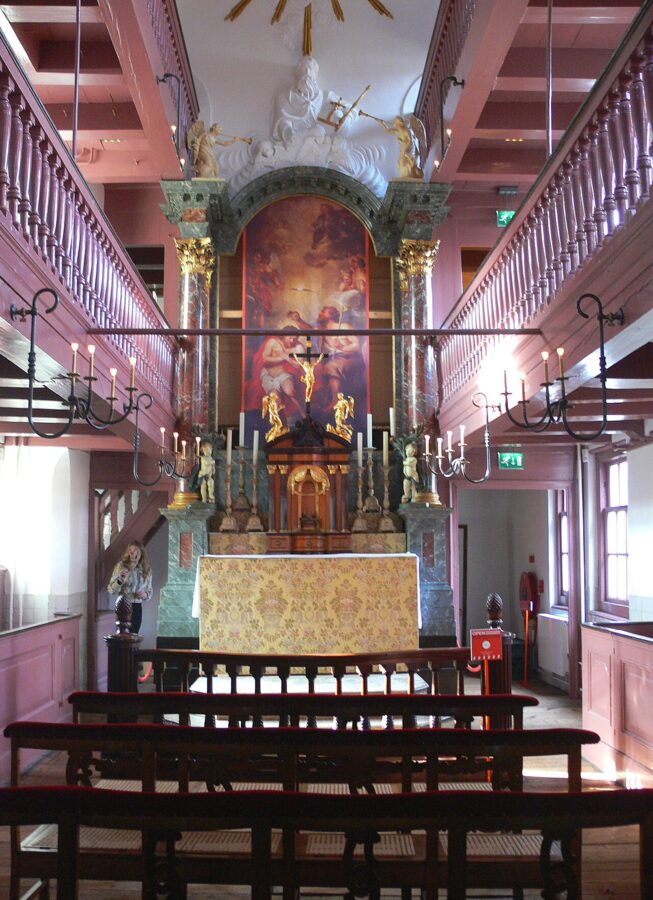
Pair the visit with Museum Ons’ Lieve Heer op Solder at Oudezijds Voorburgwal 38–40, a few minutes north, where Catholics kept worshipping in a canal-house attic after 1578 threw them out of churches like this one. Seeing the stripped Oude Kerk and the hidden church in the same morning tells the Alteratie better than any panel. It is one of the best small museums in the city, and the Amsterdam museums guide has the rest.

From there the rest of the old side is on your doorstep: the Zeedijk and the Nieuwmarkt for lunch, the Warmoesstraat one block west with the Condomerie at number 141, and the windows of the two canals after dark. If Saskia has you curious about Rembrandt, the Rijksmuseum is a tram ride south.
Come back to that stone on a weekday morning: be at the door on the Oudekerksplein at 10:00, pay your €14.50 by card, walk straight to the transept organ, and stand where the sun lands every 9 March.