
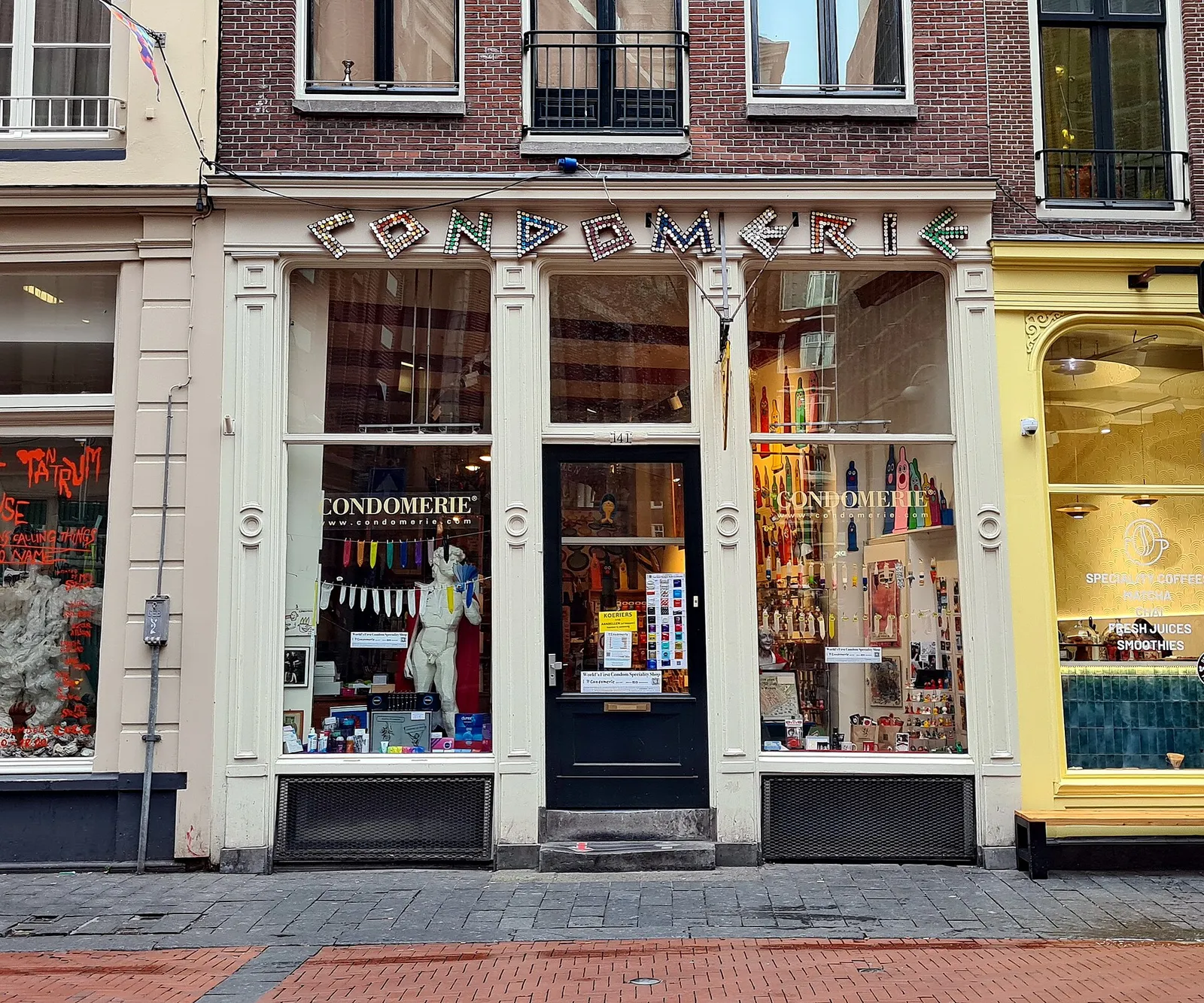

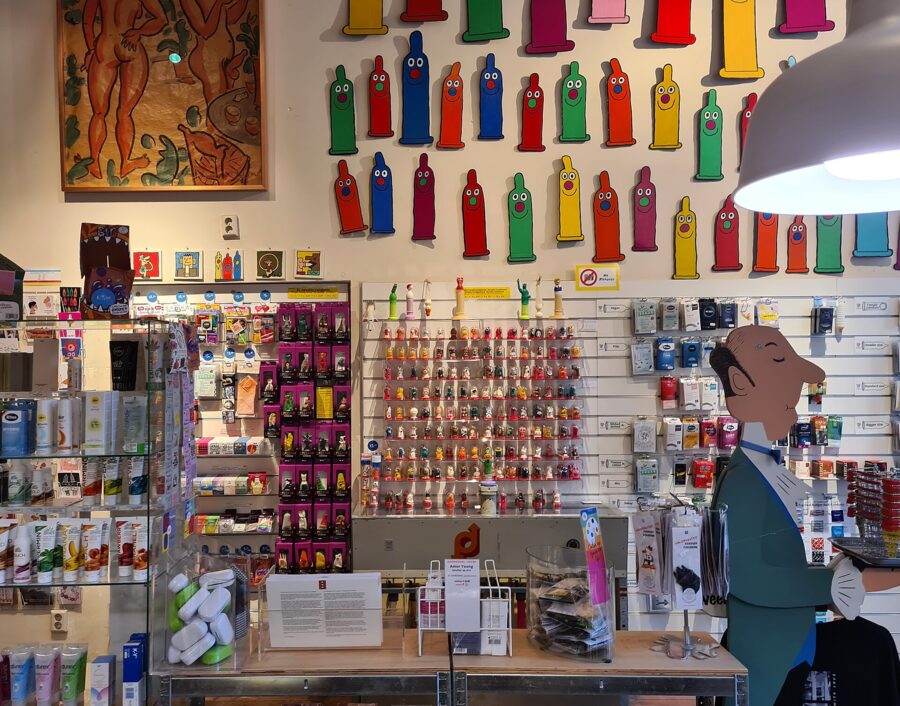
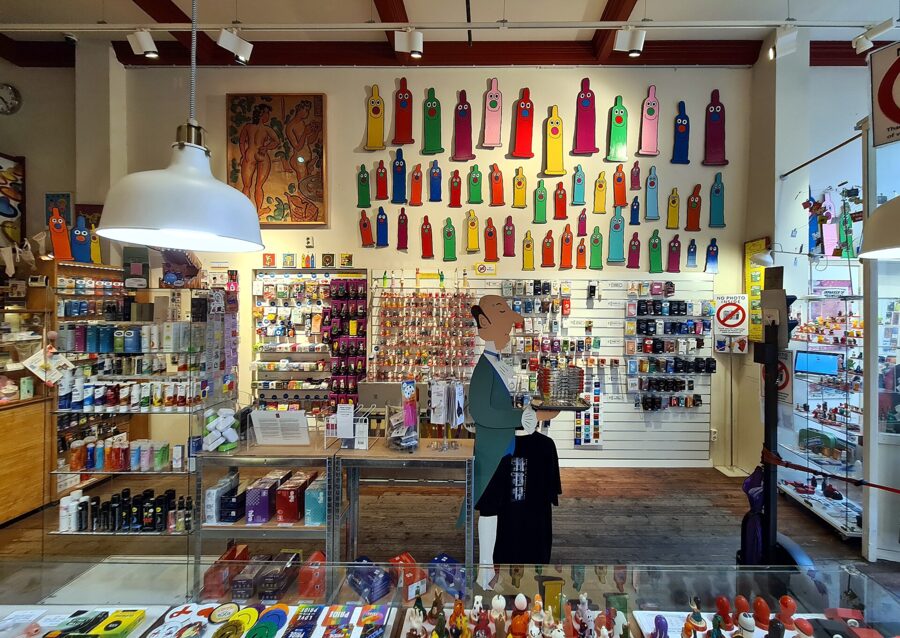
The giraffe costs €7 (about US$8). So do the cow, the windmill, the clog, the Eiffel Tower and the little red-brown bollard with three crosses on it. The Condomerie’s price list runs to 111 of these decorated novelty condoms, and the shop sums them up in four words of Dutch: niet veilig, wel leuk. Not safe, but fun.
They are what people photograph through the windows at Warmoesstraat 141, and what most of them buy, once. Theodoor van Boven, one of the three people who started the shop in 1987 and still one of its owners, has said that plain standard condoms make up 98 or 99 percent of what it sells. The sizing charts, the latex-free shelf and the old leak-testing machine exist for that 98 percent.
So buy the windmill if you want a souvenir, then ask whoever is behind the counter a real question. That is what the place was set up for, in three weeks in the spring of 1987, when nobody in Amsterdam knew how far AIDS would spread.
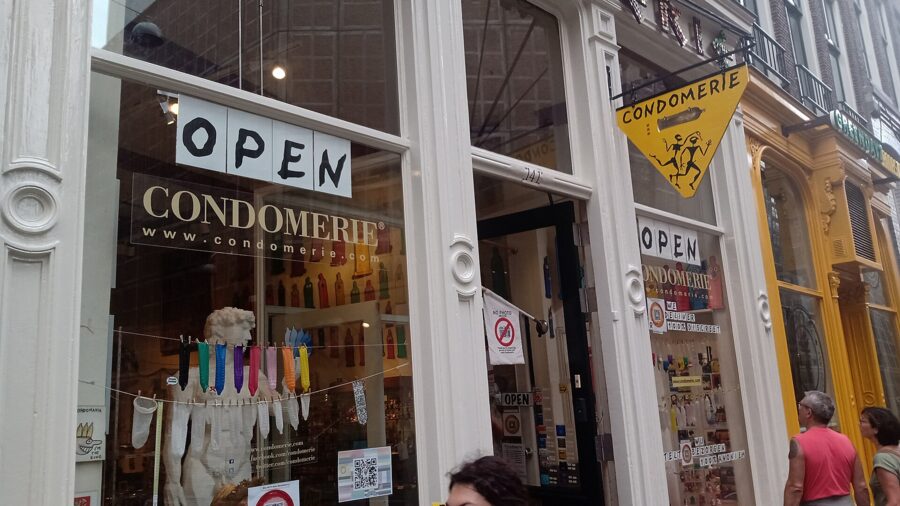


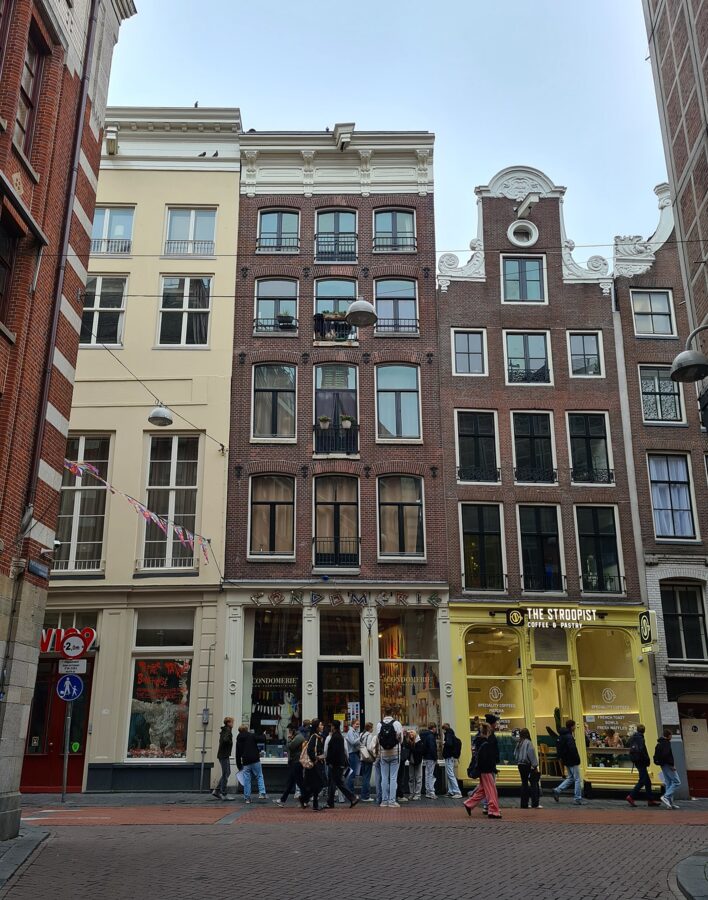

Warmoesstraat 141: hours and the way in
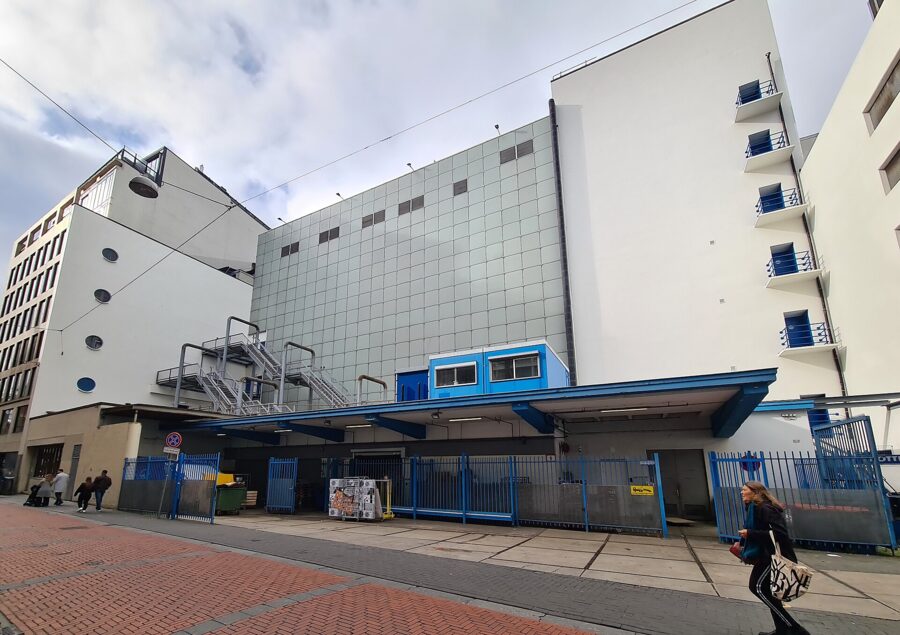
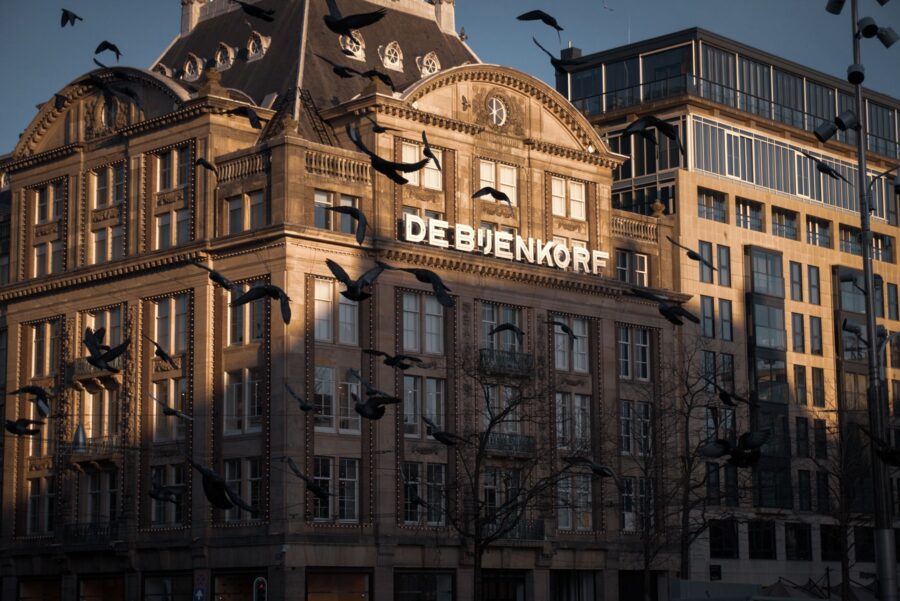
The shop is in the southern half of the Warmoesstraat, the narrow street one block east of the Damrak, a couple of minutes from the Dam. Across the road, more or less, are the back of the stock exchange and the rear of the Bijenkorf department store. Behind it lies De Wallen, the oldest part of the city, with the windows of the Red Light District a block or two east.
It keeps longer hours at the end of the week. These are the times on the shop’s own page as of November 2026:
| Day | Hours |
|---|---|
| Monday to Wednesday | 11:00–18:00 |
| Thursday | 11:00–19:00 |
| Friday and Saturday | 11:00–21:00 |
| Sunday | 13:00–18:00 |
It is closed on New Year’s Day, and the shop asks you to phone ahead for Christmas, Easter and other public holidays. There are steps up to the door of the old facade, so the shop is not wheelchair accessible; staff say they will come out to the street to show you things, and they prefer a call or an email beforehand.
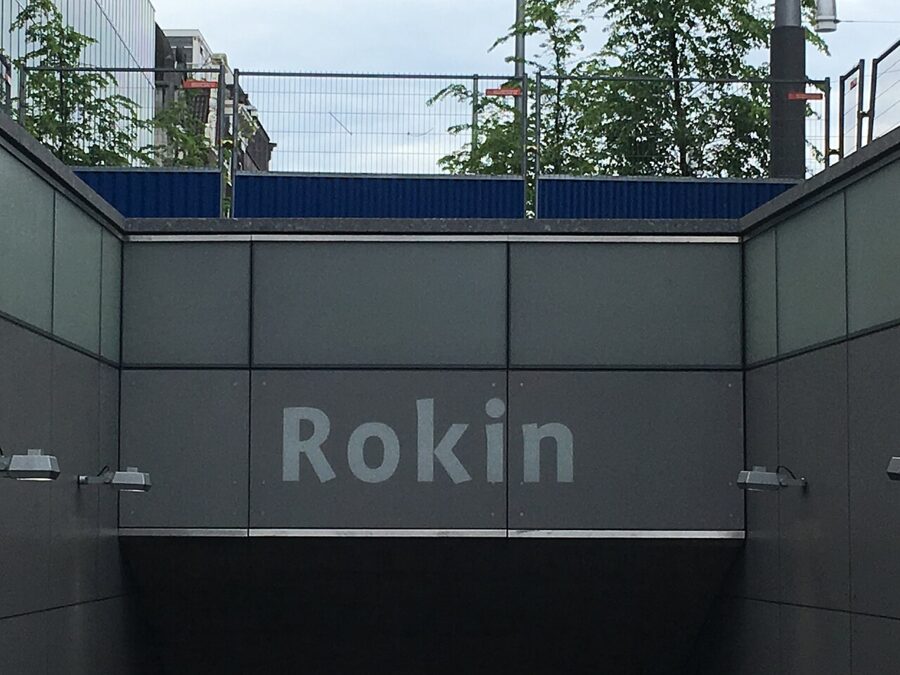
From Amsterdam Centraal it is a walk of seven to ten minutes: cross to the east side of the Damrak, turn into the Warmoesstraat and keep going south past the Oude Kerk end. Nieuwmarkt metro station, one stop from Centraal, is about six minutes’ walk east. Rokin, on the north–south metro line, is closer to the Dam side. If you cycle, the shop points to the large free bike park at the Beursplein, on the far side of the stock exchange.

Three weeks in April 1987
The idea came up on 10 April 1987, over dinner in an Amsterdam restaurant, in an argument about AIDS. HIV was then incurable and fatal, and the expectation was that it would spread fast and everywhere. Condoms were sold at the chemist, the drugstore, the sex shop and the vending machine, but the choice was small and the information was worse.
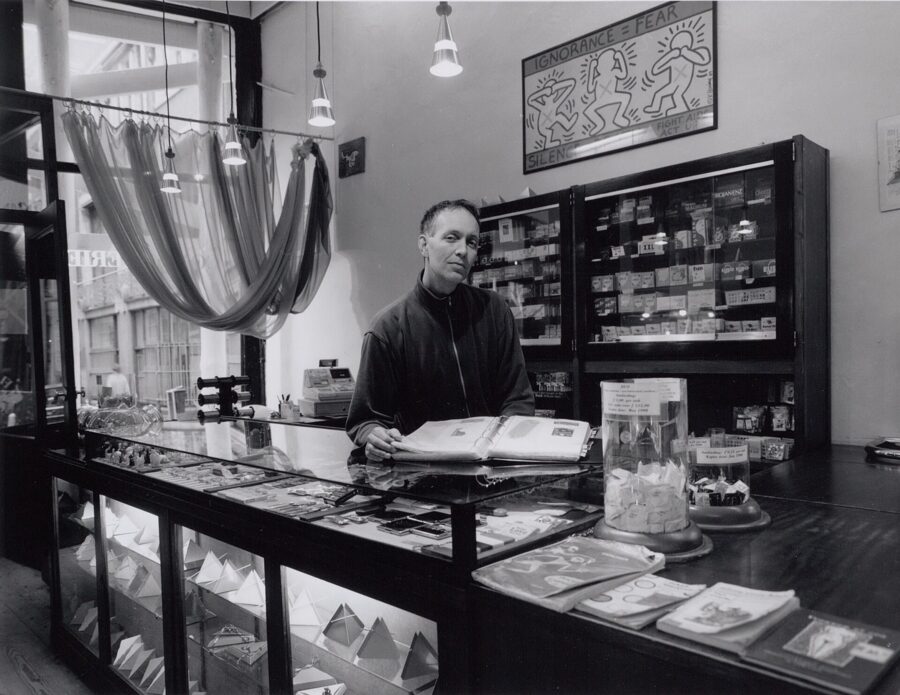
On 20 April three of the diners, Marijke Vilijn, Ricky Janssen and Theodoor van Boven, decided to do it. The shop opened at Warmoesstraat 141 on 1 May 1987, three weeks after the dinner. That is the date on the shop’s own history; in a later interview Van Boven put the opening a day earlier, on 30 April. The aim, in the founders’ words, was to get condoms out of the taboo zone and give straight, unembarrassed advice on types, sizes and brands.
The name, the women and the press
The name was Van Boven’s joke on Lenny Bruce, who said that the obscene becomes art once you say it in French. Condomerie sounds French and is not a word in any language. A friend from Maastricht, Wim Verschuren, added the second name, Het Gulden Vlies, the Golden Fleece of Jason and the Argonauts, and the cartoonist Paul Bodoni drew the logo that still hangs over the door: a woman running after a man with a condom.
One decision was political. In 1987 the rumor still went round that only gay men could get HIV, and to push against it the founders agreed that only the two women would speak to the press. It worked. The Dutch press covered the opening widely, the foreign press followed, and the story that ran was that two women in Amsterdam had opened the world’s first condom shop.
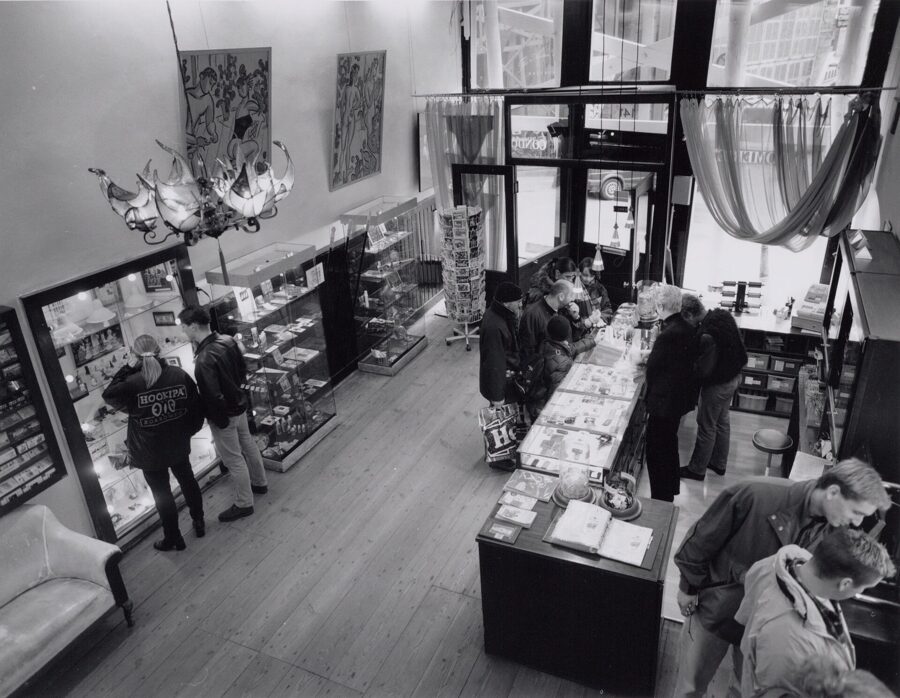
The fun condoms were part of the plan from day one, and for a stated reason: a laugh lowers the threshold, and the safe-sex message lands better with a smile. Van Boven’s line about the early years is that the condom shop let people smile about sex again at a time when AIDS had made it something to be afraid of. The customers came from Amsterdam, from the rest of the country, from abroad, and from the windows a few streets away; sex workers have shopped here from the start.
A shop in a squatted block
Number 141 belongs to the Blaauwlakenblok, the big block between the Warmoesstraat and the Sint Annenstraat, behind the Bijenkorf and the stock exchange. The department store had bought up about 60 percent of it to build a parking garage, and let the houses run down while it waited. The empty ones were squatted at the end of the 1970s. The block was full of protected buildings, which killed the garage, and in 1983 the city bought the Bijenkorf share.
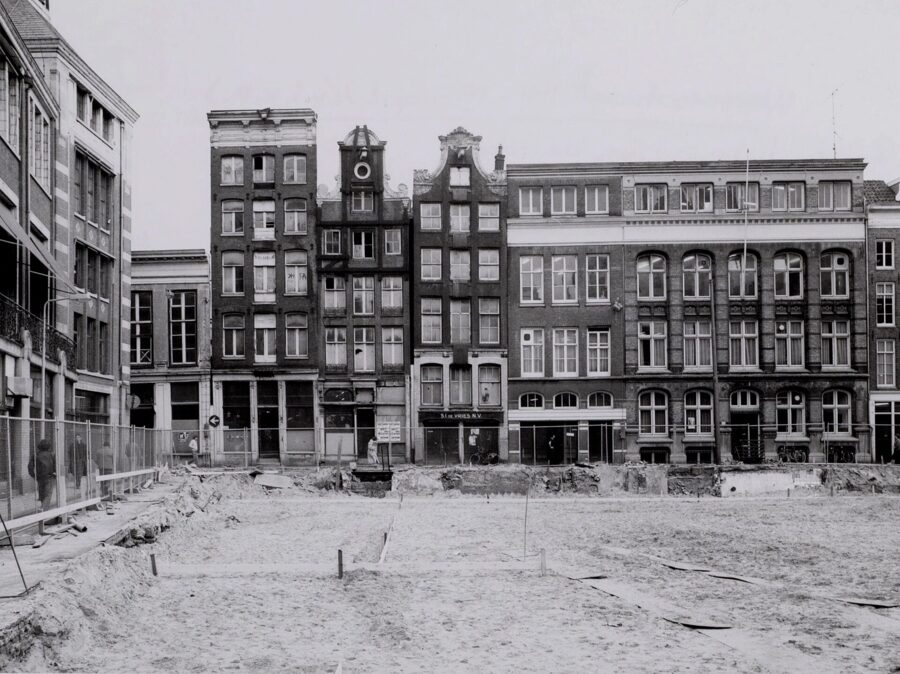
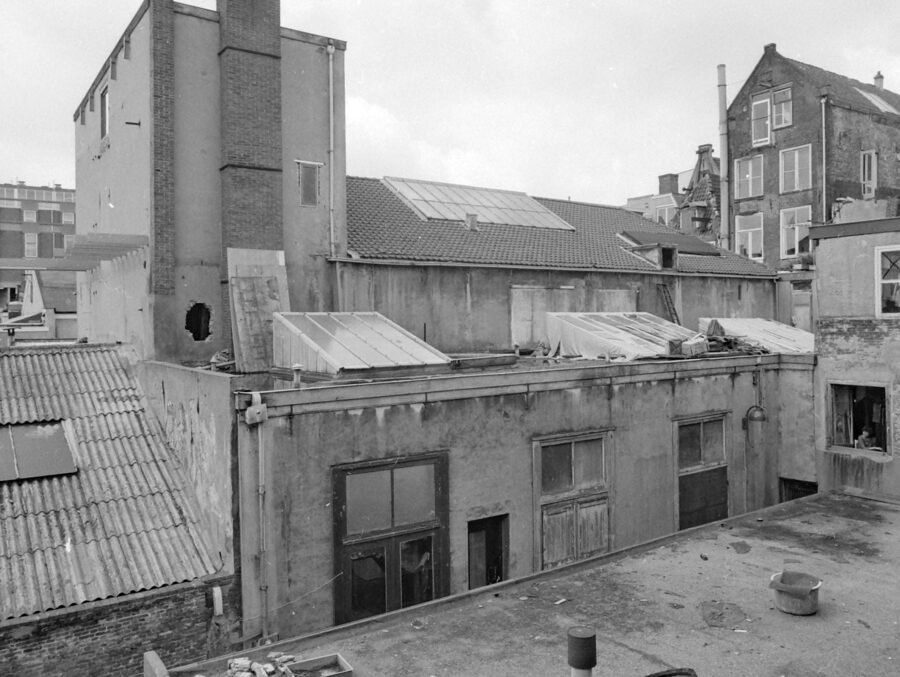
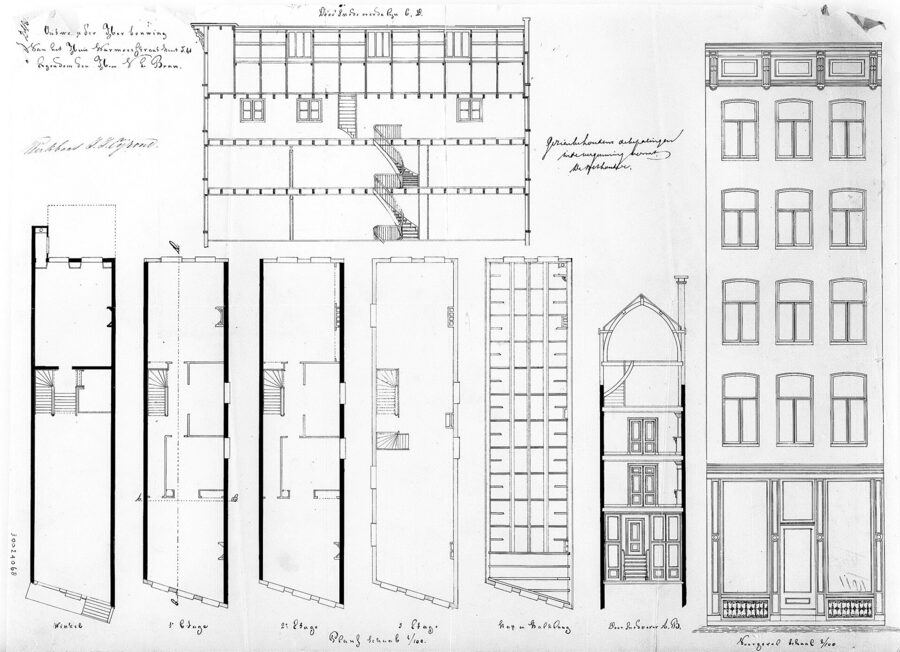
The house itself is a national monument, entered in the monuments register on 23 October 1985 as a building with a nineteenth-century facade under a straight cornice on consoles. The city archive holds the design drawing of 1871, made when the house was partly rebuilt after a fire.
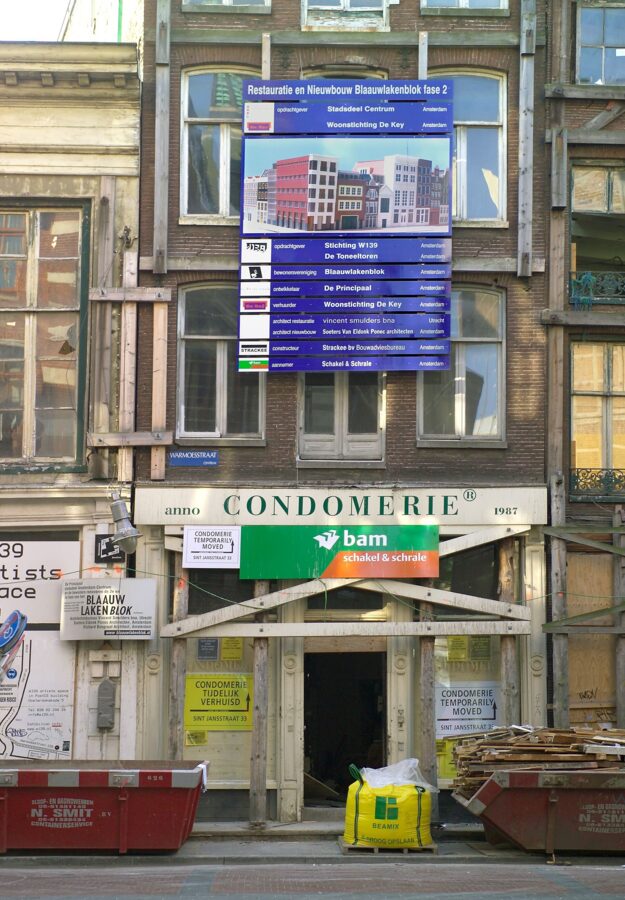
Restoring the whole block took decades. Number 141 got its turn in the middle of the 2000s, and the shop sign stayed on the scaffolding while the facade was repaired.
Inside: what the Condomerie sells
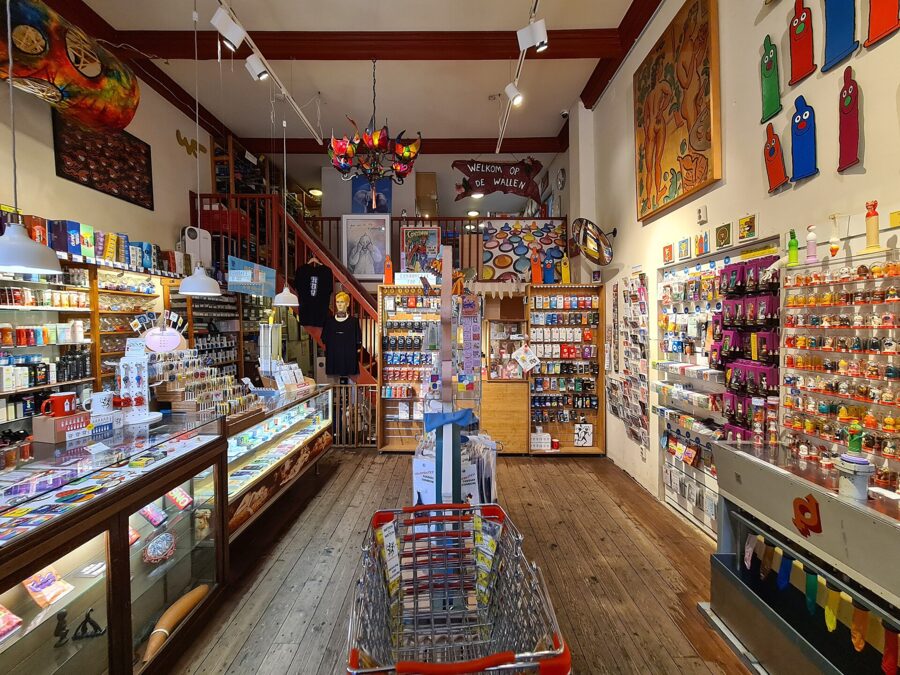
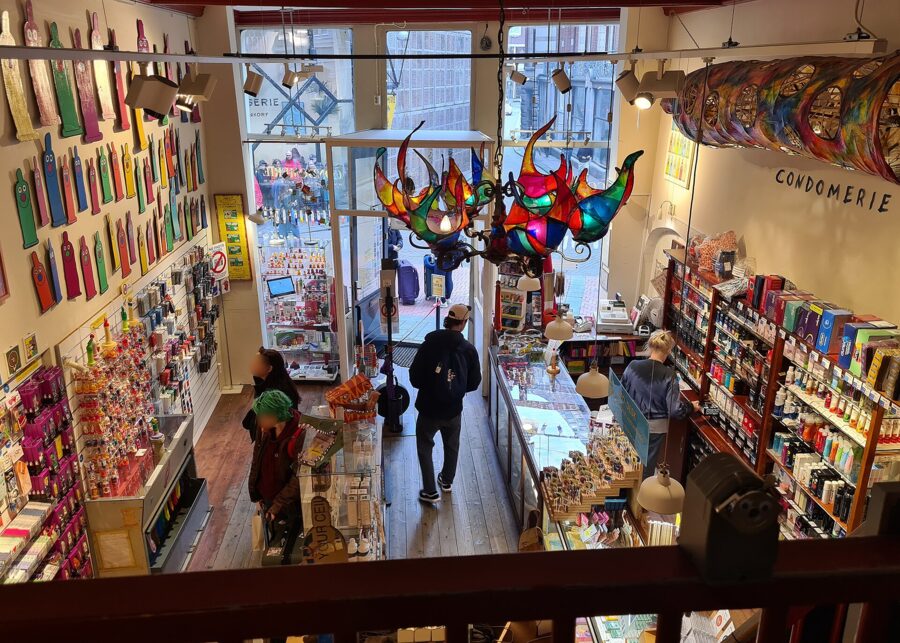
The shop floor is one long, narrow room with glass cases on both sides and the novelty wall at the back, then a few steps up to the office. It is small, and the counter is where the useful part happens, so do not be shy about waiting your turn.

Sizes first
The first questions customers asked in 1987 were about size and latex allergy, and the shop has been answering them ever since. In 1994 it paid for a study at the University of Amsterdam’s psychology faculty on penile circumference in a Dutch sample, and from that work it built its own sizing scale, the CAS index (Condomerie Amsterdam Standaard).
Every condom the shop sells has been measured in-house at two points, at the opening and about 70 mm up, and given a CAS number for width. The scale runs from CAS 0 to 9, and most brands sit at CAS 4; lower numbers are snugger and CAS 5 and up are wider. Brand labels are not much help on their own, since one maker’s large is another’s extra large. A condom that is too loose slips off, and one that is too tight breaks, which is the point of all this measuring.

If you do not know your size and do not want to measure, the easy answer is a trial pack: several brands of the same width in one bag. As of November 2026 the online shop lists the CAS 4–5 and CAS 6–7 packs at €15 each and the CAS 7–8–9 pack at €17.50, and the staff will steer you to one at the counter.
Allergies, tests and the rest
For latex allergy there is a shelf of latex-free condoms made of polyisoprene, polyurethane and nitrile, with the major brands at roughly €12.50 to €19 a pack online. The shop still sells sheep-gut condoms, the oldest kind of all, and has a fish-bladder condom in its archive. It also stocks lubricants by the dozen, dental dams, finger cots, female condoms, menstrual cups and diaphragms.
STI home tests are sold over the counter. They are lab tests from a Dutch online clinic: you take the sample yourself, post it to the laboratory and get the result online. Staff are not allowed to advise you on which test to buy, so work that out before you go in.

The novelty condoms
Now the giraffe. The novelty range is decorated latex in the shape of animals, landmarks and Dutch clichés: windmill, clog, cannabis leaf, a beer glass, Big Ben, the Statue of Liberty, and the Amsterdammertje, the bollard that carries the three crosses of the city arms. Online they cost €7 each, dropping to €6 each for three or more and €5.25 each for 24, as of November 2026.
The shop is blunt about what they are: fun condoms that offer no protection, sold as gifts, wedding jokes and conversation starters. Every condom in the main range is tested and carries a quality mark; the novelties are the exception and are meant to look like it. Do not mix them up in a drawer.
Souvenir or the real thing
If you want something to take home that is funny and also works, the flavored, colored and glow-in-the-dark condoms are the tested versions of the joke. The cheapest packs in that range start under €4 online, a glow-in-the-dark condom starts at €6, and a mixed pack of the shop’s own selection is €15. All of them pass the legal standards that the novelties do not.
My advice is to buy one novelty for the photo and one trial pack in your size for yourself. The second is the better souvenir, and it is the one the shop was founded to sell.
More than a shop
The Condomerie is also a wholesaler, a web shop and a small information center. It runs short condom lessons for school groups in the shop (about fifteen minutes) and longer sessions for nurses and doctors. From 2009 to 2020 it ran Club Gun, a condom distribution project in gay bars and clubs paid for by Aids Fonds and the Amsterdam health service: by the end of 2014 there were 30 venues handing out nearly half a million free condoms a year.
A separate charity, the Condomerie Foundation, was set up in 2009. For eleven years it backed Sape Moderne in Abidjan, an AIDS-education project run by Ivorians around a yearly football tournament; in 2013 alone that meant 32 teams, 189 HIV tests and 2,500 condoms handed out. The shop has worked carbon neutral since 2011 and has a seat on the ISO committee that writes the international standard for latex condoms.
It takes sides in neighborhood politics too. In June 2025 the shop put on its blog the manifesto against the city’s planned erotic center, a building elsewhere in town meant to take about 100 workplaces for sex workers out of De Wallen. The manifesto names the Condomerie among the district’s landmarks, alongside Casa Rosso, the Bananenbar and The Bulldog.
The city pressed on for a while. In December 2025 the mayor and aldermen adopted a project plan for a site on the Europaboulevard in Zuid and left the next step to the council elected in March 2026. The new coalition dropped the plan in its June 2026 agreement and said it would look at several small locations instead. For now the shop’s neighbors on the canals stay where they are.
The Warmoesstraat, the oldest street
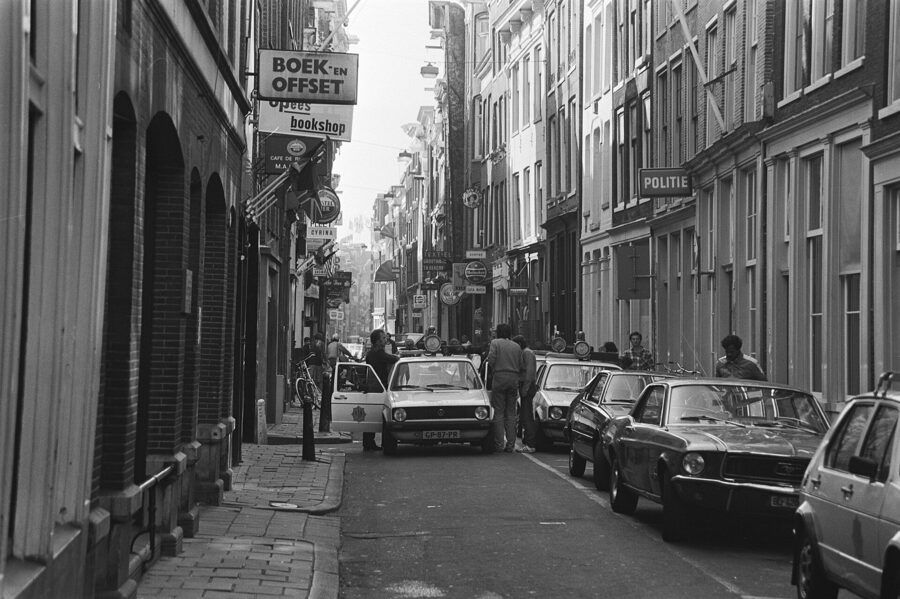
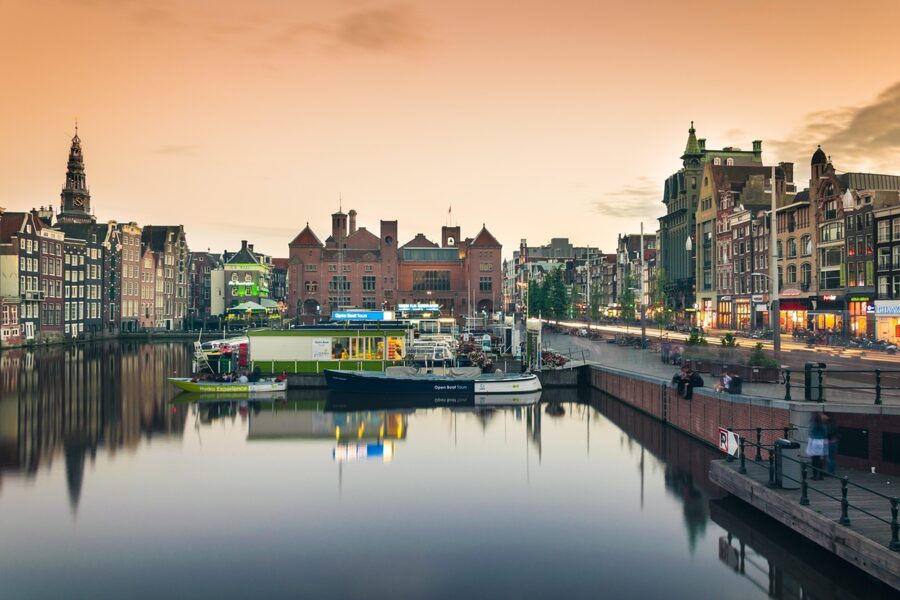
The Warmoesstraat runs about 550 meters from the Dam to the Nieuwebrugsteeg near Centraal, and it is one of the first streets the city had. It was built on the dike along the east bank of the Amstel mouth, now the Damrak, and the houses on its west side were pushed out over the water. Their back walls still stand in the Damrak, and the row of leaning gables in every photograph of the Damrak is the back of the Warmoesstraat.
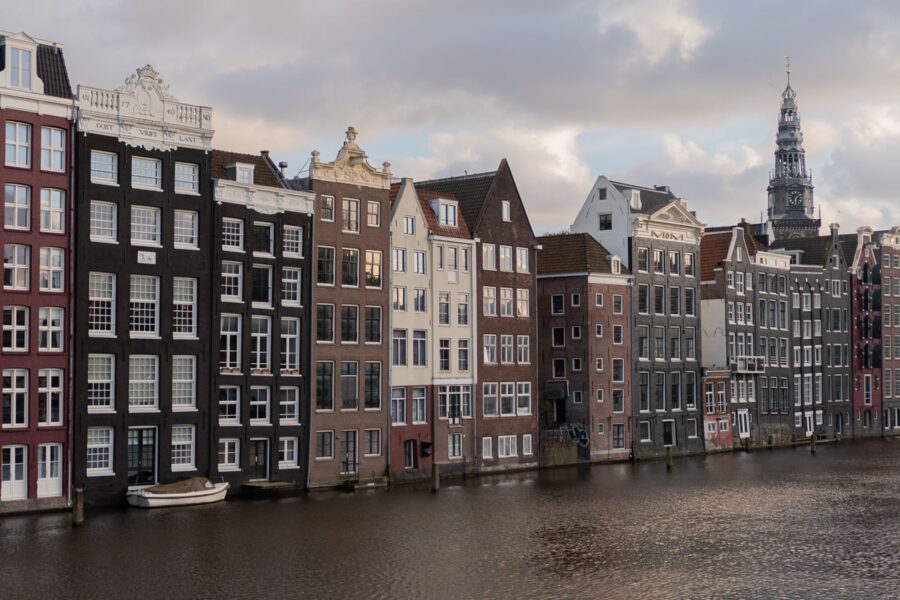
The name comes from warmoes, an old word for vegetable greens and chard, which were sold here. In the sixteenth century it was the city’s grandest shopping street, with the biggest houses and some twenty inns for foreign merchants on the water side; the poet Joost van den Vondel kept a stocking shop on it. Warmoesstraat 90 is thought to be the oldest house standing in Amsterdam, its timber dated by tree rings to about 1485.

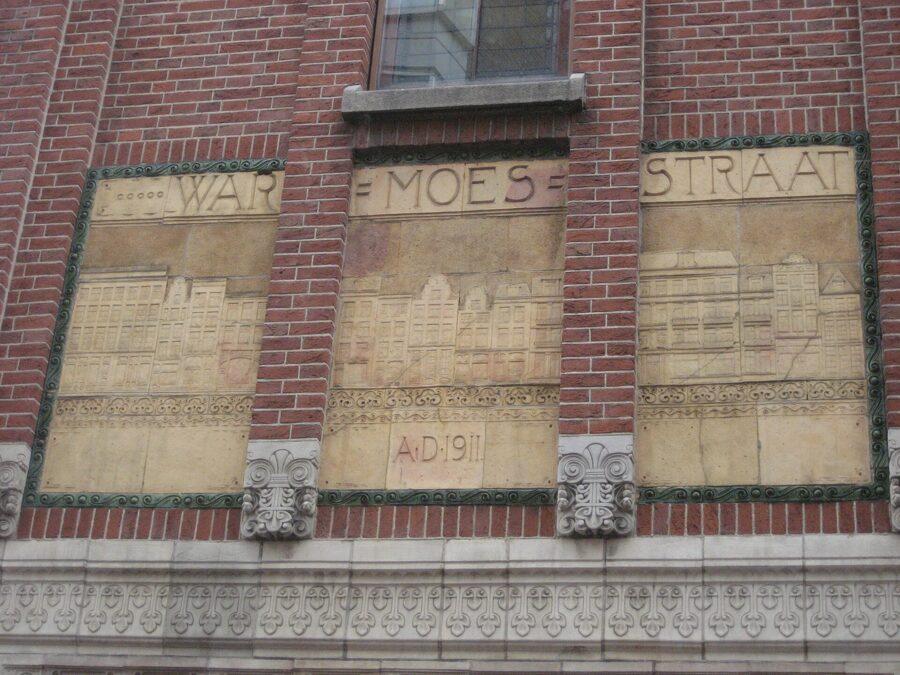
The west side opposite the Condomerie went in the early twentieth century, when houses were pulled down for the stock exchange on the Beursplein. Its back wall on the Warmoesstraat carries a relief of the houses that were demolished, with the street name cut across the top. From the shop door, look across the street.

Then the street went down. By the early 1980s the Warmoesstraat and the Zeedijk were among the most notorious streets in the country for drug dealing, and the decay of the houses behind the Bijenkorf was part of the same picture. From the late 1970s it was also the center of the city’s leather bars. Police work, cameras and the long restoration of the old center turned it around, and today it is one of the safer streets in the center.
What is on the street now
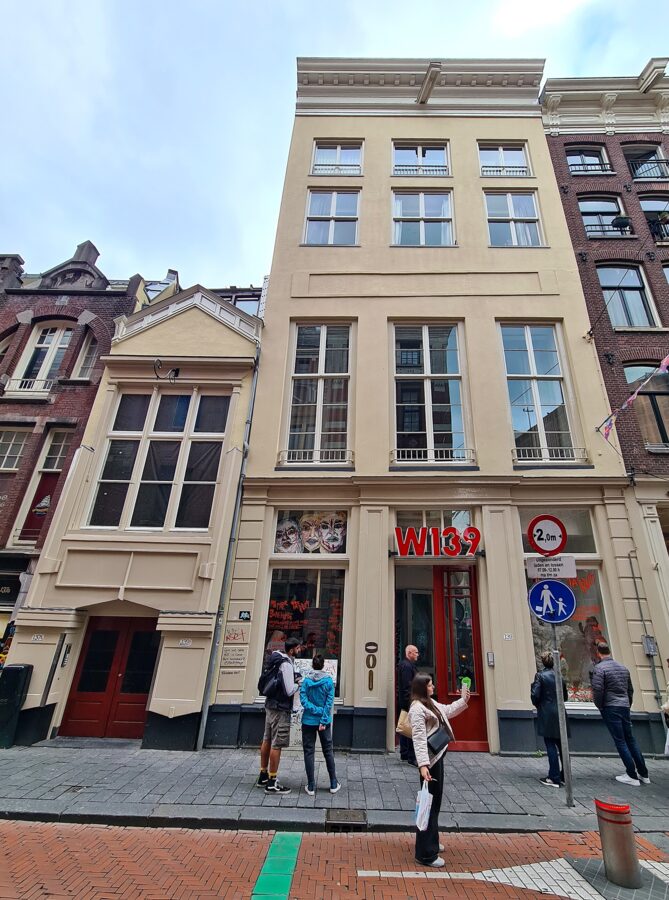
It is hotels, bars, souvenir shops and a couple of serious addresses. Next door at number 139 is W139, an artist-run space for contemporary art that has been in the building since 1979 and still puts on new shows; in November 2026 it was running a group exhibition called Heaving Room. A few doors north, Belushi’s at number 129 is the loud bar with DJs. The coffeeshops that gave the street its reputation in the 1980s were put on a die-out policy in 2006, and the coffeeshops guide covers where to go now.

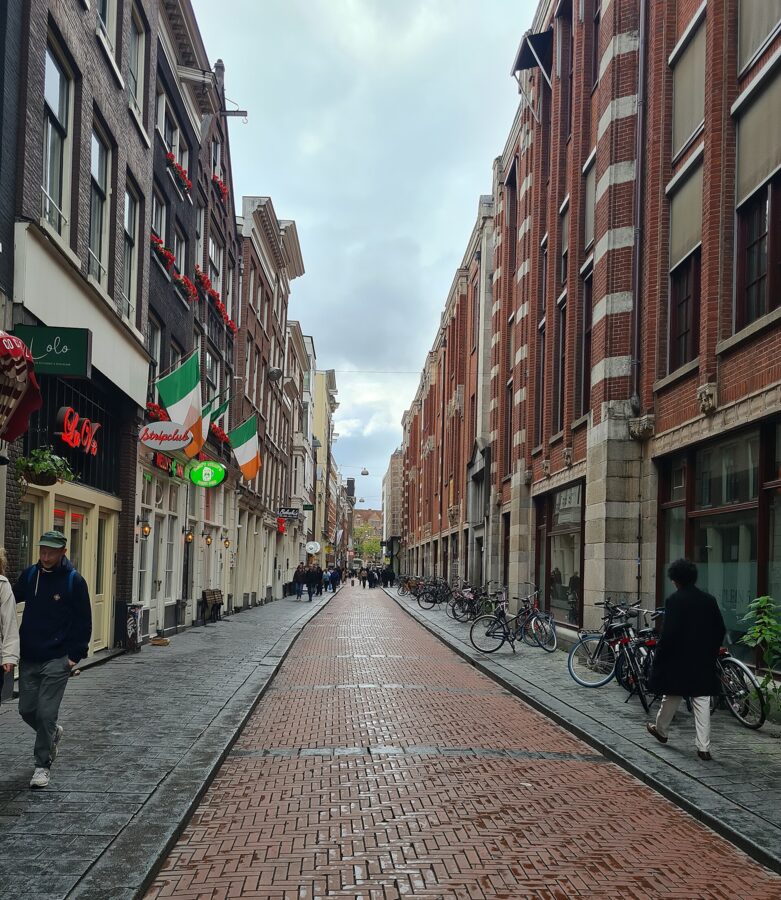
The usual rules of the district apply here as well. Since May 2023 you may not smoke cannabis in the street in this part of the center, drinking in the street is banned, and photographing the windows is the quickest way to get shouted at. The Red Light District rules and etiquette apply on this street too, fines included.


Nearby
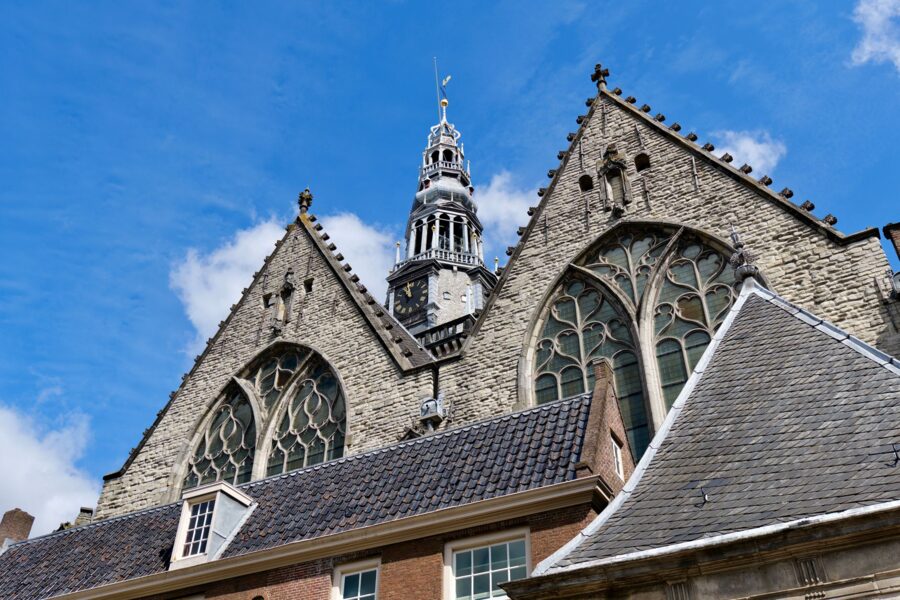
The Oude Kerk, the oldest building in the city, is a few minutes’ walk north; its visitor page lists it as open daily, 10:00–18:00 from Monday to Saturday. The Beurs van Berlage, the brick exchange of 1898–1903, closes the end of the Damrak two minutes west. On the Damrak itself is the Sex Museum, and a few minutes east on the Oudezijds Achterburgwal are the Erotic Museum and the Moulin Rouge.
If you want the condom in its museum setting, the Rijksmuseum bought a condom from around 1830, probably sheep gut, decorated with an erotic etching, and showed it from June to November 2025. The Condomerie congratulated the museum on its blog, admitted to being a little jealous, and pointed out that it still sells sheep gut today.
For the evening, the nightlife guide covers where to drink once the shop has shut. On a Friday or Saturday it stays open until 21:00, which is late enough to fit in after dinner.
Come up at Rokin, cross the Dam, turn into the Warmoesstraat behind the Bijenkorf and stop at number 141. Buy the windmill. Then ask for the trial pack in your size.