
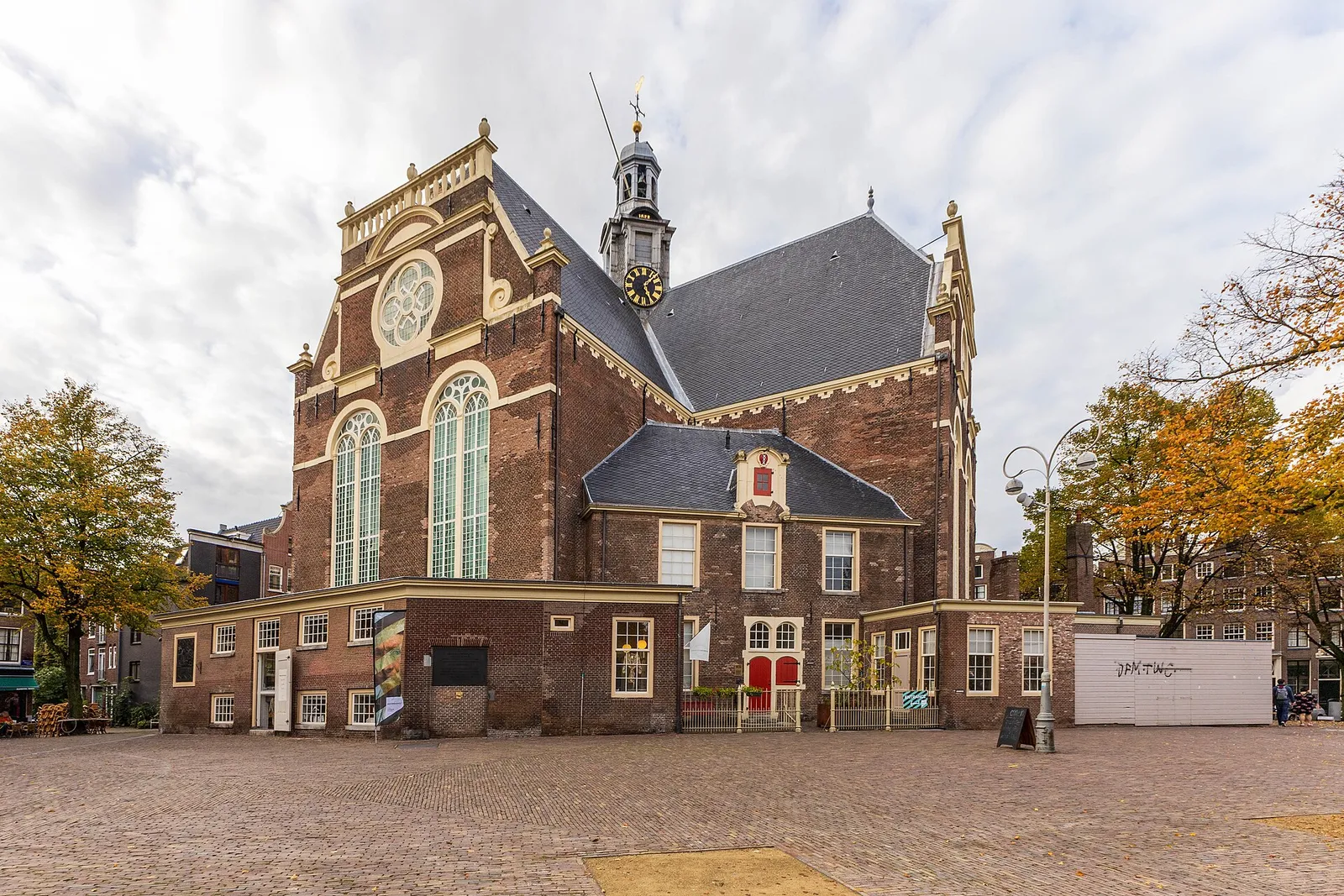

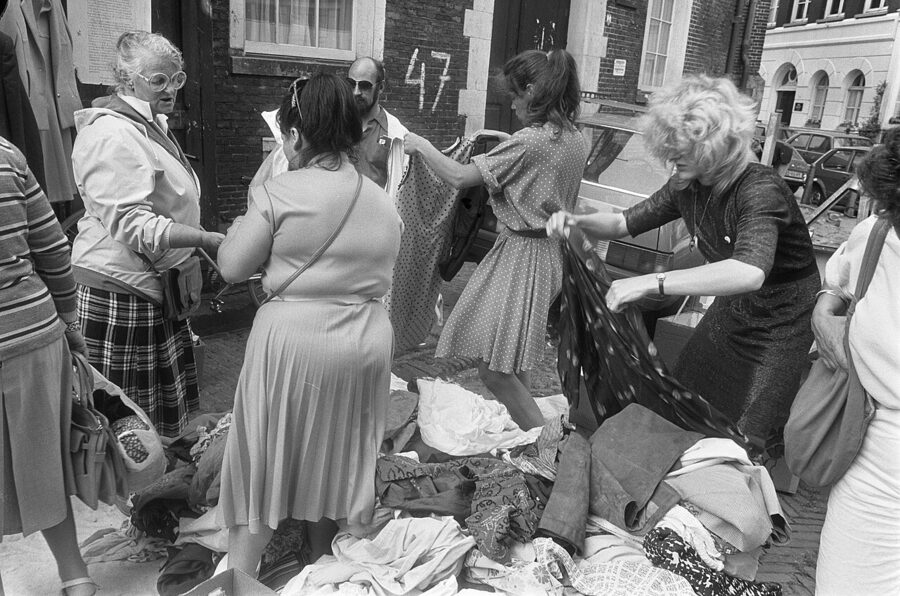
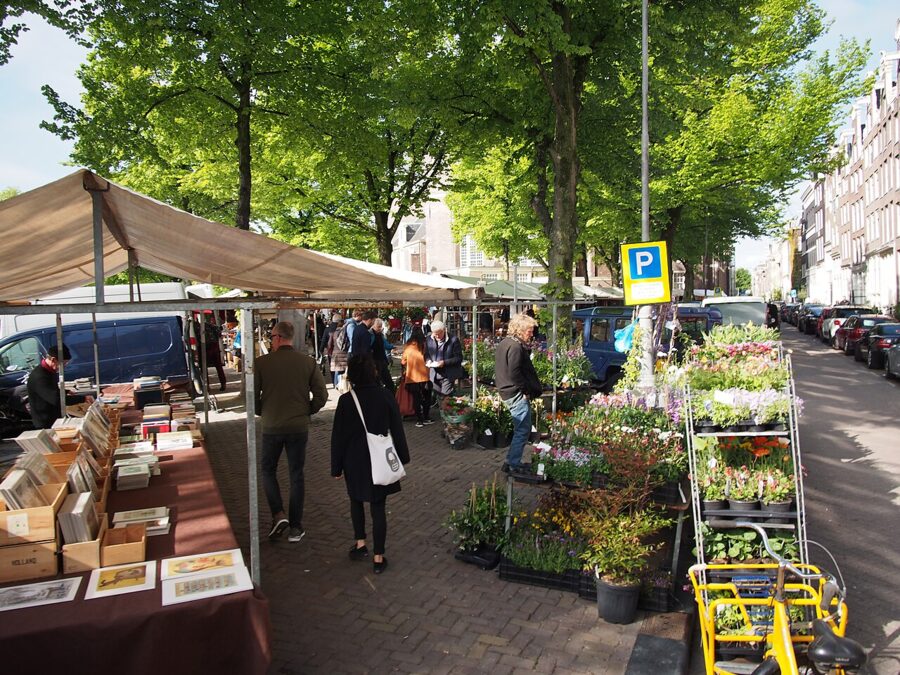
Come on a Monday and the cobbles in front of the Noorderkerk are covered in old coats, cut-glass bowls, school prints and shoeboxes of buttons, and the fabric sellers carry on round the corner and up the Westerstraat. Come on a Saturday and the same square smells of wild mushrooms, farmhouse cheese and pancakes, and the queue is at the vegetable stalls instead of the clothes rails. Come on any of the other five days and there is nothing to buy at all: lime trees, parked bikes, a church and a café terrace.
That is the whole trick of the Noordermarkt, and the reason people who walk over from the Anne Frank House on a Wednesday leave puzzled. It is two markets on one square, on two days, and both have been running in some form for a very long time. There has been trade in front of this church since the 1620s, when it sold pots, and soon rags, to the people of the Jordaan.
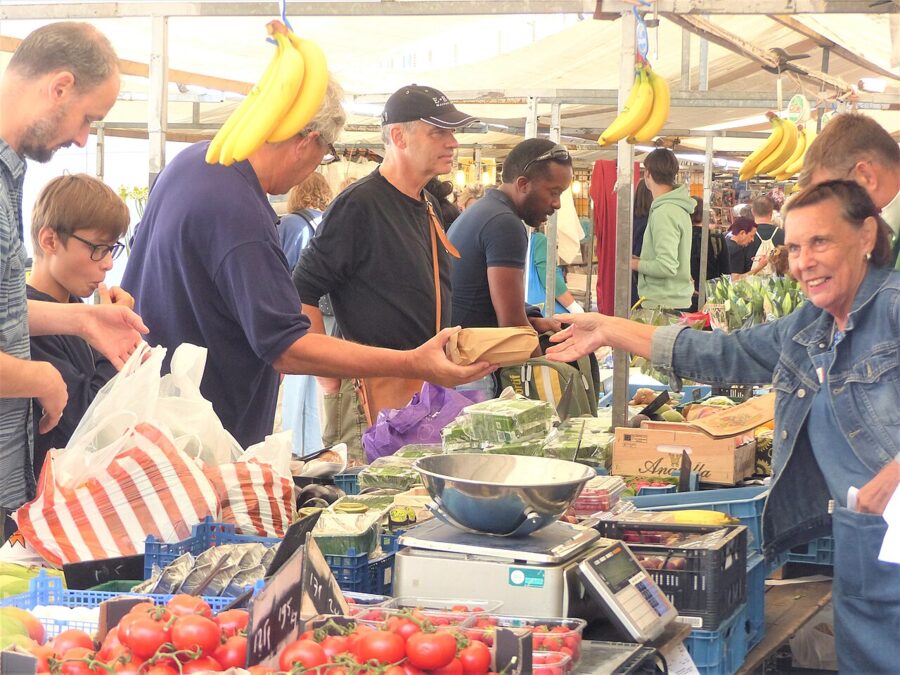
Pick the day first. Monday morning is for second-hand clothes, textiles, brocante and the long fabric market on the Westerstraat. Saturday is for the organic Boerenmarkt, a smaller goods market beside it, and the big ordinary street market on the Lindengracht one block north, with a slice of apple pie at the corner café somewhere in between.

Which day for which market
The hours below are the ones the market itself publishes and the city’s market rules set, as of November 2026. All three markets are outdoors and run in all seasons. The Noordermarkt is called off when the wind reaches force 7, because the stalls can blow over, and in rain or strong wind there may be a thinner market rather than none; the market’s own notice tells you to check the forecast the day before and on the morning itself.
| Day | Where | What | Hours (as of 2026) |
|---|---|---|---|
| Monday | Noordermarkt, the whole square | General goods: vintage clothing, brocante, antiques and curiosa, textiles and haberdashery, prints, jewelry, bags, crafts | 09:00–14:00 (stallholders must stay until at least 13:00) |
| Monday | Westerstraat | The lapjesmarkt: fabric by the meter and remnants, plus fish, cheese, bread, vegetables and flowers | 08:30 to 13:00 at least, 14:00 at most |
| Saturday | Noordermarkt, the café Winkel end | Biologische Boerenmarkt: organic produce, cheese, bread, mushrooms, meat, fish, honey, flowers | 09:00–16:00 |
| Saturday | Noordermarkt, the canal end | General goods market: antiques, jewelry, hats, rugs, tiles, toys, recycled bags | 09:00–16:00 |
| Saturday | Lindengracht | An ordinary neighborhood market of 224 stalls: food, flowers, plants, household goods | 09:00–17:00 |
Public holidays catch people out. Under the city’s 2026 decree the Monday market skips New Year’s Day, King’s Day and Christmas, but it does trade on Easter Monday and Whit Monday. Whit Monday is in fact the Noordermarkt’s big day of the year, the Pinkstermarkt, held every year on the second day of Pentecost; the most recent one, on 25 May 2026, packed the square and the terraces around it.
Which day is better depends on what you came for. If you want to buy something to take home, Monday wins: textiles, prints and small brocante pack flat, and fresh cheese and oysters do not. If you want to eat your way round a market and watch the neighborhood shop, come on Saturday, and walk the Lindengracht too.
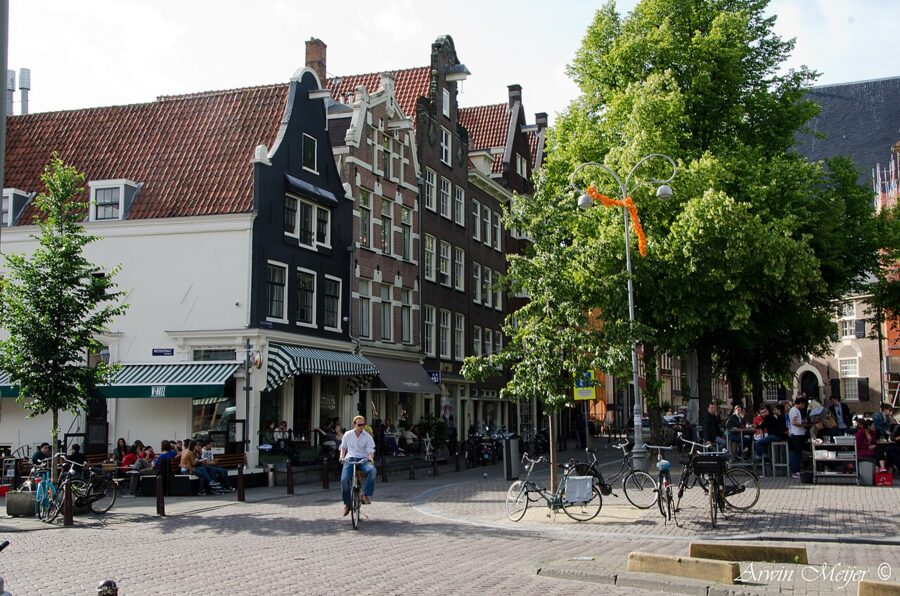

Monday: textiles, vintage and the lapjesmarkt
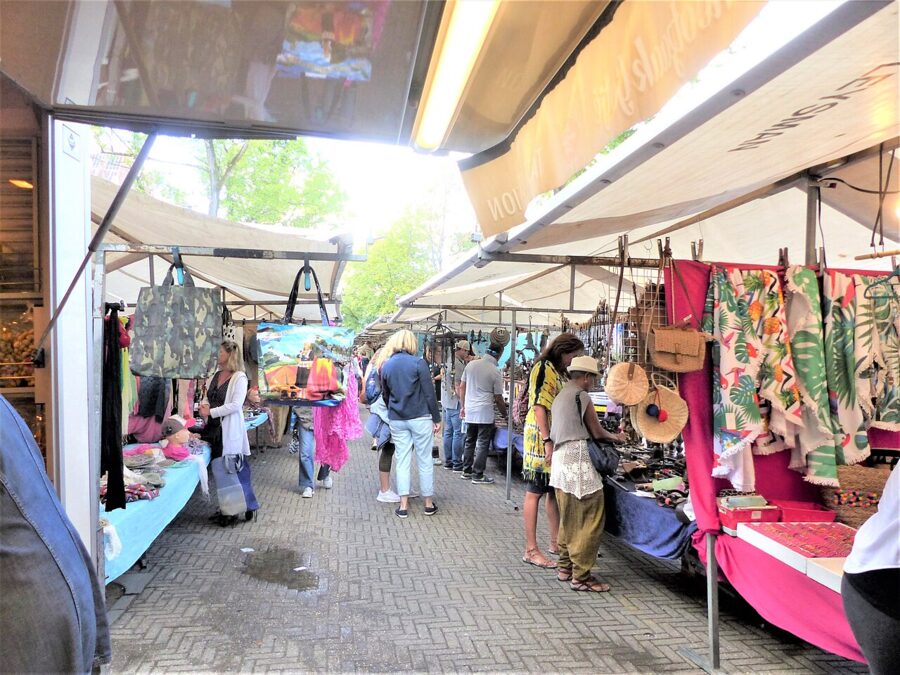
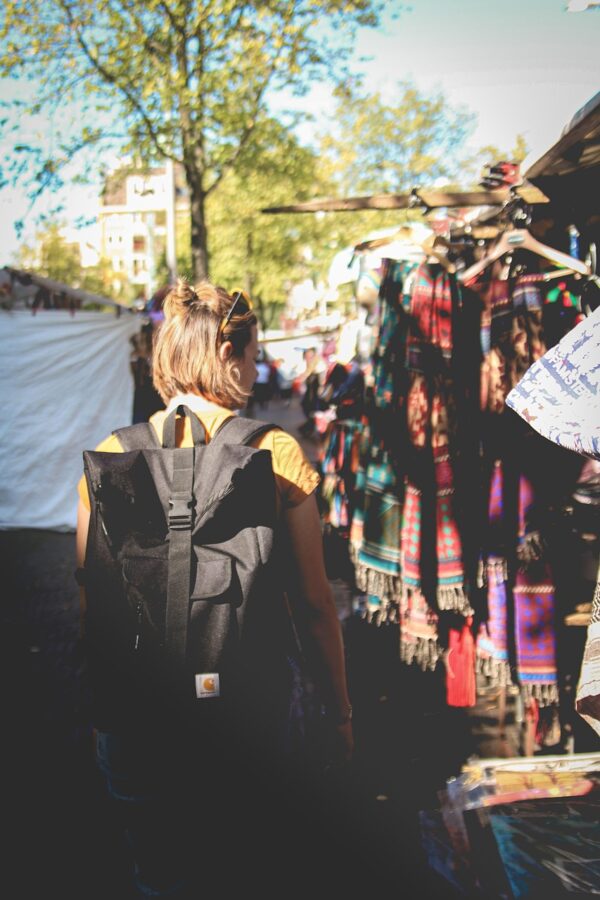
On Monday mornings the whole square in front of the church is one general goods market. The Noordermarkt describes its Monday line-up as brocante, curiosa, vintage clothing, earthenware and small furniture, with haberdashery, jewelry, bags, textiles, prints and handmade work alongside. Its traders are filed under headings that tell you the flavor: antique tiles, old Dutch school wall charts, ethnographica, lamps, hats, glass and tableware, rugs, scarves, toys.
This is not a junk market in the way Waterlooplein can be. Many stalls are run by dealers and makers who come every week, and prices reflect that. The finds are smaller and more particular, things like a box of old glass buttons, a stack of indigo-dyed cloth, an antique tile, a wool coat that fits.
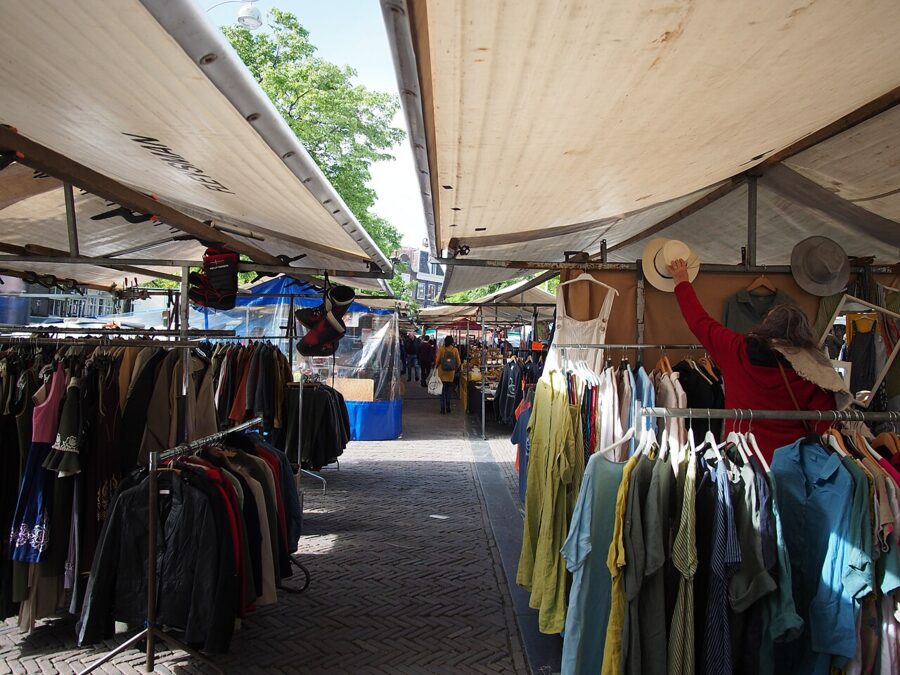
Textiles have been the point of Monday for centuries. A city decision of 1627 added a rag market to the pottery market already held by the churchyard, and from 1845 the Noordermarkt became a fixed weekly market on Mondays, selling mostly second-hand goods, cloth and household things. When the Anjeliersgracht was filled in 1861 the market spilled into the new Westerstraat, which is how the fabric market there began.
The textile stalls today are a mix of old and new. Some sell vintage linen and table runners, others ribbon, tape and buttons, and a few are makers’ stalls: one weaver, Akelei Hertzberger, sells tea towels woven with the Noordermarkt and the Noorderkerk on them, made at the weaving museum in Geldrop. Not every trader appears on the market’s website, but many keep an Instagram account, and the market suggests looking there if you are hunting a particular stall.
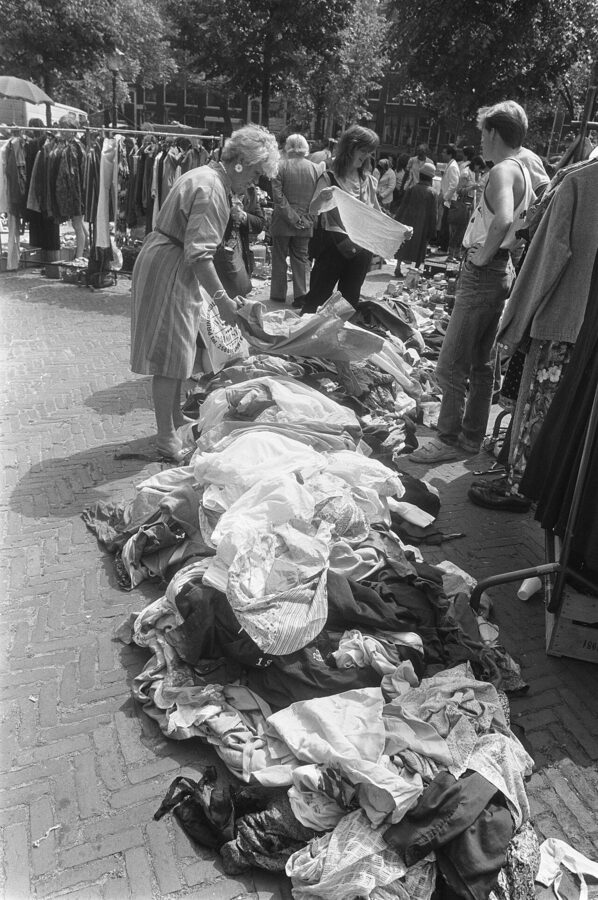
How to shop it
Arrive at nine, or as close as you can manage. Dealers set up from half past eight, the best brocante goes in the first hour, and soon after one o’clock some stalls start folding tables even though the market runs to two. Bring some cash for the smaller stalls, which do not all take cards.
On second-hand goods, asking “what for the two?” is ordinary market manners and usually gets a round number back. On new work from makers, the price on the tag is the price. Carry a bag of your own, and if you came by bike, the market’s own advice is to rent one with a basket.
Saturday: the Boerenmarkt and the goods market
On Saturdays the square is split in two. The organic farmers’ market, the Biologische Boerenmarkt, starts at the corner by café Winkel and fills the west end of the square; keep walking toward the canal and it turns into a general goods market. Walk off the square toward the Brouwersbrug, turn left at café ‘t Papeneiland, and you are on the Lindengracht market: three markets in one, as the Noordermarkt likes to say.
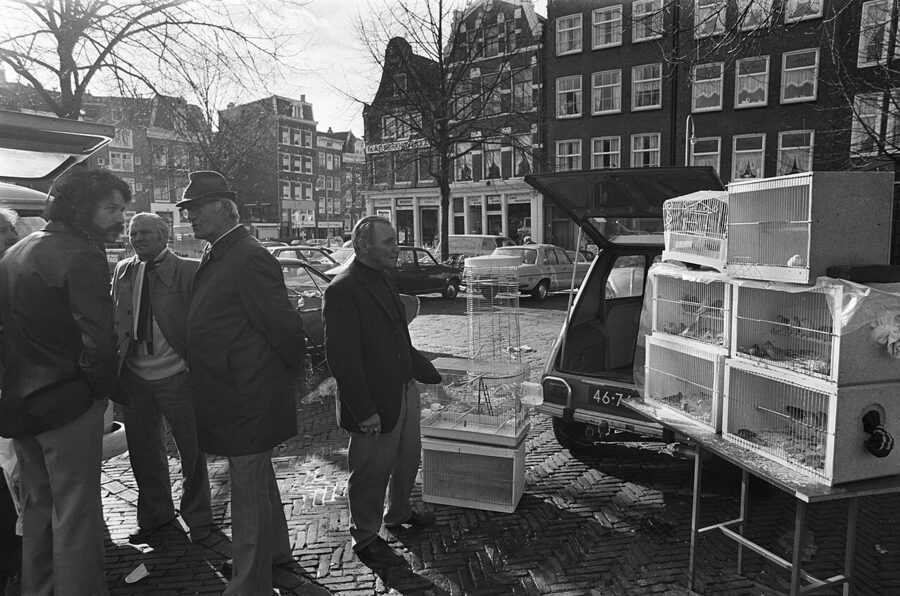
The Boerenmarkt began in 1987 and is often described as the first organic farmers’ market in the Netherlands. It took over Saturday mornings from a pigeon and bird market that had been held on the square since 1929 and was by then fading. The city’s market rules fix its selling hours at 09:00–16:00, with stallholders setting up from seven.
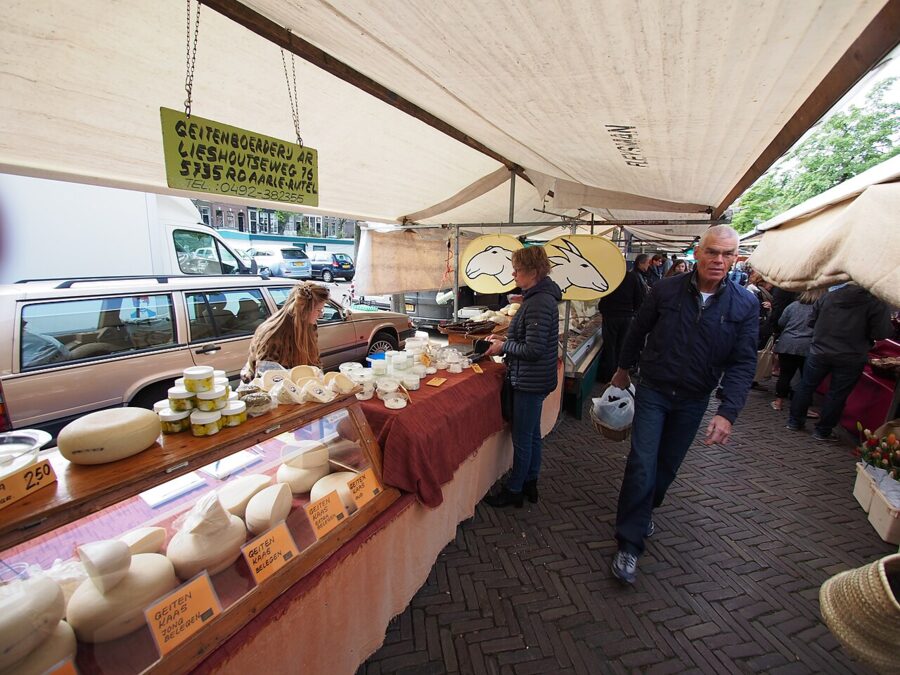
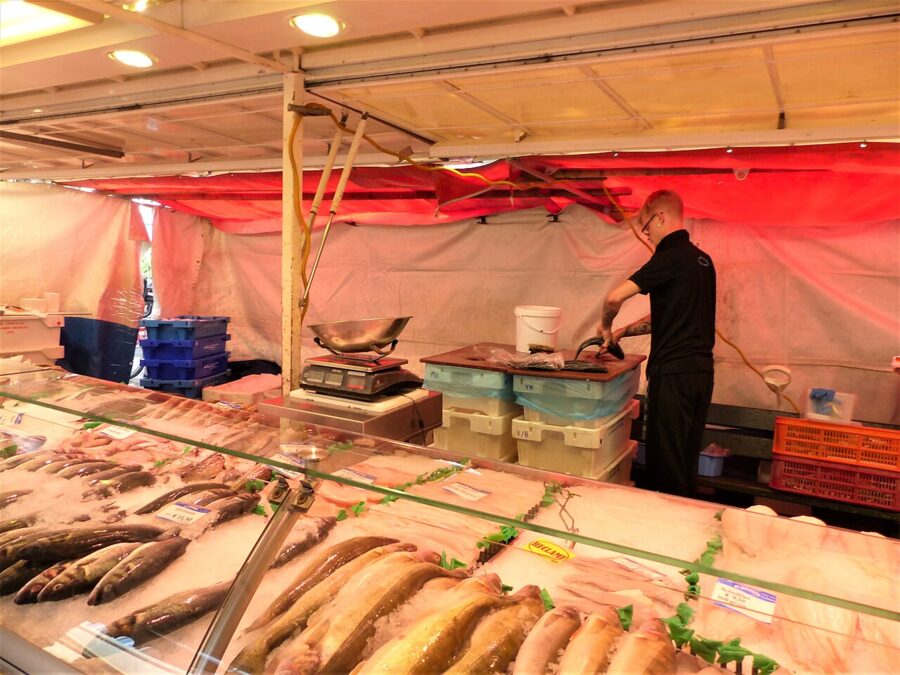
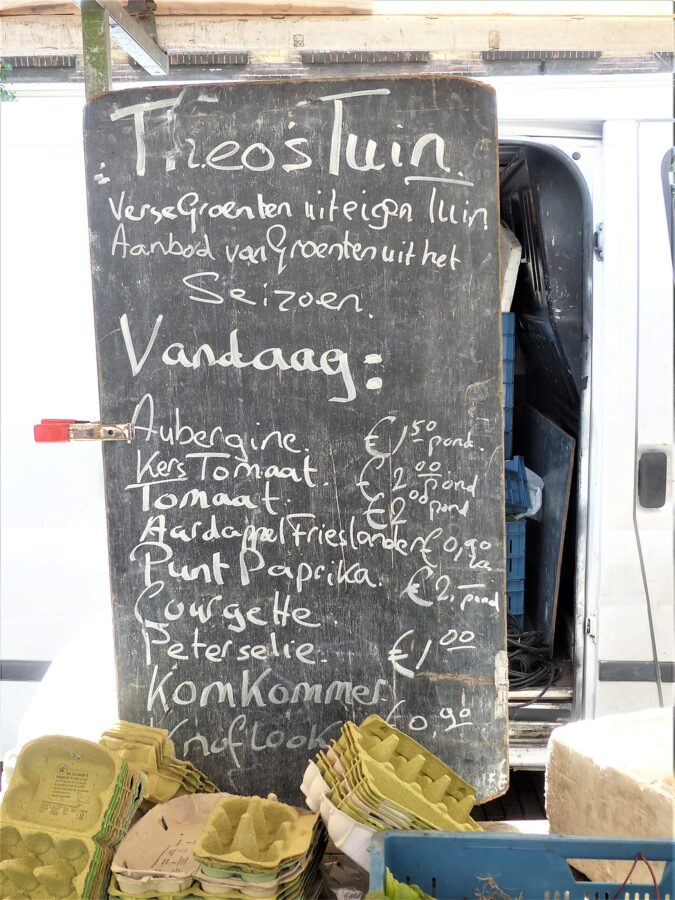
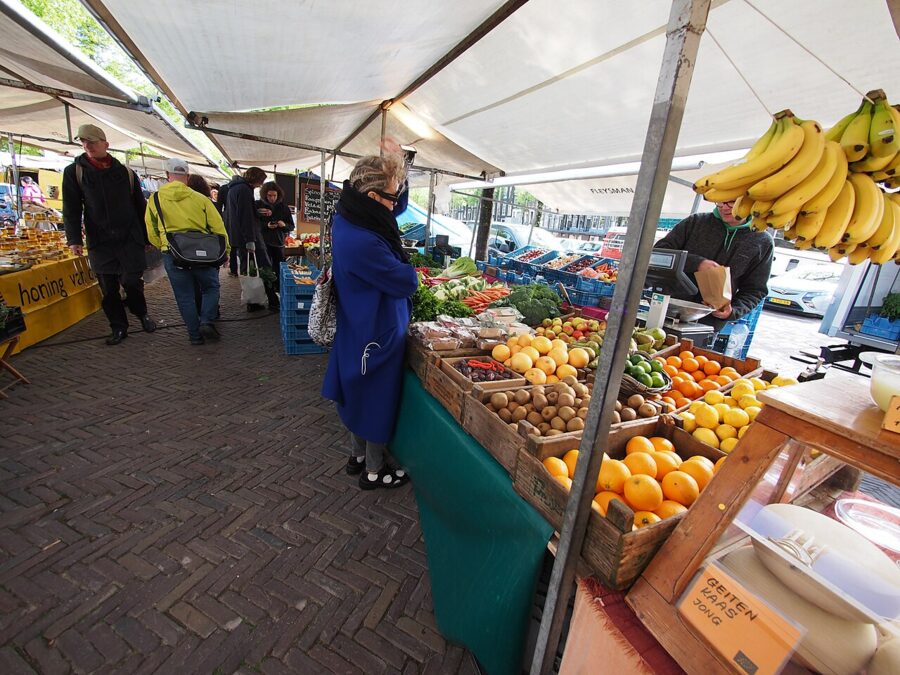
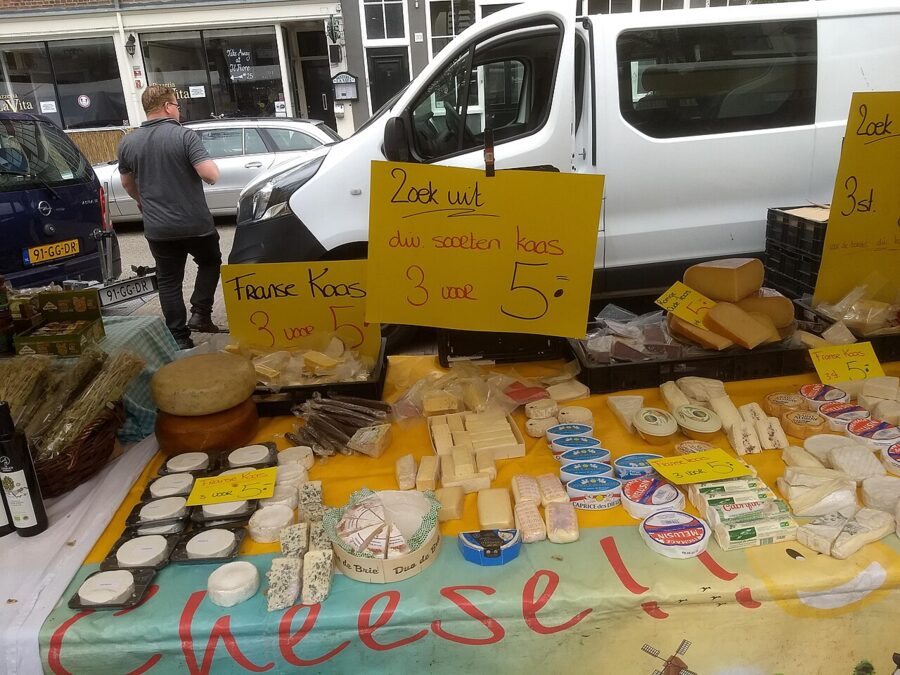
What is on sale follows the season: vegetables and fruit, bread, cheese, herbs, meat, fish, honey, flowers, and the mushrooms the market is known for. The mushroom stalls are the best reason to come in autumn, with wild and cultivated kinds laid out in crates; one stall, Portabella, is the one locals name first. There are juice and super-food stalls, jam and sweets from small producers, fresh pasta, and a fish stall that will open oysters for you to eat on the spot with a glass of wine.
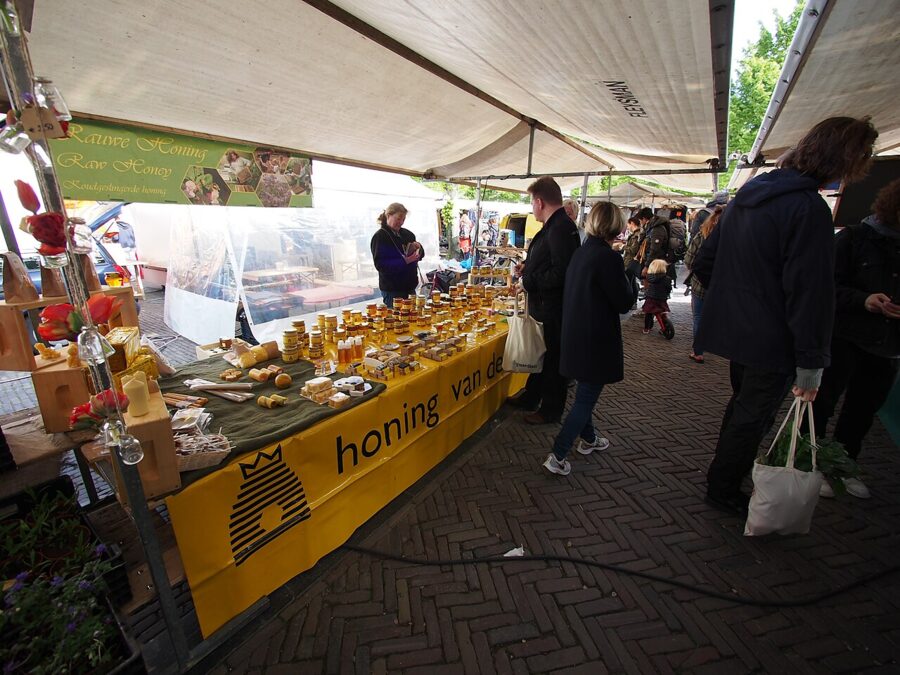
It is not cheap. Vegetables cost more than at the supermarket round the corner, and the people who shop here every week do it for the quality and the conversation, not the price. For a visitor that hardly matters, since you are buying lunch rather than a week’s groceries.


What to eat while you are there
Eat standing up and in this order: oysters at the fish stall, a pancake from the pancake stand, then whatever the cheese sellers offer as a taste. Bread from one of the bakers’ stalls and a wedge of aged cheese make a better lunch than most cafés in the center will sell you.
The goods market on the other half of the square
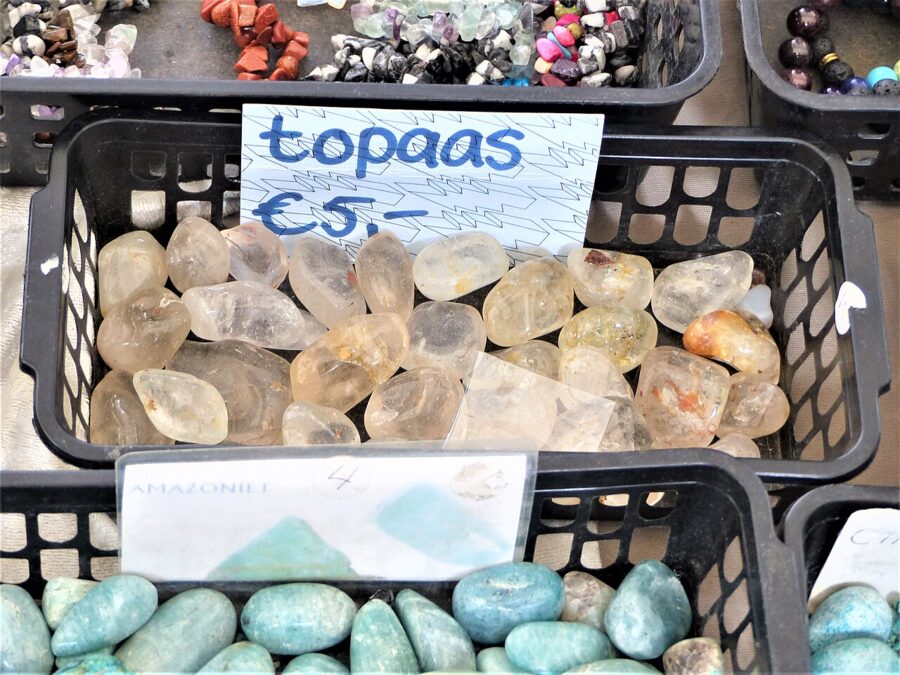
The Saturday goods market is smaller than Monday’s and leans toward new things: jewelry, gemstones, hats, rugs, antique tiles, prints, toys and bags made from recycled material, including some sewn from old tent canvas. The market makes a point of traders who make what they sell and of socially responsible business, and says some of the recycled goods are sold at no other market. Antiques and a few brocante stalls fill the rest.


Winkel 43 and the apple pie
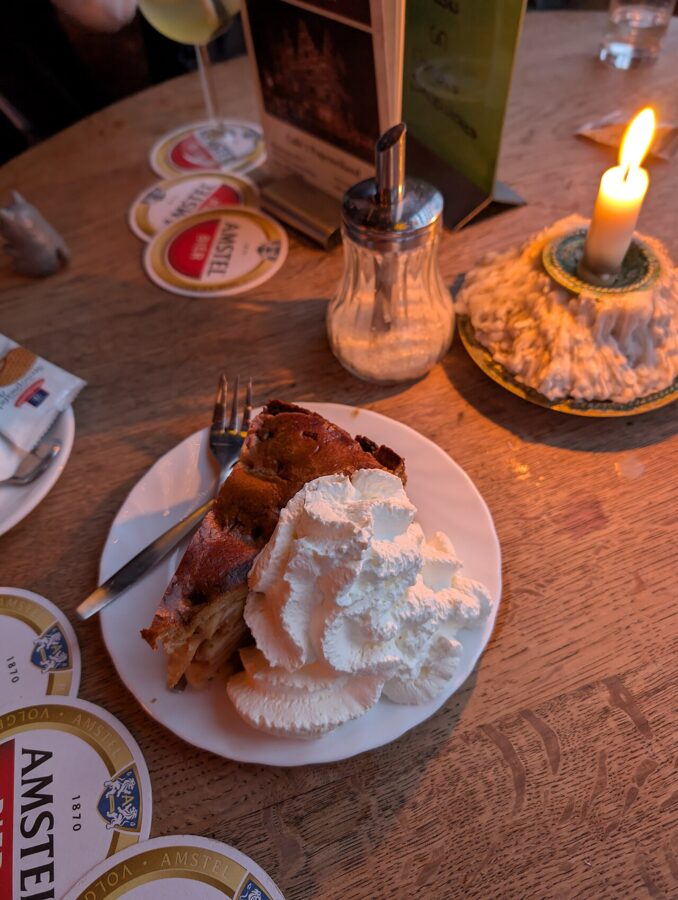
The corner building where the square meets the Westerstraat, Noordermarkt 43, has been the café Winkel 43 since 1983. Its apple pie is the one Amsterdam talks about: a tall slice with a thick, crisp crust and soft spiced apple inside, served with a heap of whipped cream. It costs €8 (about US$9) on the menu as of November 2026, which is steep for pie and fair for this one.
The pie is baked fresh every day, and not by the café’s regular cooks. Winkel bakes with a team from Cordaan, the Amsterdam care organization, so the people making it in the kitchen are people with disabilities working there daily. On market mornings the café opens at 07:00 (on other weekdays at 08:00, Sundays at 09:00) and runs a separate market menu.
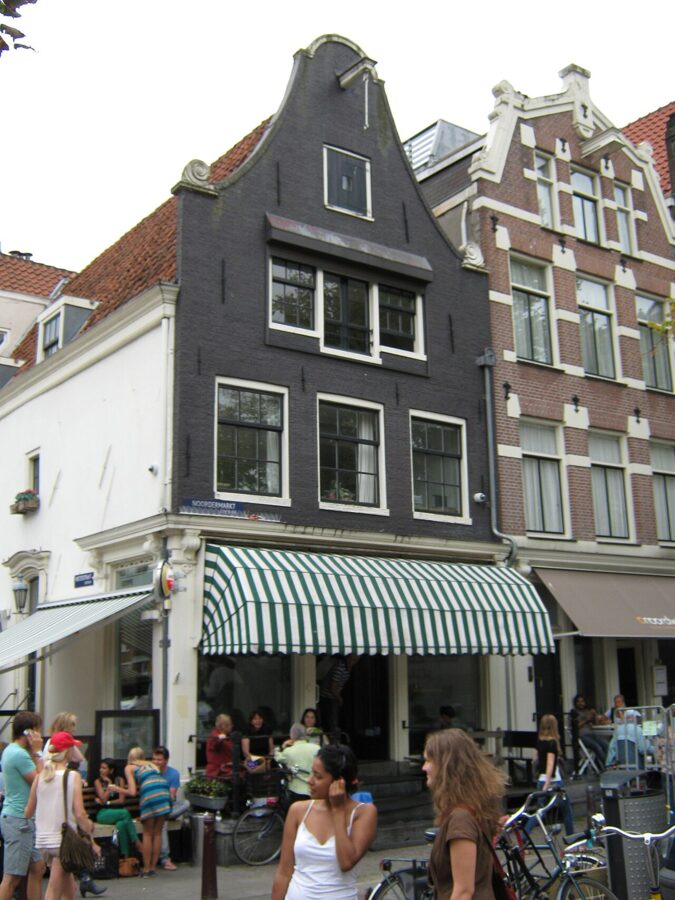

Is it worth the wait on a Saturday? Yes, if you go at the right time. Come early or late in the day and you will usually find a seat; in the middle of a sunny Saturday you may stand. On a Monday it is easier, and you can take the slice out to the terrace and watch the textile sellers pack up.
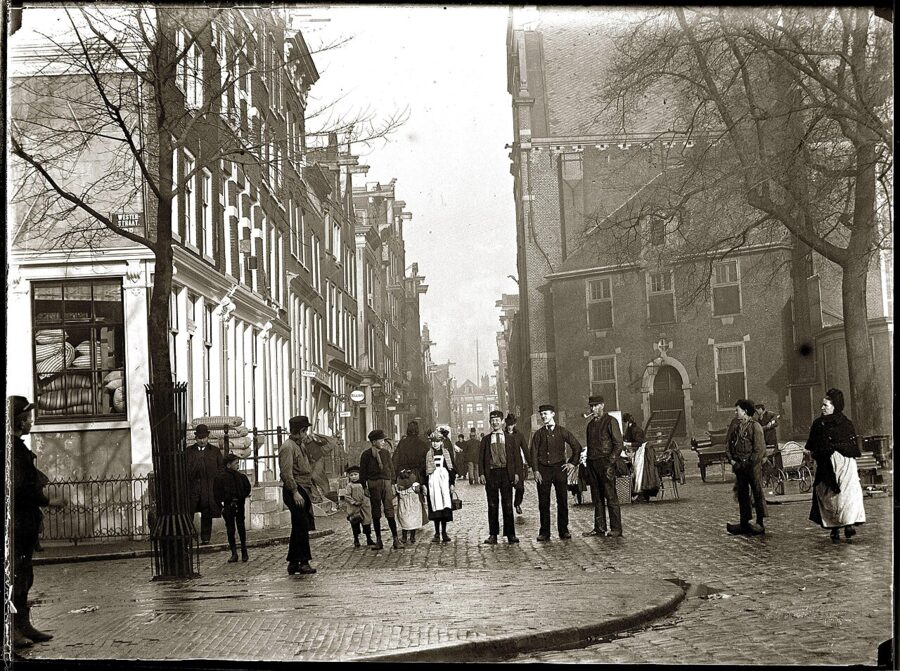
The Noorderkerk
The church that gives the square its name, the North Church, was built between 1620 and 1623 to serve the fast-growing Jordaan and the western canal belt. Hendrick de Keyser designed it but died in 1621, and the city carpenter Hendrick Staets finished the work with de Keyser’s son Pieter. The first stone was laid on 15 June 1622 and the first service held on 16 April 1623.
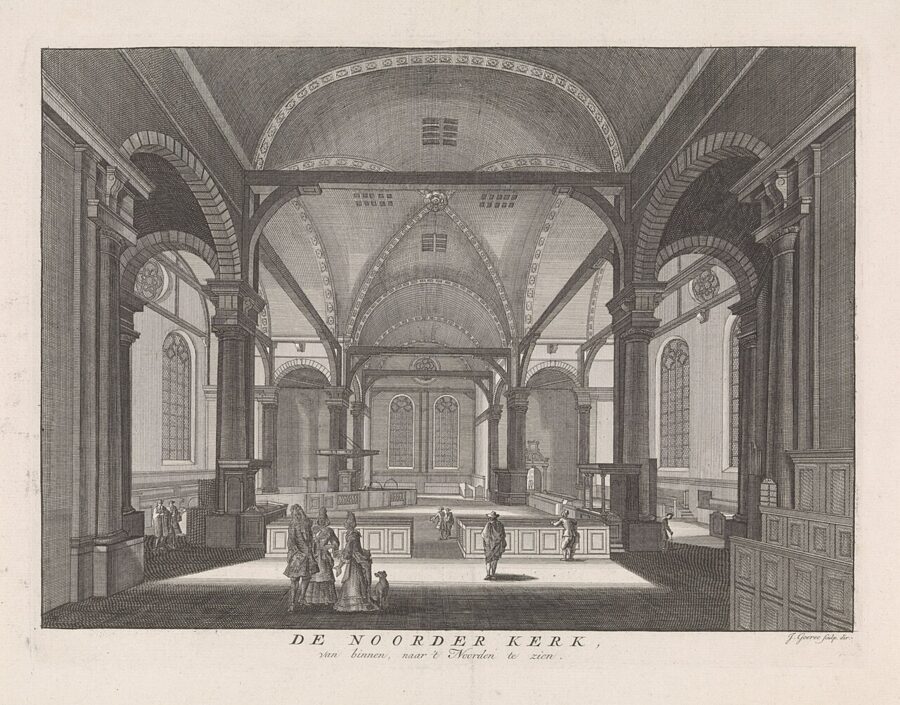
It looks unlike Amsterdam’s other big churches because of its plan, a Greek cross with four equal arms, and small houses tucked into the angles between them. It became a model for many Protestant churches built in the Dutch Republic, among them the Nieuwe Kerk in Groningen and the one in Emden. Inside, four heavy piers carry the vaults.
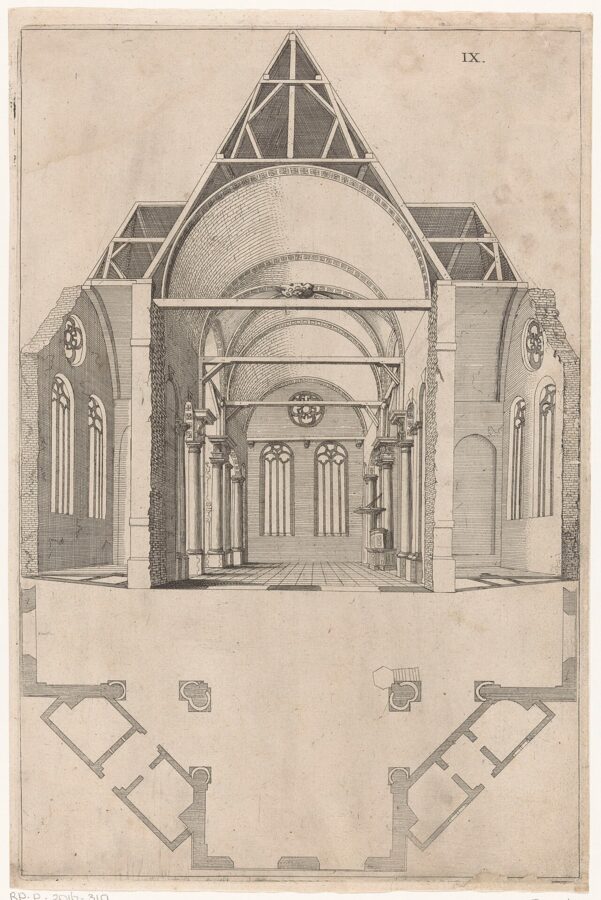
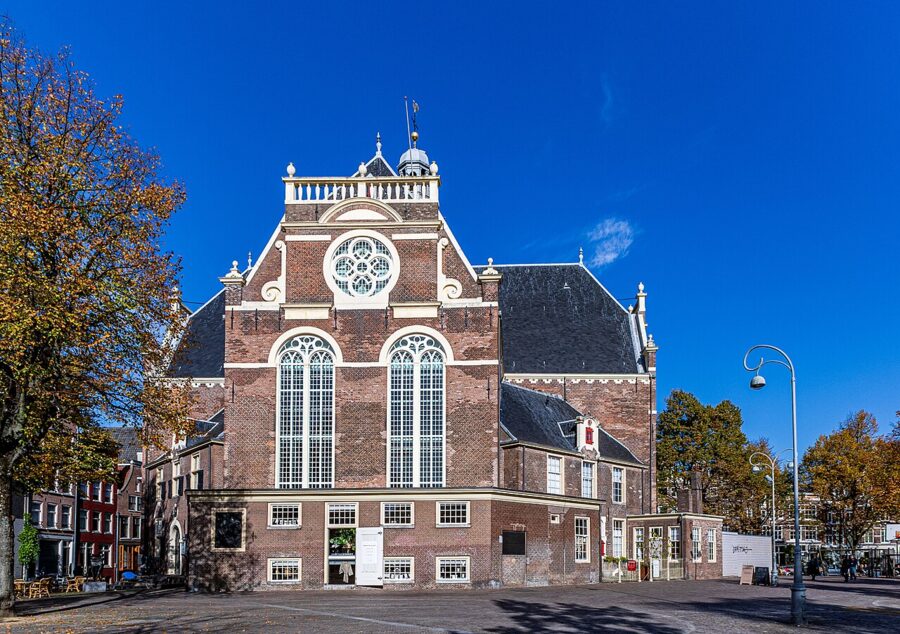

The Noorderkerk is still a working Protestant church, with services at 10:00 and 18:30 on Sundays, and a restoration in the 1990s, paid for largely by the city and the state, came with the condition that it be used for culture as well. Since 1999 the Noorderkerkconcerten have put classical chamber music in the church on Saturday afternoons, which makes an easy end to a market morning. Check the season’s program before you plan around it.
Since 2024 the church has also housed a light show, Vincent van Gogh & Rembrandt in Amsterdam, about 40 minutes long with timed tickets sold on its own site. It is not the Van Gogh Museum and does not pretend to be. The Van Gogh link is real, though: on 10 June 1877 the young Vincent heard a sermon here on the parable of the sower that stayed with him, and a month later he wrote to his brother Theo about the preacher, Eliza Laurillard.
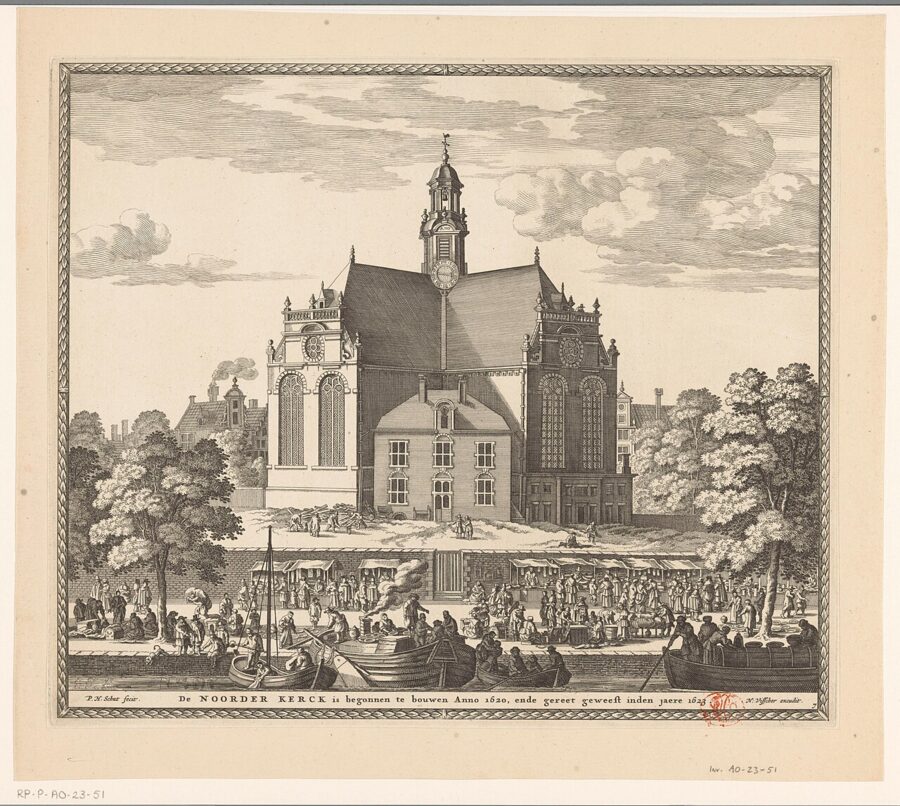
Four hundred years on one square
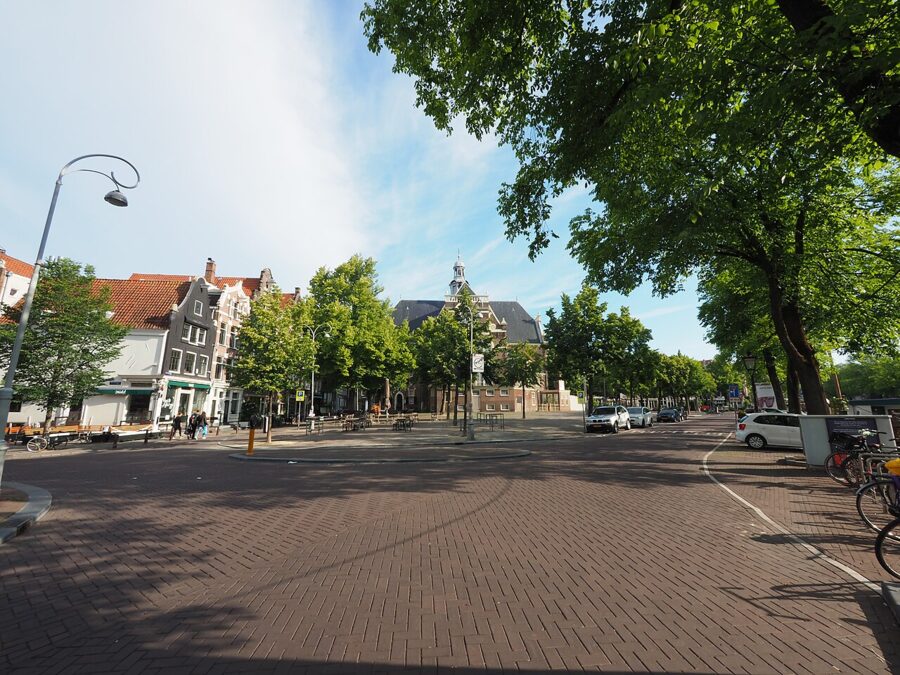
The square was laid out in 1616 and first called the Prinsenmarkt, after the Prinsengracht it borders. Once the church was finished the name Noordermarkt pushed out the one the city had given it, and for its first decades most of the square was graveyard. The pottery market was licensed to the churchyard, the rag market joined it in 1627, old hats were allowed from 1703, and the square stayed a center of the pigeon trade for the bird-keepers of the Jordaan.
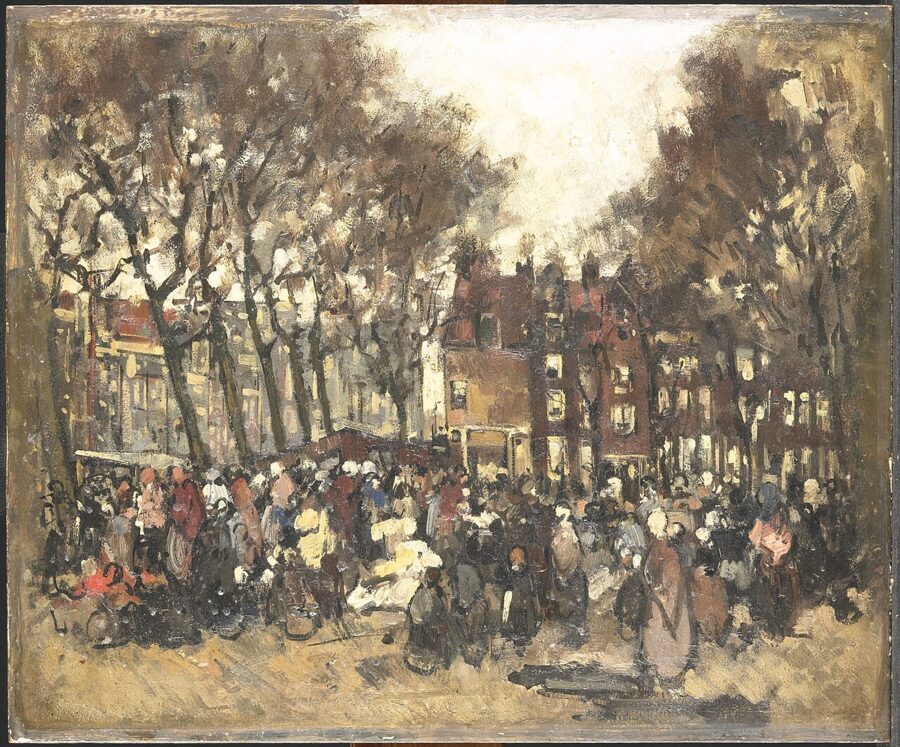
By the late 1920s this was the most important market in Amsterdam, with the Lindengracht a close second. In the slump of the 1930s second-hand goods sold better than ever, and the number of pitches on both markets grew. In July 1934, days after the government cut unemployment benefit by about ten percent, the Jordaan rose in riots that the army was called in to put down; a police report counted five dead.
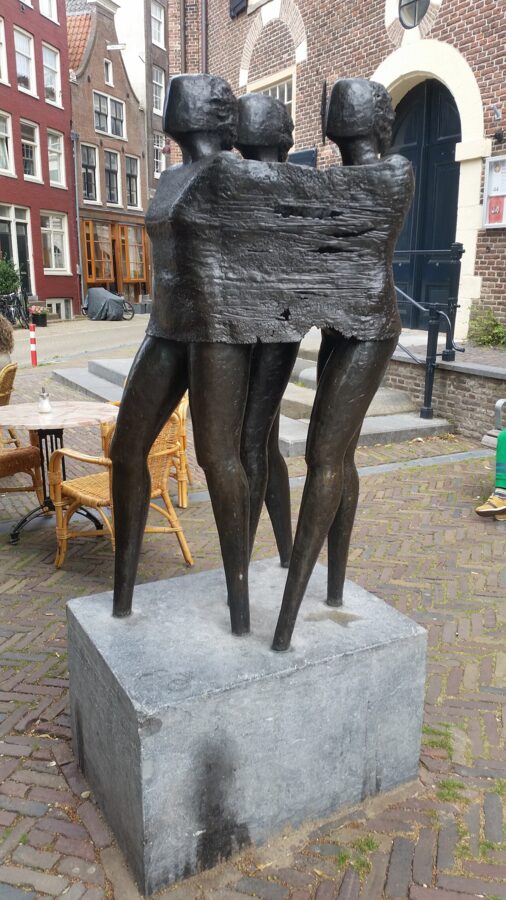

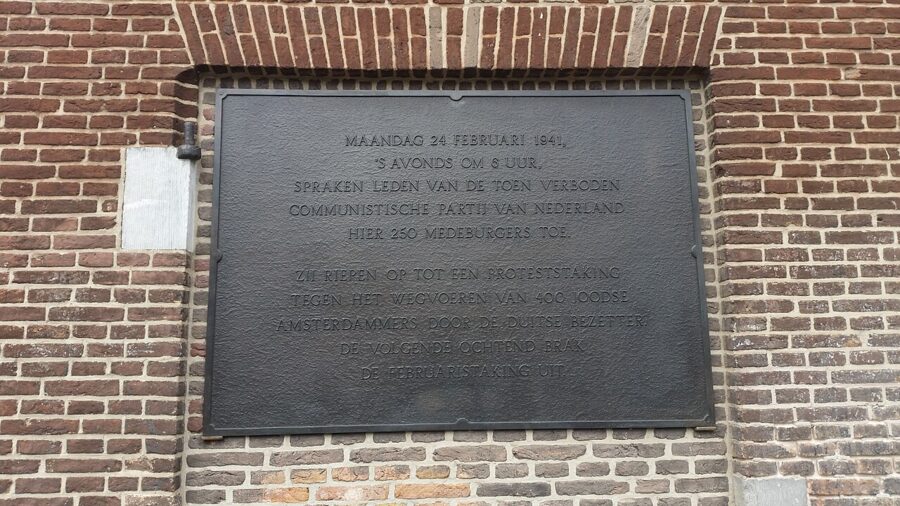
The square’s most important hour came on Monday 24 February 1941. At six in the evening, members of the banned Communist Party spoke to a crowd here and called for a strike against the deportation of Jewish Amsterdammers by the German occupier. The next morning the February Strike broke out across the city. A bronze plaque on the south wall of the church gives the crowd as 250; other accounts say about 400.

The war hollowed out Amsterdam’s markets. The number of market traders in the city fell from 3,600 in 1940 to 1,000 in 1944, Jewish traders were arrested and deported, and the Nieuwmarkt and Waterlooplein markets disappeared until 1947. The Noordermarkt kept going on second-hand goods through all of it.
From the 1970s the Jordaan changed around the market. Between 1977 and 1987 the neighborhood held a yearly Noordermarkt festival that grew out of protest at the emptying and gentrifying of the district, and the cafés on the square have come and gone, some noisily. The market turned 400 in 2023, and in December 2025 its traders presented a book, Streetwise, on the four centuries, sold at the stalls and in bookshops.

The markets around it
The Westerstraat on Monday
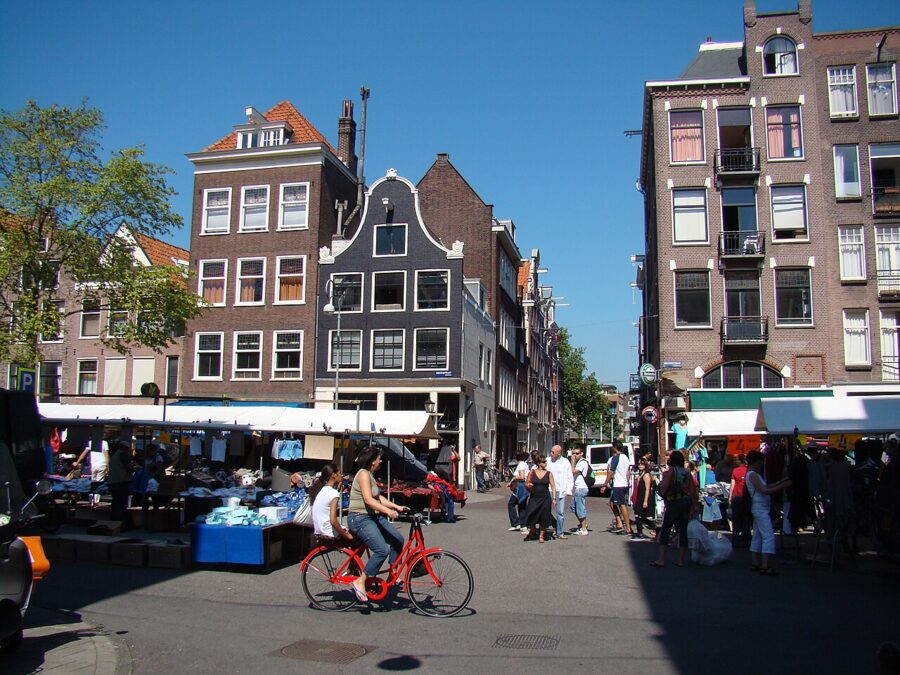
Stand on the Noordermarkt on a Monday and look left of the church: the stalls carry on up the Westerstraat, a broad street built over the filled-in Anjeliersgracht. This is the lapjesmarkt, the remnant market, and it is where Amsterdammers who sew still buy their cloth. Many stalls sell fabric by the meter and offcuts, and there are fixed pitches for fish, cheese and bread, vegetables and flowers.
The city’s rules allow 139 pitches and set selling hours of 08:30 until at least 13:00 and at most 14:00, as of the 2026 market regulations for the Westerstraat. One regular who sews cushions from its remnants says it feels more personal than the Albert Cuyp, and that her fabric seller asks every week whether the last one is finished. If you only have one Monday, do the Noordermarkt first and the Westerstraat on the way out.
The Lindengracht on Saturday
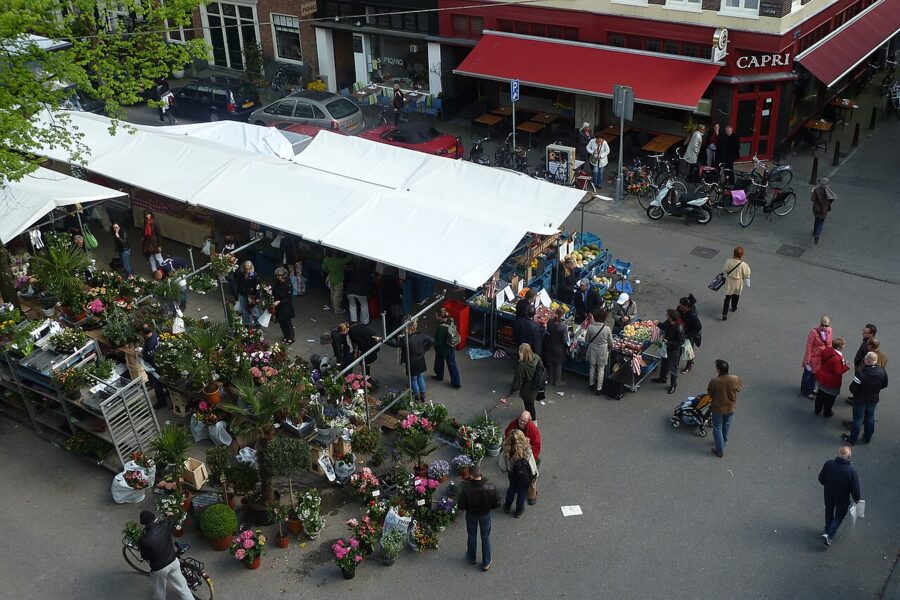
The Lindengracht runs parallel to the Westerstraat one block north, and it too was a canal until it was filled in 1895. Its Saturday market started in the 1890s, around the time the canal was filled, and today it has 224 pitches and runs more than 900 meters, 09:00–17:00 according to I amsterdam’s listing of the Lindengracht market. This is a plain neighborhood market, not an organic one: fruit and vegetables, fish, cheese, flowers and plants, and the everyday goods of any Dutch street market.
Prices are generally lower than on the organic market, the crowd is local, and it is the better place for a cheap lunch. Locals recommend tasting your way down it and stopping for a sabich, the Iraqi-Jewish pita of fried eggplant and egg, at one of the food stalls.


Amsterdam’s other flea market, the Waterlooplein market by the Stopera, is rougher and runs on more days of the week. For tulip bulbs and cut flowers, the Bloemenmarkt on the Singel is the famous one.
Getting there
The Noordermarkt has no house number of its own; it sits between the Prinsengracht, the Westerstraat and the Lindengracht, and the church is at Noordermarkt 48. From Amsterdam Centraal it is 1.3 kilometers, about 18 minutes on foot: out of the station to the right along the Prins Hendrikkade, down the Haarlemmerstraat, left along the Prinsengracht and over the Brouwersgracht. It is the best way in, and the Haarlemmerstraat is worth walking anyway.
- Tram: tram 12 to Nieuwe Willemsstraat or Marnixplein, then five minutes east along the Westerstraat. Since GVB’s 29 March 2026 timetable change tram 12 has taken over this stretch from the old tram 3. Tram 5 from Leidseplein also stops at Marnixplein.
- Bus: bus 21 from the IJ side of Centraal stops at Buiten Brouwersstraat, about six minutes’ walk from the square.
- On foot from the Anne Frank House or the Westerkerk: about 700 meters north along the Prinsengracht, ten minutes.
- By bike: lock up in a side street, not against the stalls; on market days the square and the market streets have no room for bikes.
- By car: don’t. Use a P+R on the edge of the city and come in by tram, or one of the garages near Centraal.
Lines and stops are as of November 2026 and change with roadworks, so check the 9292 planner or the GVB app on the morning you go.
A Jordaan walk after the market
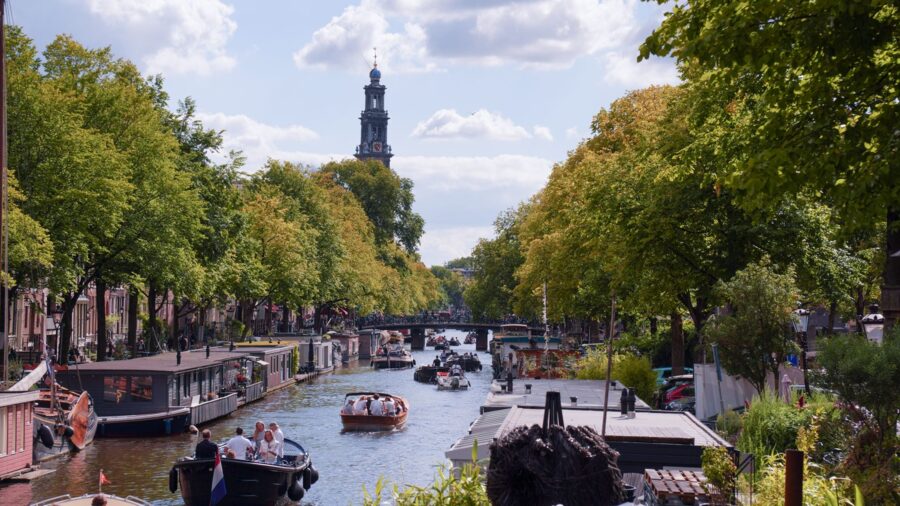
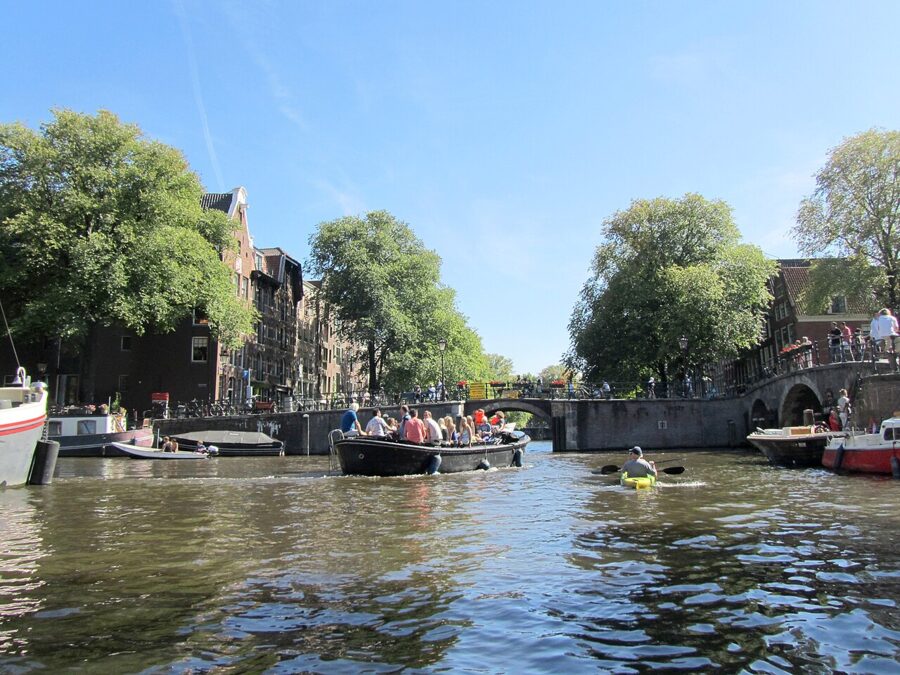
Leave the square at the canal end and walk a minute north along the Prinsengracht to its corner with the Brouwersgracht, one of the finest canal corners in the city. Café ‘t Papeneiland, at Prinsengracht 2, has stood on that corner since 1642; it is a classic brown café with a homemade apple pie of its own. It made world news when Bill Clinton came in to taste that pie on his visit to Amsterdam.
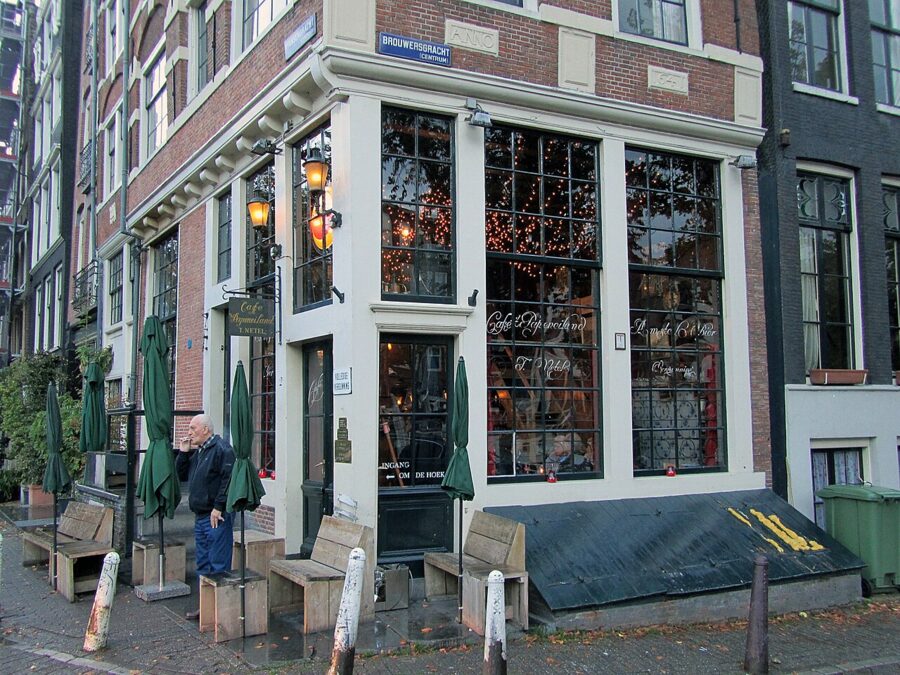

So which pie? Winkel’s is taller and creamier; Papeneiland’s comes with a seat in a canal-corner house from the 1640s. Have one on the market and the other on the way back, and stop pretending you came for the vegetables.

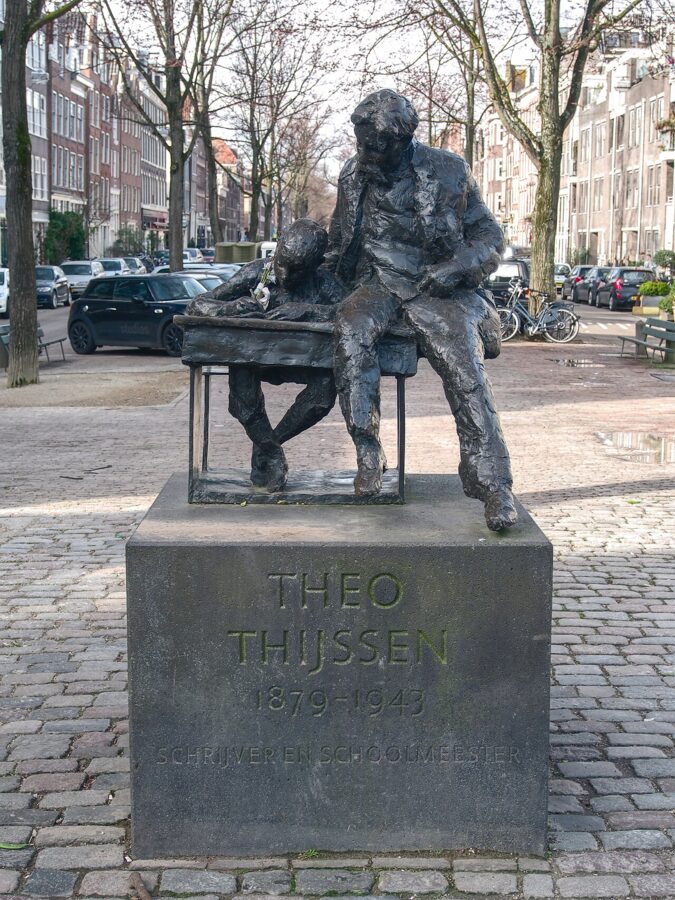
From Papeneiland, walk west along the Brouwersgracht and turn left down the Lindengracht. At the Brouwersgracht end stands Hans Bayens’ bronze of Theo Thijssen, the Jordaan schoolteacher who wrote Kees de jongen, and Café Thijssen on the corner is named after him; his birthplace on the Eerste Leliedwarsstraat is now the small Theo Thijssen Museum. Halfway along the Lindengracht, at numbers 94–112, the Lindenhofje of 1616 is one of the oldest almshouse courtyards in Amsterdam.
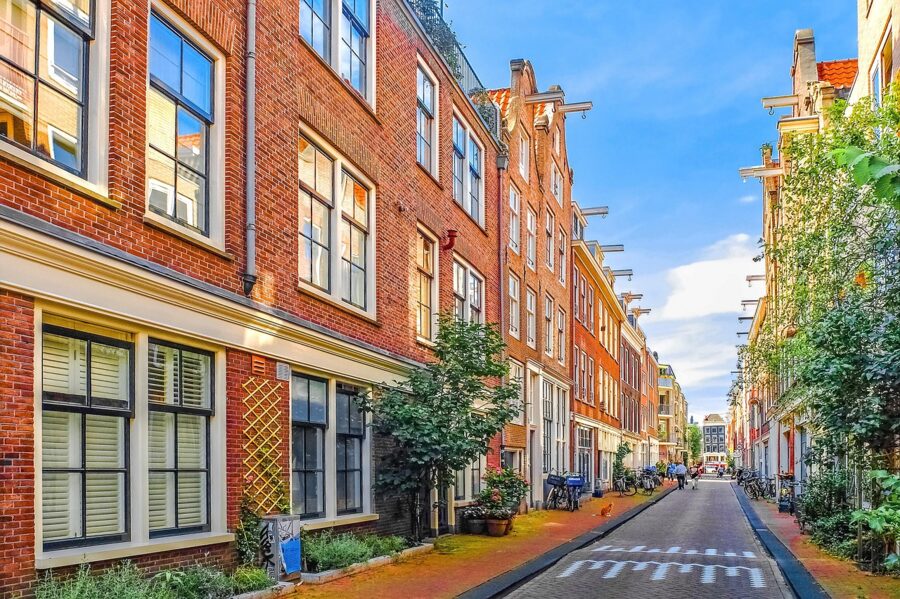
Then cut south through the side streets, the dwarsstraten, toward the Westerkerk and the Anne Frank House, both about ten minutes from the Noordermarkt. The streets between the Westerstraat and the Rozengracht are where the Jordaan is still mostly homes and small shops rather than terraces. If you have the afternoon, the canal cruises are the other way to see the Prinsengracht and its church towers.
Go on a Monday for the textiles and a Saturday for the food, and never midweek. Take tram 12 to Nieuwe Willemsstraat or walk the eighteen minutes from Centraal, be at the stalls by nine, and save the apple pie at Winkel 43 for when the dealers start packing up.