
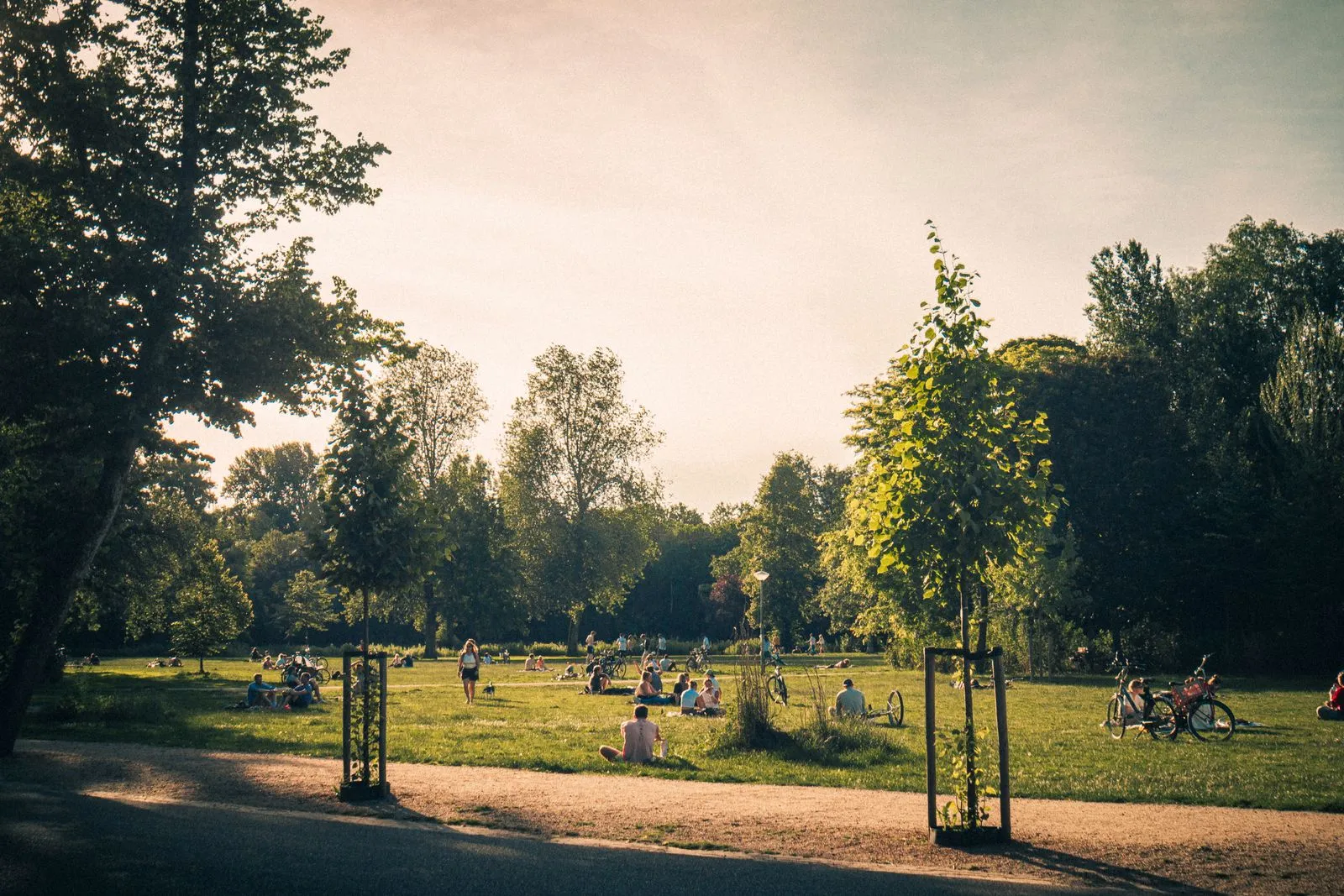
Since 11 May 2026 there has been a sign at the Vondelpark entrances that would have baffled the men who laid the park out in 1865: no fatbikes. The city put it up after years of complaints about heavy electric bikes on paths full of toddlers and dog walkers, and by 1 September its officers had written 167 fines. Barbecues went the same way in 2017. What is left is what the park was always meant to be, a long strip of lawns, ponds and old trees where you walk, sit, run and drink a beer.
An estimated ten million visits a year land on its 47 hectares (116 acres), which makes the Vondelpark the busiest park in Amsterdam and, on a warm Saturday, one of the most crowded places in the city. It runs from the Stadhouderskade, two minutes from the Leidseplein, south-west to the Amstelveenseweg. The east end is the one everyone uses. The west end, past the rose garden and the old cow meadow, is where the park goes quiet.
Entry is free and there is nothing to book unless you want a guaranteed seat at the open-air theater. What you do need is a sense of which end to start from, which café is open in November, and which rules are actually enforced here. That is what follows, from the gate on the Stadhouderskade to the pumping station at the far end.

The park end to end on foot
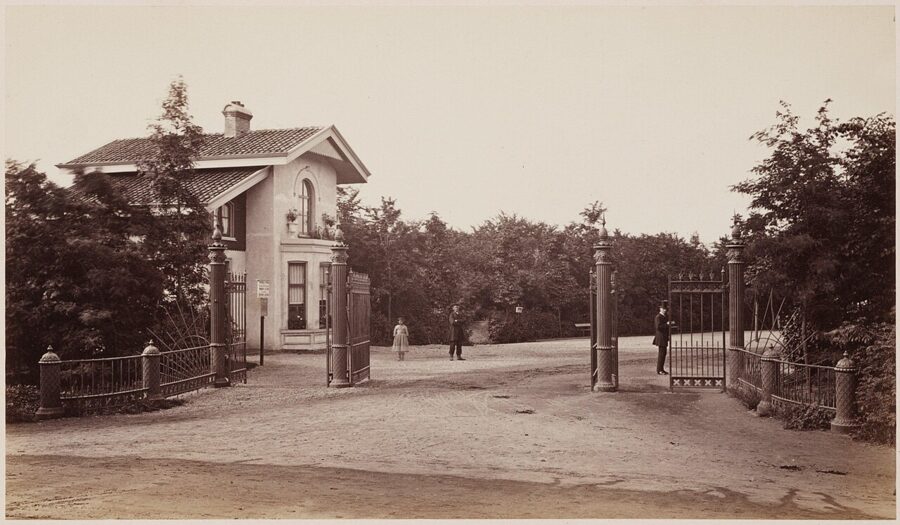
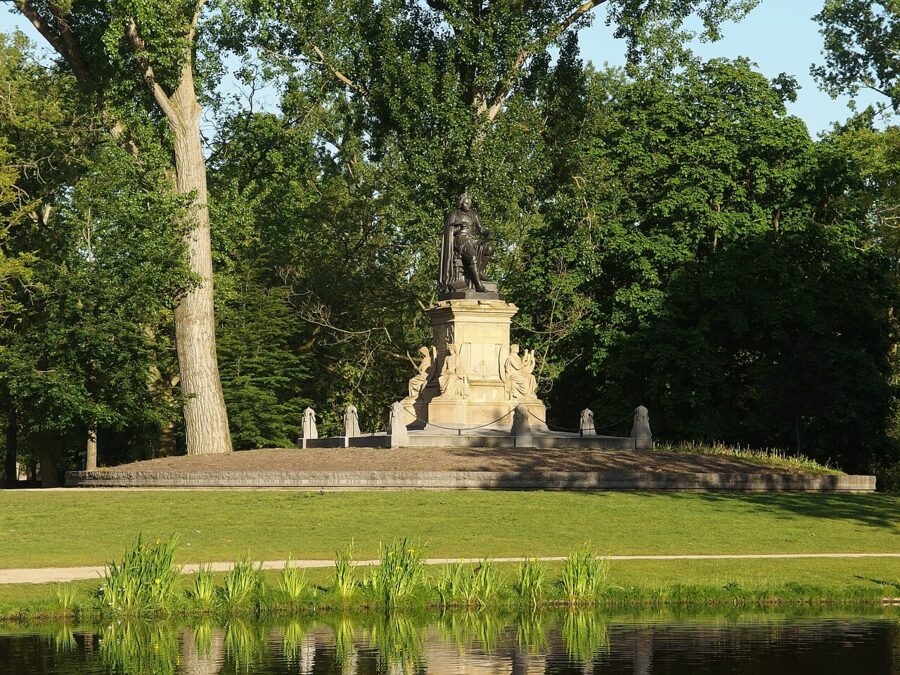
Start at the main gate on the Stadhouderskade, across the road from the Singelgracht. The small house beside it is the park keeper’s lodge of 1867, designed by Louis Paul Zocher, one of the two garden architects who drew the park. From here the main lane bends past the first ponds, and on this oldest stretch, between the gate and the Vondelbrug, stands the seated bronze of Joost van den Vondel on his tall pedestal.
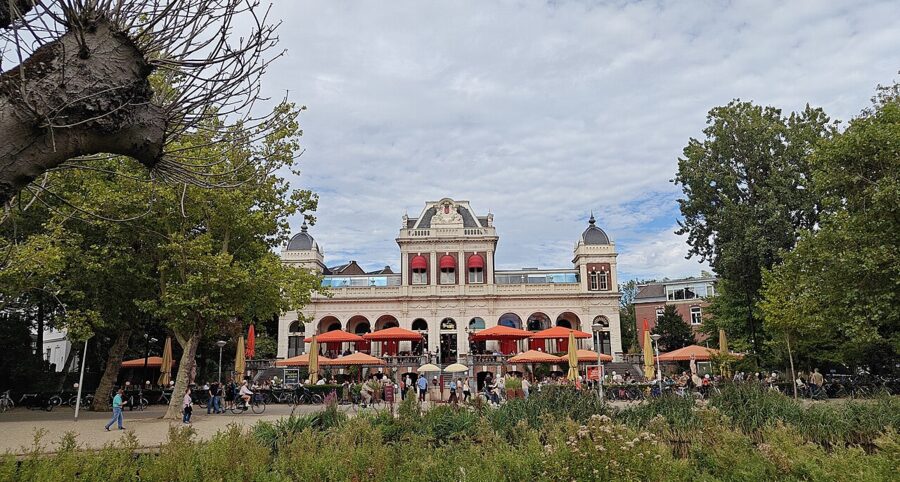
Next comes the cream-colored Vondelpark Pavilion, the former Filmmuseum, with its café terrace facing the park. Just beyond it the Vondelbrug, a 1947 road and tram viaduct, crosses overhead, and tram 12 runs across it. Under the bridge’s north end is the old nuclear shelter now known as the Vondelbunker.
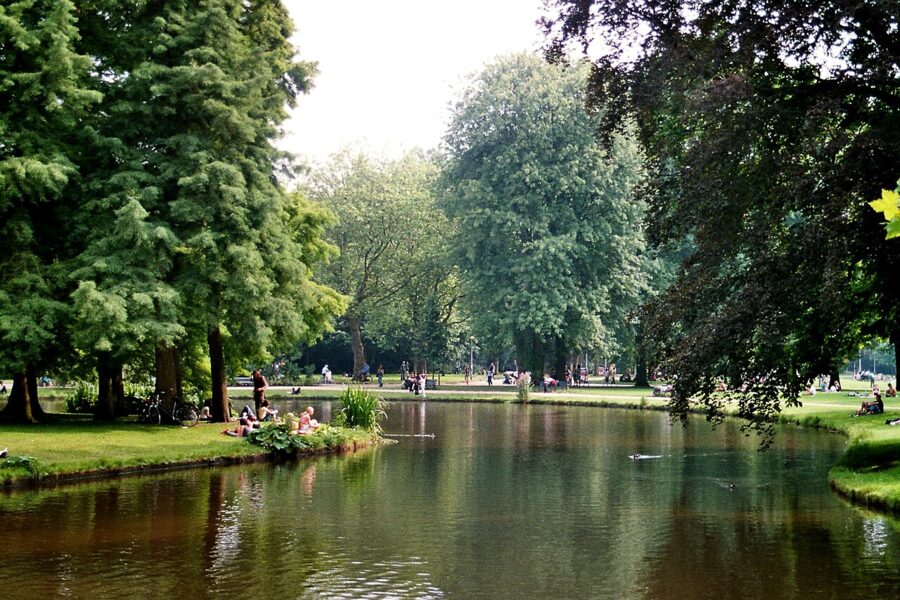
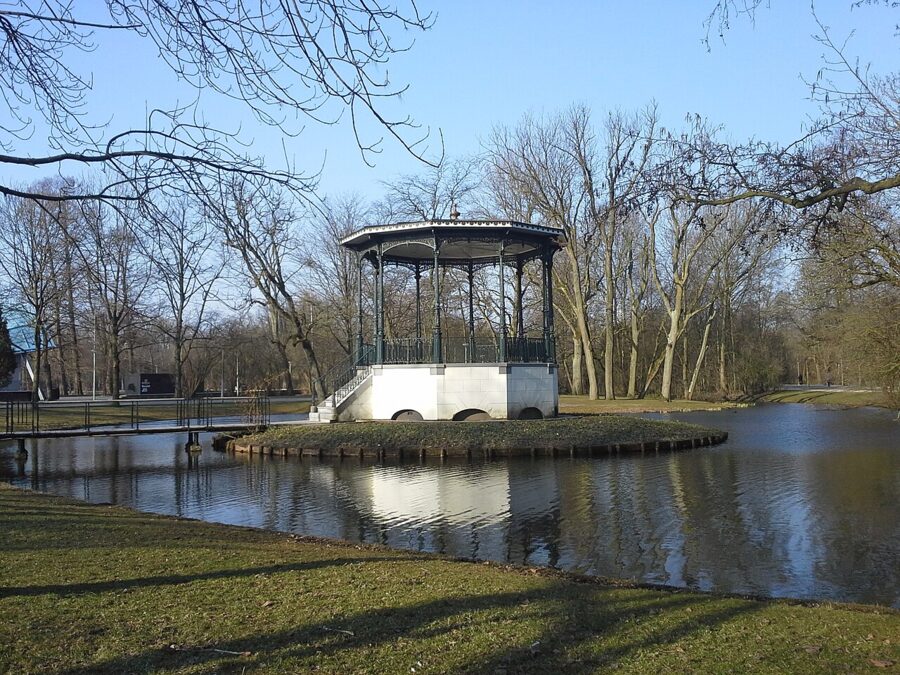
West of the bridge the park widens. The round Blauwe Theehuis sits near the middle with the Openluchttheater close by, and a white bandstand stands on its own island in a pond. Farther on come the Rosarium, the Picasso sculpture on its lawn, and the Groot Melkhuis with its playground.
The last third is the least groomed. Fenced meadows here still go by the names Koeweide and Schapenweide, the cow and sheep meadows, and storks nest on poles in both; their chicks are ringed almost every June by a volunteer team working with the city. The far end has its own pumping station by the Amstelveenseweg, because constant drainage has made the peat shrink, and the whole park now lies about two meters below the streets around it.
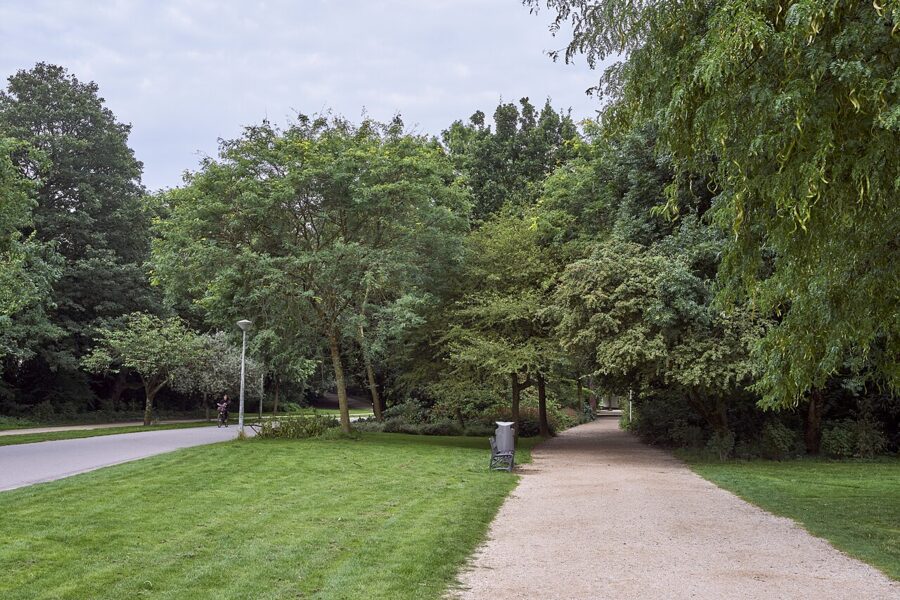

How long does it take? The outer paved loop is a little over 3 kilometers, about 3.3 by the usual measure, so walking it without stopping takes around 40 minutes. If you only want to see the park once, walk it one way, from the Stadhouderskade gate to the Amstelveenseweg, and take a tram back.
How the park came to be here
The Vondelpark was a property deal before it was a park. In 1864 a group of wealthy Amsterdammers led by Christiaan Pieter van Eeghen formed the Vereniging tot aanleg van een Rij- en Wandelpark, an association for a riding and walking park, and bought a long strip of peat meadow outside the city. A park would raise the value of the villas they meant to build around it, and it did.
They gave the design to the Haarlem garden architects Jan David Zocher and his son Louis Paul, who worked in the English style: winding paths, irregular ponds, clumps of trees placed so that you lose sight of the city. The first part opened on 15 June 1865 as the Nieuwe Park, the new park. Members walked in free; everyone else paid. Louis Paul Zocher’s extension of 1876 to 1877 took it to its present size.
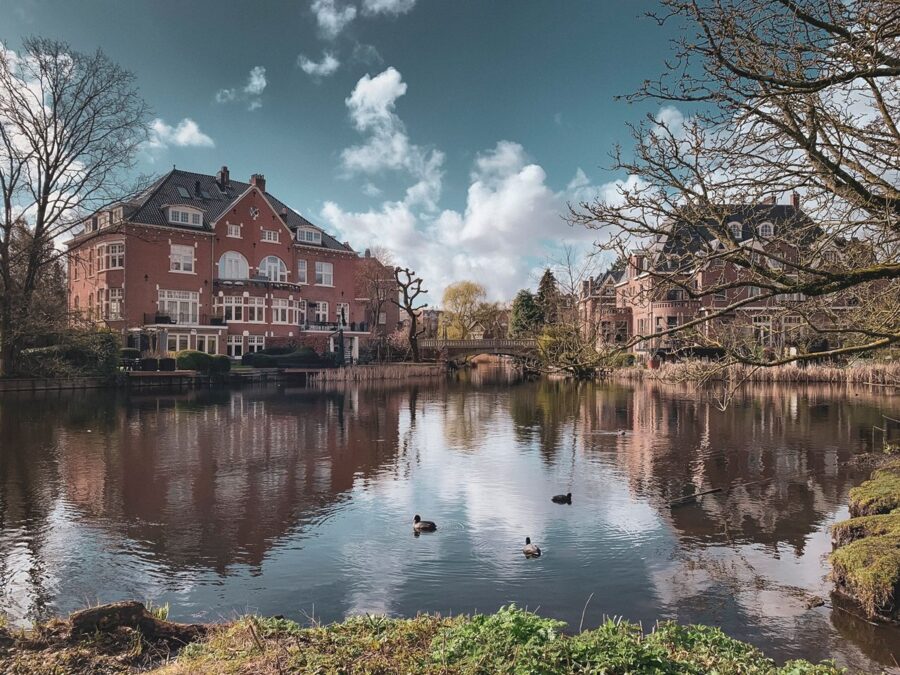
The association kept the park private for almost ninety years. During the German occupation it was requisitioned, ditches were dug across the lawns against glider landings, and from mid-November 1944 it was closed because freezing Amsterdammers were cutting its trees for firewood. In 1953 the association, unable to pay for upkeep, gave the park to the city.
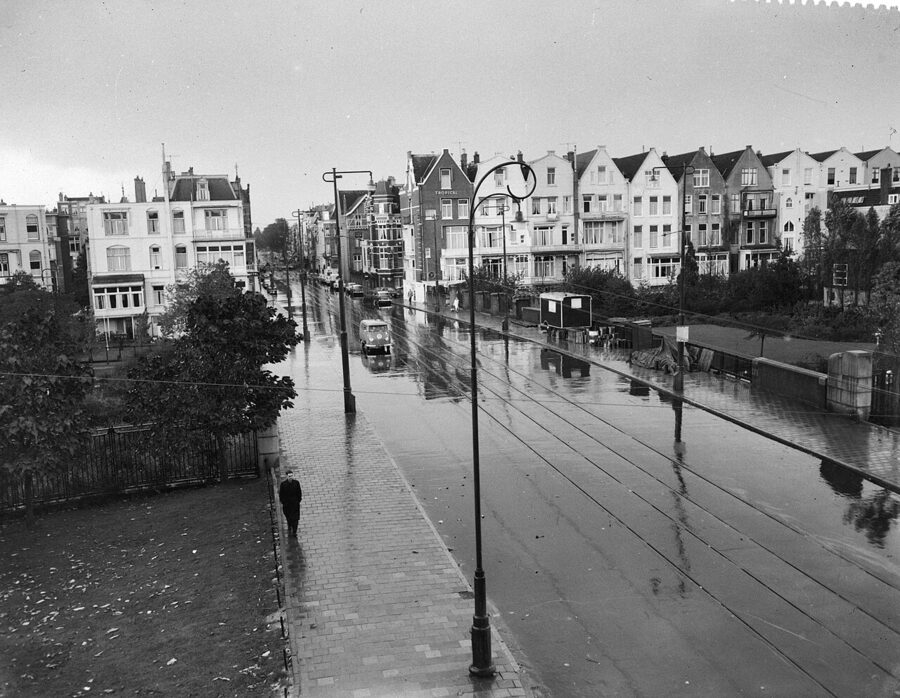
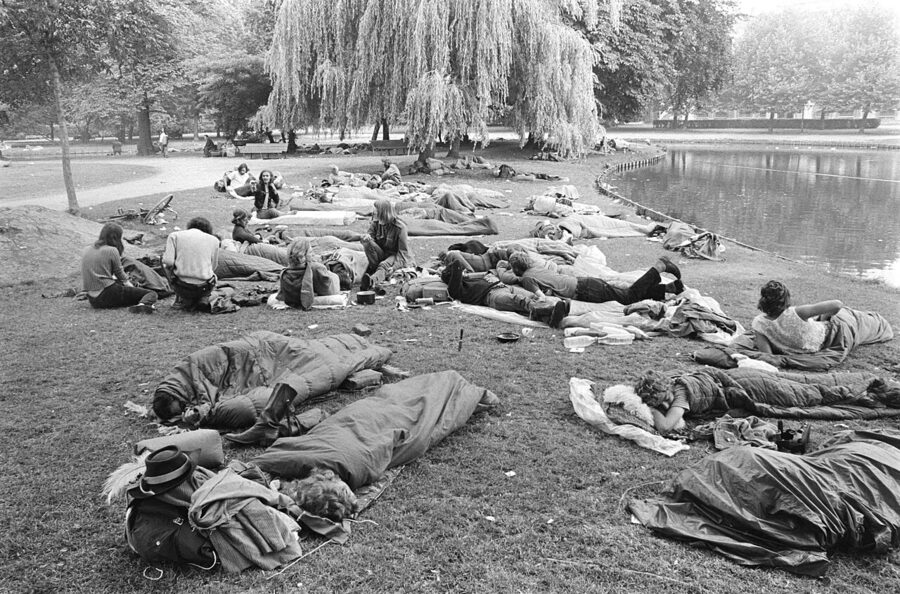
The 1960s and 1970s made it famous abroad, when young travelers slept on its lawns through the summer. Since 1996 the park has been a rijksmonument, a protected national monument. Between 1999 and 2010 it was rebuilt from below, with new drainage, new foundations for the trees and joined-up ponds with natural banks, and it reopened on 28 February 2010.
Vondel and his statue
The name came from a statue. The architect Pierre Cuypers, who lived on the nearby Vondelstraat, campaigned from 1862 for a monument to Joost van den Vondel (1587-1679), born in Cologne and raised in Amsterdam, the poet and playwright the Dutch rank as the greatest writer in their language. Cuypers organized fund-raising festivals and designed the pedestal himself.
The bronze by Louis Royer was unveiled on 18 October 1867. It shows Vondel seated with a book on his knee and a quill raised, and the four sandstone angels at the corners, by Jean Hubert Lauweriks, stand for his tragedies, satires, didactic verse and sacred poetry. People started calling the place Vondel’s park almost at once. After a linguistic quarrel over that possessive s, “Vondelpark” became the official name in 1880.

The Picasso, the rose garden and Mama Baranka
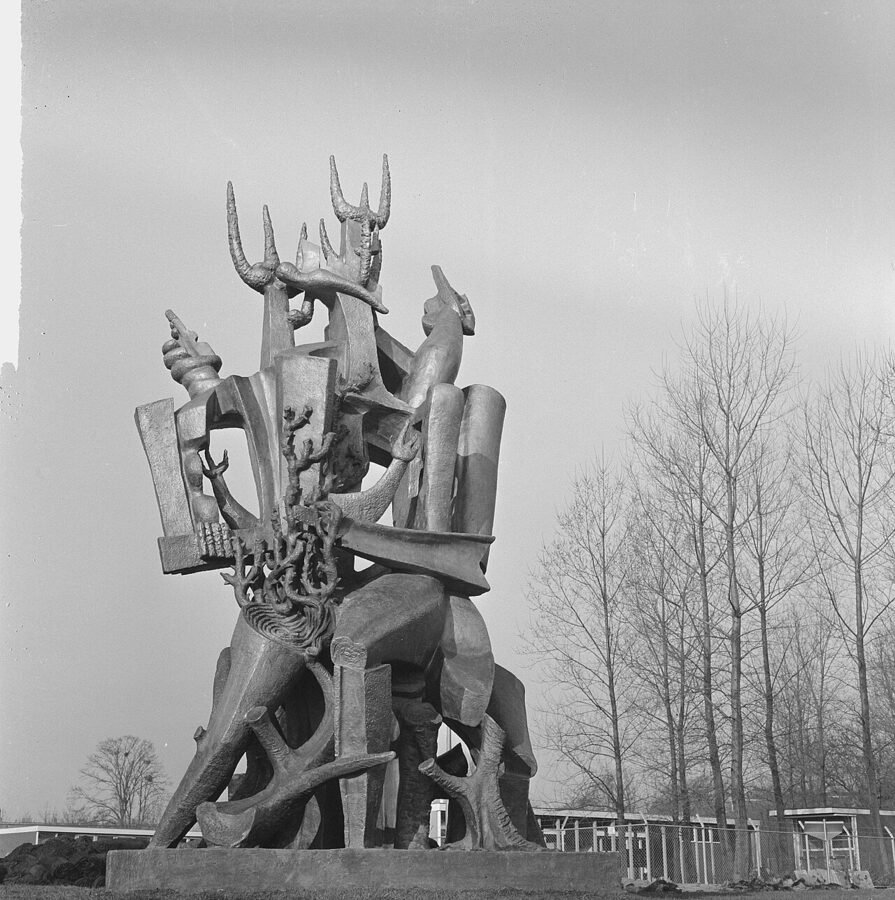
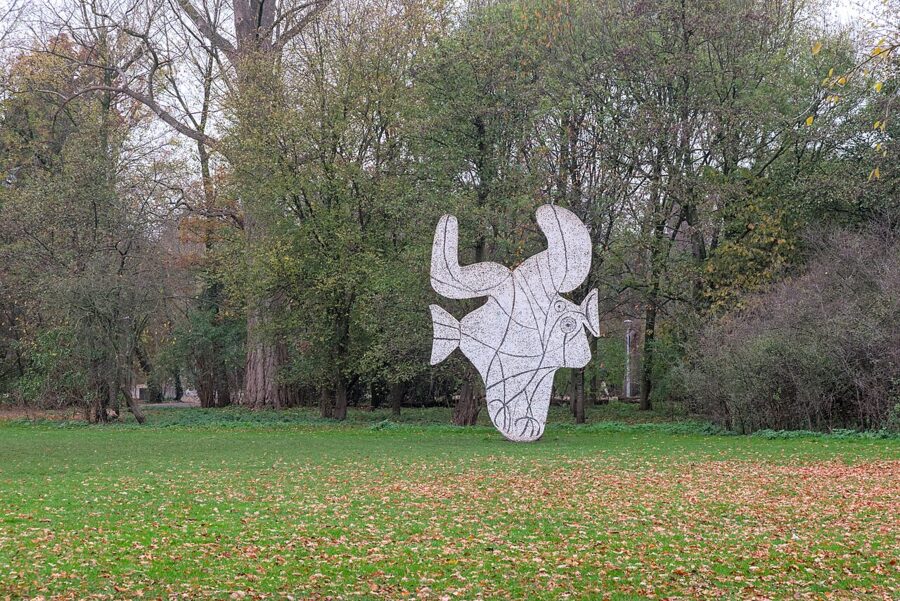
For the park’s centenary in 1965, Willem Sandberg, just retired as director of the Stedelijk Museum, put together an international sculpture show here with work by Karel Appel, Alexander Calder, Henry Moore, Jean Tinguely, Ossip Zadkine and Pablo Picasso. Picasso’s piece stayed. Figure découpée, a flat concrete figure about seven meters high, was executed by the Norwegian sculptor Carl Nesjar from Picasso’s sketch.
Amsterdammers call it the flat fish or the flat bird. Picasso waived his fee on condition that the city pay for the installation and that the work always remain on public view. When the borough floated selling it in 1994 to cover park maintenance, the city blocked the idea on exactly those grounds.

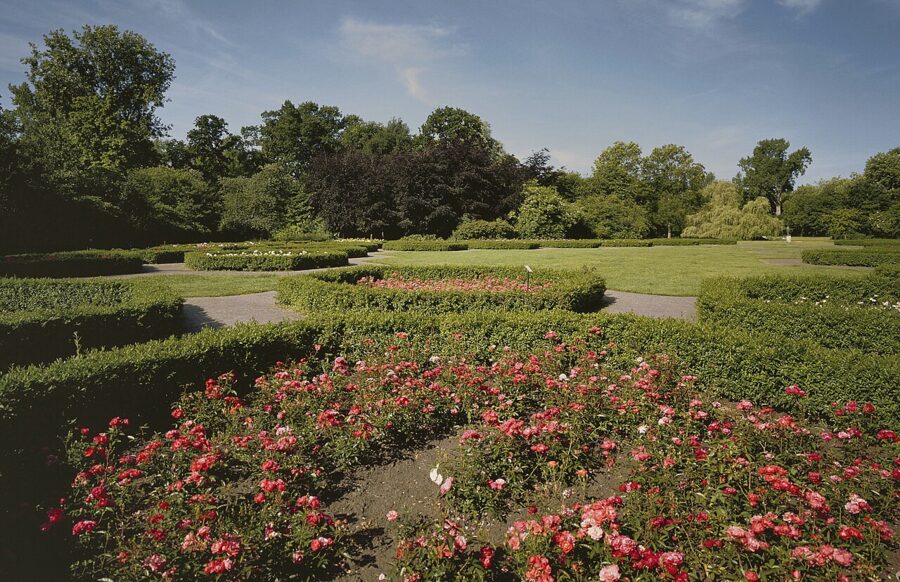
The Rosarium in the north-west of the park took its present form in the 1958-1959 renovation by the garden architect Egbert Mos: 80 hexagonal beds, 63 of them for roses. June is the month to see it in flower, and volunteers help the city keep it.

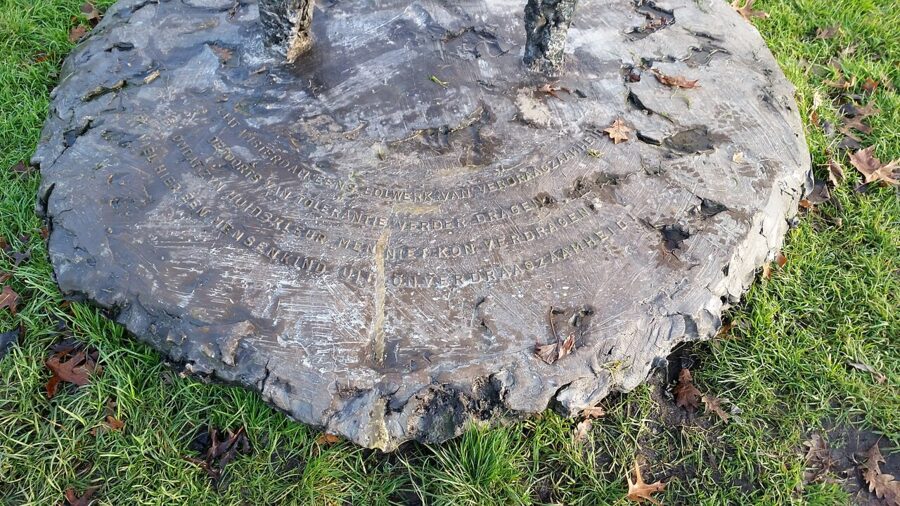
Near the water stands Mama Baranka, a stone figure by Nelson Carrilho unveiled in 1984 in memory of Kerwin Duinmeijer, a fifteen-year-old Antillean Amsterdammer stabbed to death in a racist attack in 1983. Carrilho chose a mother figure, Mother Rock, rather than a portrait of the boy. A commemoration is held here every August.

Cafés and terraces
There are three places inside the park I would sit down at, and they could hardly be more different. Hours below are as of November 2026, and in this park they move with the weather, so treat them as a guide rather than a promise.
‘t Blauwe Theehuis
The round building near the middle of the park looks like a flying saucer that landed in 1937. The brothers Herman and Jan Baanders designed it in the Nieuwe Bouwen style, the Dutch take on Bauhaus, after their earlier thatched “Swiss” tea house on the spot burned down in 1936. It is a rijksmonument, and since July 2018 it has been the second taproom of Brouwerij ‘t IJ, the Amsterdam brewery.
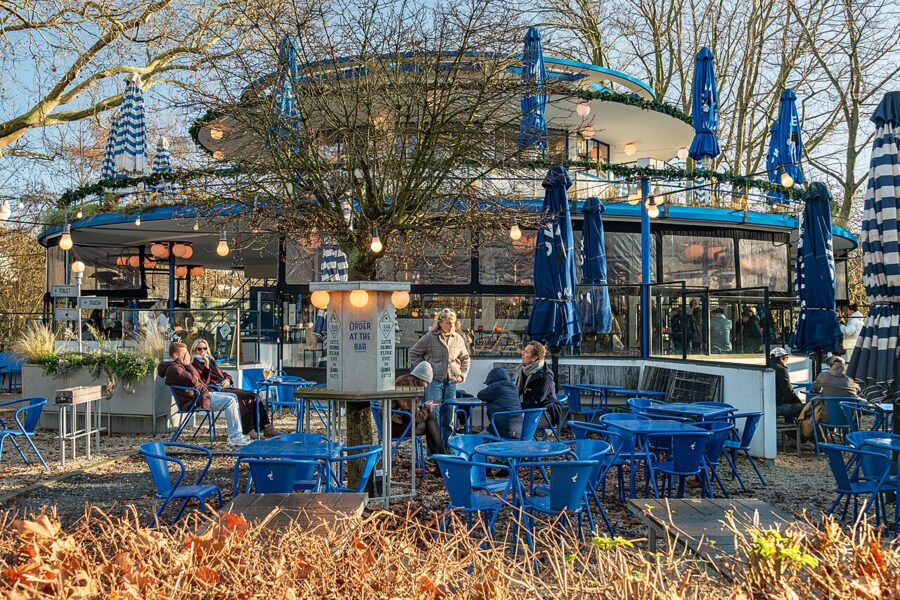

What you get is ‘t IJ’s beer on tap, coffee, sandwiches, pizza and bar snacks, plus a pétanque court and a table-tennis table. Dogs are welcome; wheelchairs, unfortunately, are not, as the building has no step-free access. The taproom’s hours as of November 2026 are Monday to Wednesday 09:00-18:00, Thursday 09:00-20:00, Friday and Saturday 09:30-20:00, and Sunday 09:30-18:00.
Groot Melkhuis
The Groot Melkhuis, the big milk house, keeps the name of the park’s nineteenth-century melkhuis, a refreshment stop for walkers. Today it is a café-restaurant with a large terrace and its own playground, and it is where families with small children end up. As of late November 2026 it opens every day from 10:00 to 17:00.
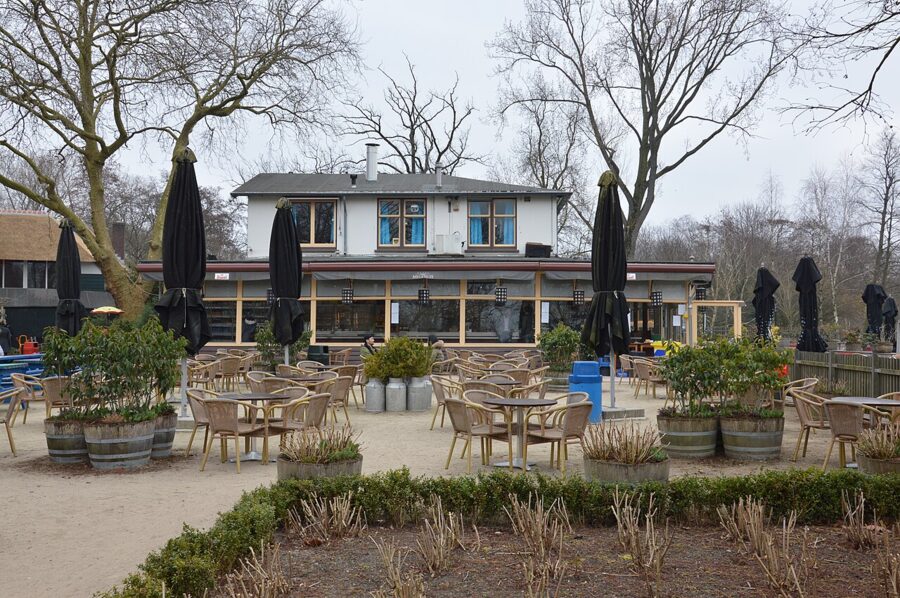

It also runs the park’s small winter fixtures. Groot Melkhuis holds a Christmas market on its terrace on Sunday 29 November 2026 from 11:00 to 16:00, and an Ugly Christmas Sweater Run through the park on Saturday 19 December; last year’s drew about 300 runners.
Café Vertigo
Inside the Vondelpark Pavilion, Café Vertigo opened on the ground floor in June 2025. The name goes back to the film café that ran here when the building was the Filmmuseum, itself named after Hitchcock’s 1958 film. The terrace looks out over the park, and it is the obvious place for a drink before a film upstairs.

At the Amstelveenseweg end, a garden café by the playground has traditionally opened in summer. I could not confirm its 2026 season, so treat it as a bonus rather than a plan. Picnics on the grass are fine anywhere; just take your rubbish out with you.
The Openluchttheater
The Vondelpark Openluchttheater has put on free summer performances since the 1970s and draws more than 100,000 people a year. From May to September it is open (almost) every weekend for music, comedy, dance, classical concerts and children’s theater. A day usually opens with young and new talent before the main act.
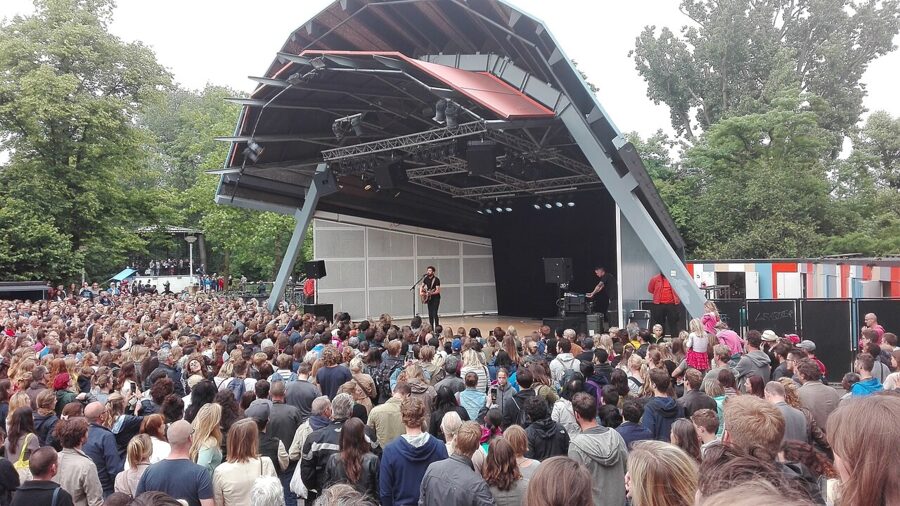

Entry is free. The theater asks for a voluntary contribution at every show, by QR code, card reader or collection tin, and it needs it. If you want a sure view, you can reserve a seat for €8.50 (about US$10) as of 2026, up to an hour and a half before the program starts. Reserved seats are held until five minutes before the opening act; after that the stand opens to everyone, and an unused reservation becomes a donation.
There are children’s festival afternoons during the season, and in the summer school holidays the theater runs BuitenSpelen, a week-long theater course for 8- to 12-year-olds that ends with a premiere on the main stage. Check the program for your dates before you plan around a show: it changes every weekend.
The film museum pavilion
The Vondelparkpaviljoen went up between 1874 and 1881 to a design by the architect W. Hamer, in an Italian Renaissance manner with fluted half-columns, round-arched windows and small domed towers. From the start it held exhibitions of modern art and drew Amsterdam’s bohemians. The German occupiers took it over during the war, and in the 1950s it was the base of the Holland Festival.
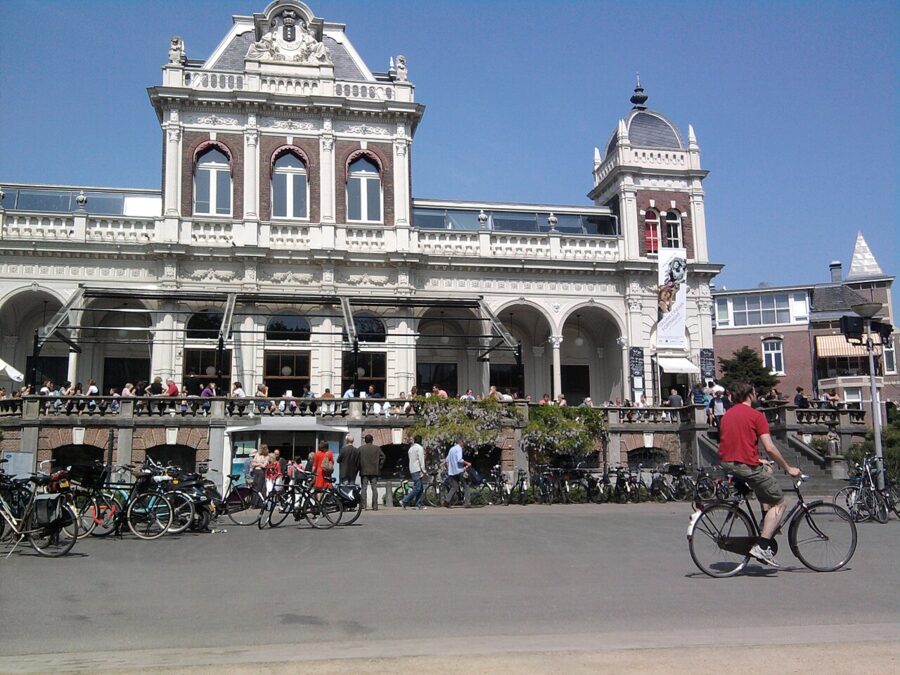

From 1972 to 2012 it housed the Filmmuseum, which became a real draw here with two small screens and more than 150,000 visitors a year, but never had enough room. The last film shown, on 8 January 2012, was the silent classic Sunrise; the museum then moved across the IJ to the Eye building in Amsterdam-Noord.
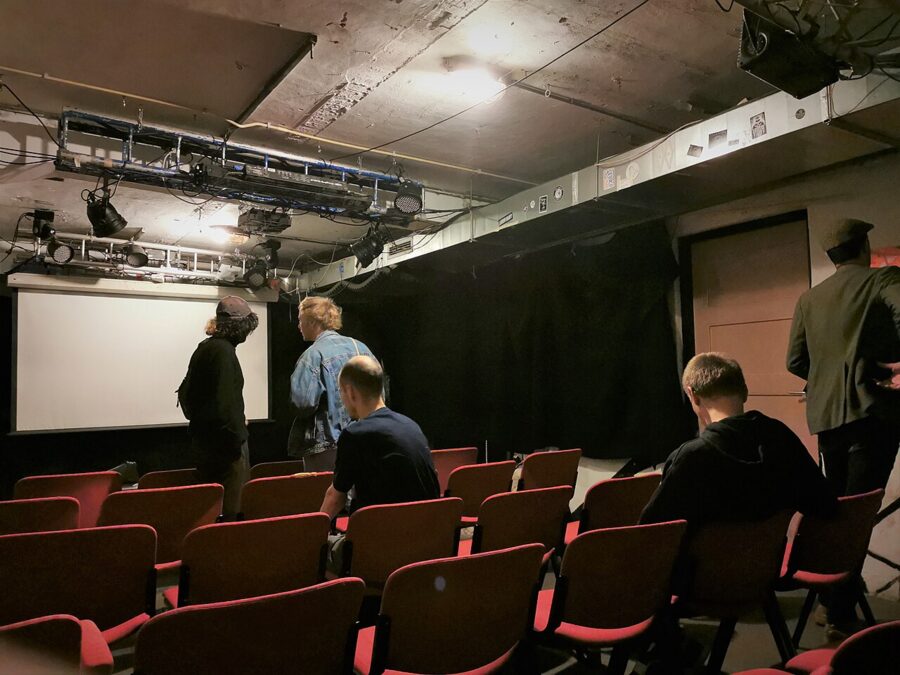
Film came back in 2023, when the documentary festival IDFA moved in. Het Documentaire Paviljoen opened officially in March 2024 and shows documentaries all year in De Spiegel, a 70-seat cinema, alongside talks and school programs. The address is Vondelpark 3; the upper floors are reached by lift, with help from the café staff.
The Vondelbunker under the nearby Vondelbrug has its own story. Built in 1947 as a nuclear shelter beneath the new viaduct, it reopened in 1968 as a tiny club called Beatkelder Lijn 3, after the tram line overhead, and Pink Floyd played there before it closed for lack of money within a year. Since 2011 it has been run as a self-declared free space for exhibitions, film nights and talks.

Cycling, running and skating
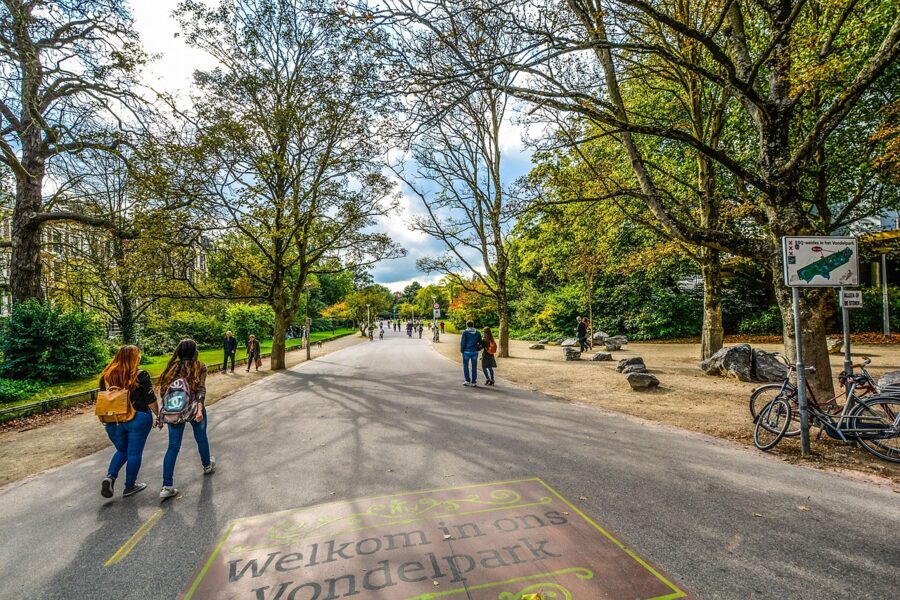
Bicycles have been allowed in the park since 1893, at first only in the mornings, and since the park was private you could not be fined for riding without lights. Today the asphalt lanes are a through route for cyclists as much as a leisure path. Ride at a sensible speed, ring before you pass, and watch for children chasing balls across the lane.
Since 11 May 2026 one kind of bike is banned: pedal-assisted fatbikes with tires wider than 7 centimeters. You may push one through, but riding it costs €115 (about US$135) for anyone 16 or older and €57.50 for 12- to 15-year-olds; under-12s are not fined, but the city contacts their parents. After two weeks of warnings, officers handed out 167 fines and 138 warnings by 1 September, and the city has decided the ban stays, though it will not be extended to other parts of the city for now.
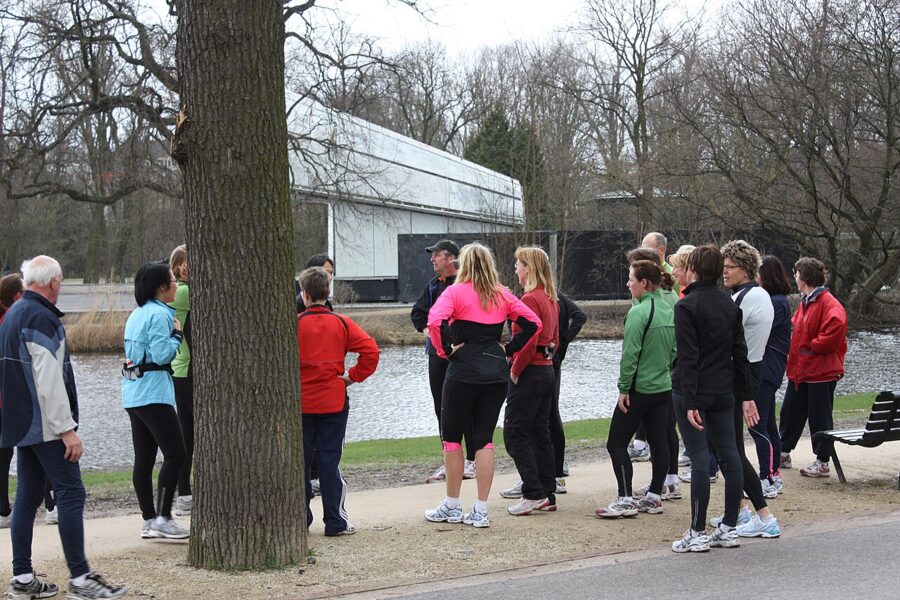

For runners, the outer loop of about 3.3 kilometers is the standard lap, and the main lanes are lit after dark. Early morning is the time to run it, before the cyclists and the dog walkers. The Amsterdam Marathon in October runs partly through the park, and the lawns are a regular base for outdoor bootcamp groups.
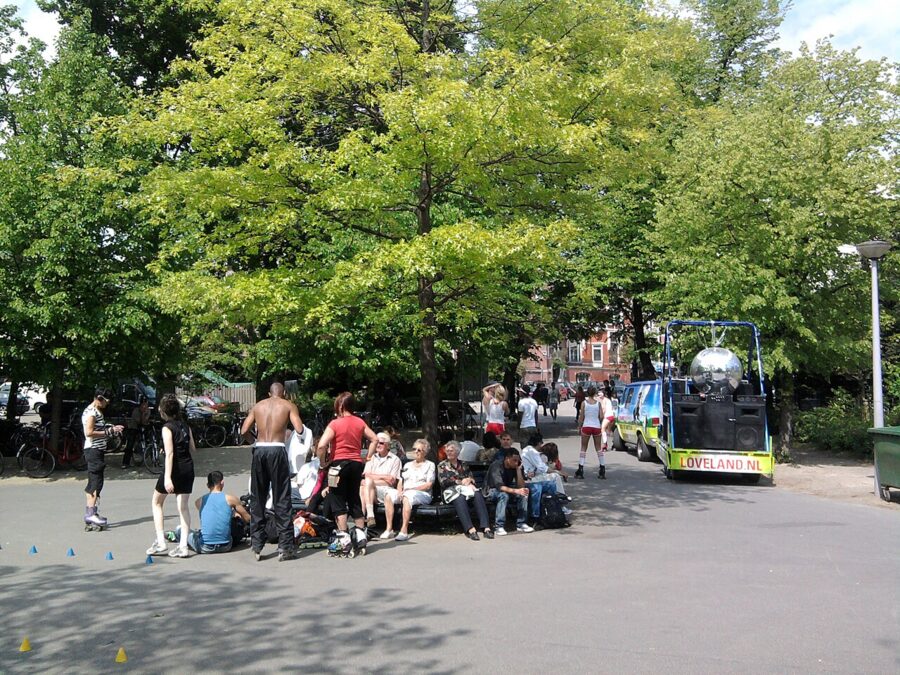
On fine weekends you will also find roller skaters on the wide asphalt, some just cruising and some practicing slaloms between cones. It is a good show from a bench and a bad place to cycle through quickly.

The rules: barbecues, dogs, smoking and after dark
Barbecues are not allowed anywhere in the Vondelpark. It was the first Amsterdam park to ban them, in 2017, after years of complaints about smoke and litter, and the city’s park page says so plainly. Bring a cold picnic instead.
Dogs may run off the leash only in marked parts of the park, shown on the city’s map, and must be under control everywhere else. Keep them out of the playgrounds and the fenced meadows. The Blauwe Theehuis is happy to see them on its terrace.
Smoking is where people get confused. I found no park-wide ban on tobacco in the Vondelpark, and the 2023 ban on smoking cannabis in the street covers the Red Light District, not here. Buy cannabis only in a licensed shop, though; the coffeeshops article explains how that works. Never buy from anyone offering it on the paths.
That last point is why the city made the Vondelpark and its surrounding streets a nuisance area on 24 February 2026. The district cited drug dealing, drunken disturbances, street robberies and fights, and park businesses had complained of repeated break-ins. In a nuisance area the police can order someone out for 24 hours, or 72 for dealing, and the mayor can ban repeat offenders for longer.
So is the Vondelpark safe? In daylight it is as safe as anywhere in the city, with thousands of people around. After dark, stay on the lit main lanes, keep your phone and bag close, and don’t take shortcuts across the unlit lawns. I would not walk it alone at two in the morning.
Seasons and events
Spring
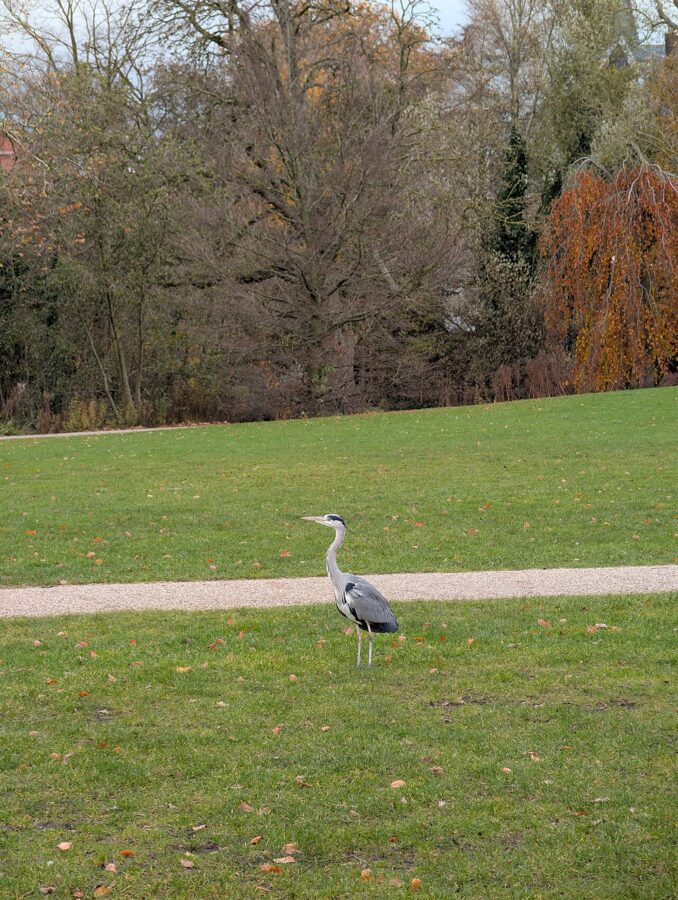
Spring brings the birds. The bright green rose-ringed parakeets that screech in the treetops have lived here since the 1970s, the storks return to their meadow poles, and the herons nest. In December 2025 even a bittern, a shy reed-bed bird rarely seen in a city, spent time fishing in the park.
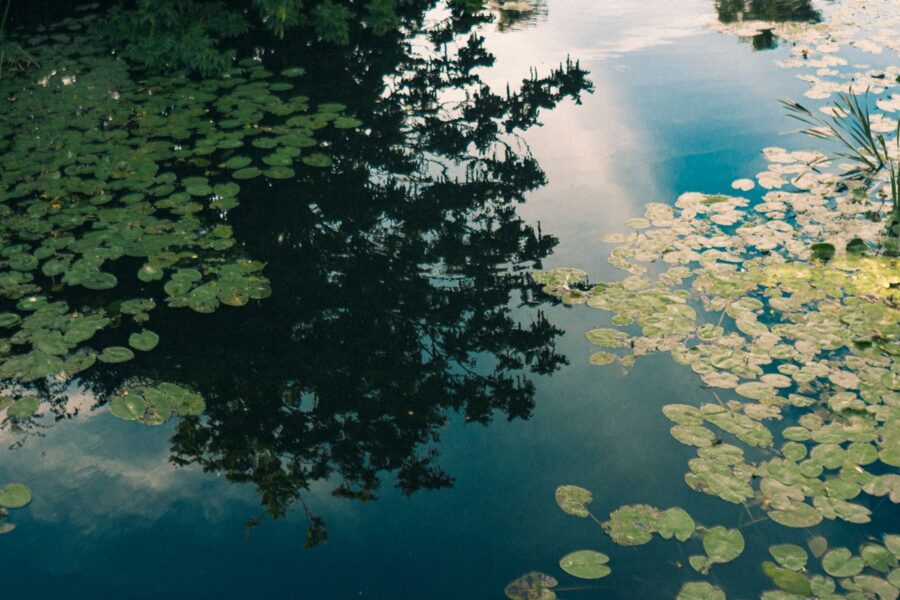
On King’s Day, 27 April (a Tuesday in 2027), the park hosts the kindervrijmarkt, the children’s free market, where kids lay out blankets to sell their old toys and books. It is the gentlest way to see the holiday, and much calmer than the canals.
Summer
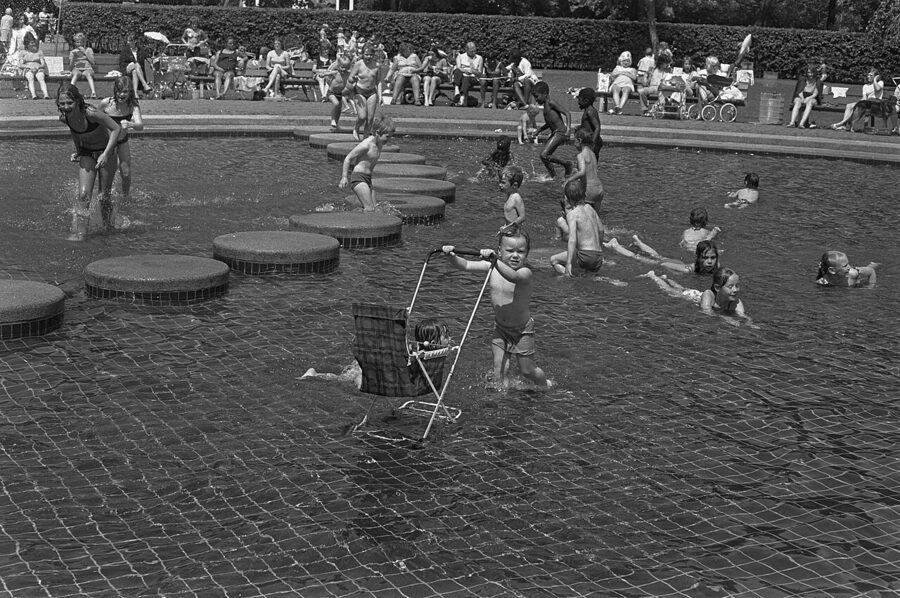
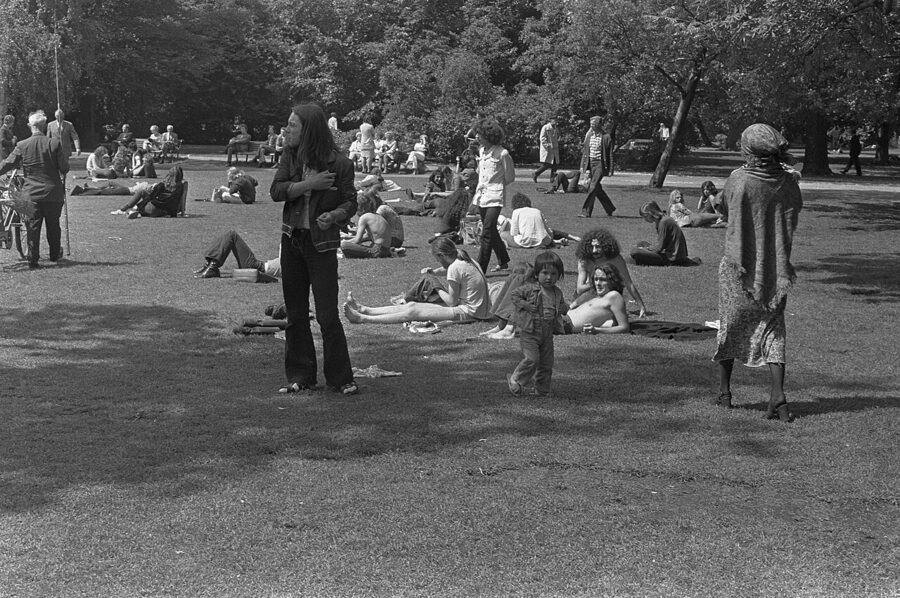
Summer is the theater season, the picnic season and the season of crowds. The children’s paddling pool opens for the warm months, and on hot evenings the lawns east of the Vondelbrug are shoulder to shoulder.
Autumn
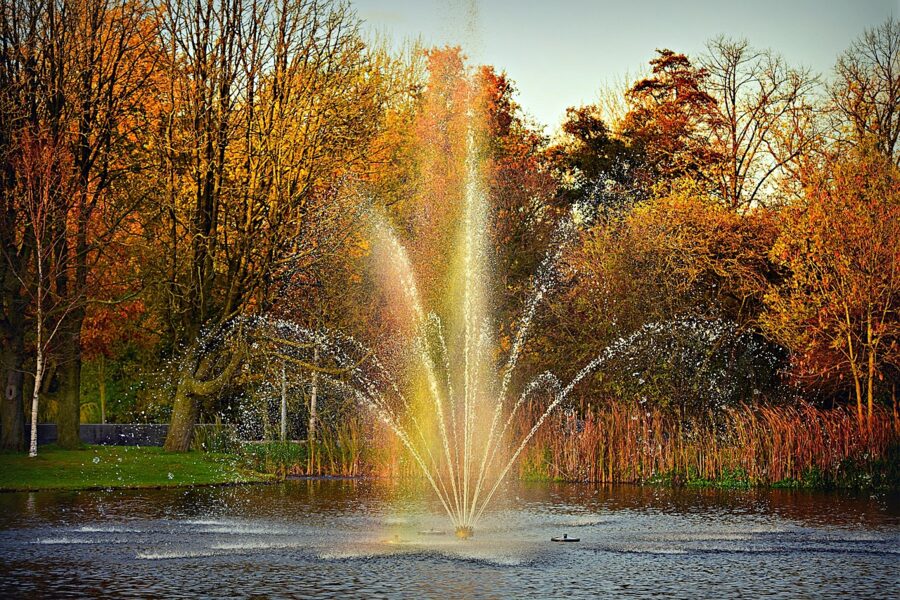
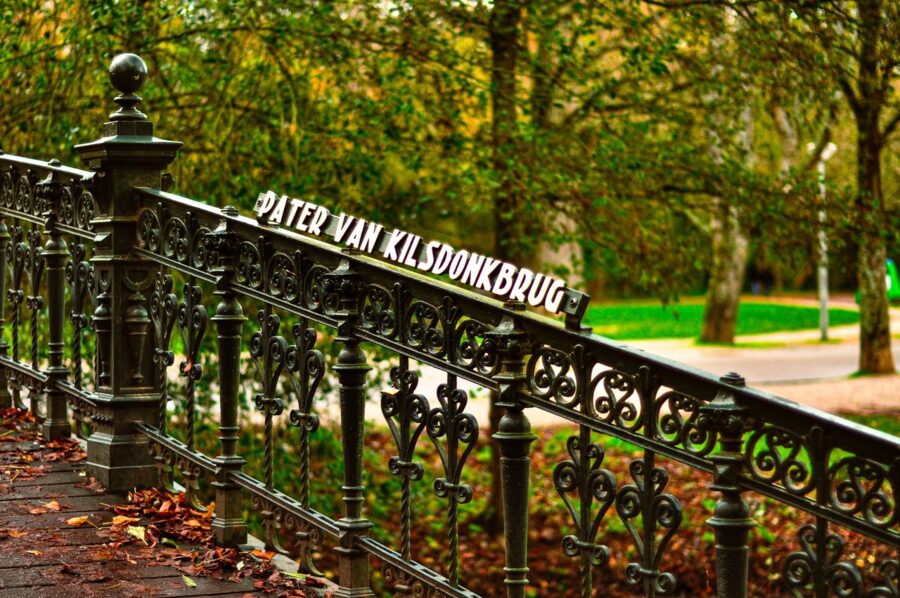
Autumn is my favorite time here. The paths empty, the light comes in low over the ponds, and the plane trees and chestnuts color; the chestnuts along the Paviljoenweg have suffered in recent hot, dry summers, and several have been felled. On 2 November, All Souls’ Day, people float small decorated boats with mementos of someone they miss on the large Zocher pond.
On 11 November, St. Martin’s Day, children carry lanterns through the dark park; the 2026 parade set off at 18:00 from Koninginneweg 1 with a street band and took about three quarters of an hour.
Winter
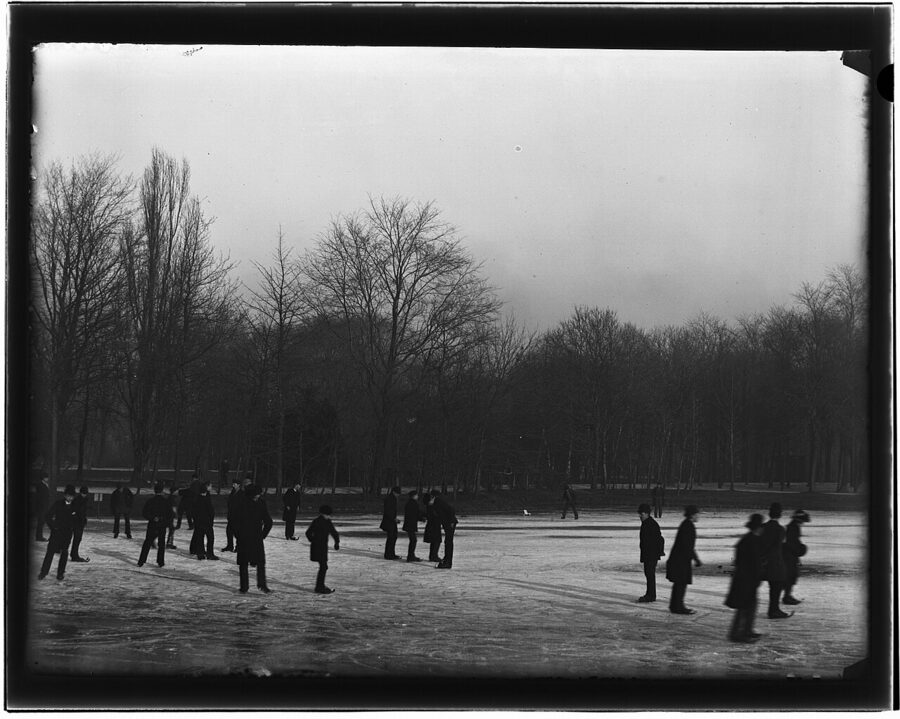
Winter is quiet and often gray. Snow is now rare enough to be news: on 6 January 2026 the park got its first proper snowfall in four years, and by the end of the school day the lawns were dotted with snowmen. The old photographs of crowds skating on the frozen ponds are from a colder Amsterdam; don’t count on ice.
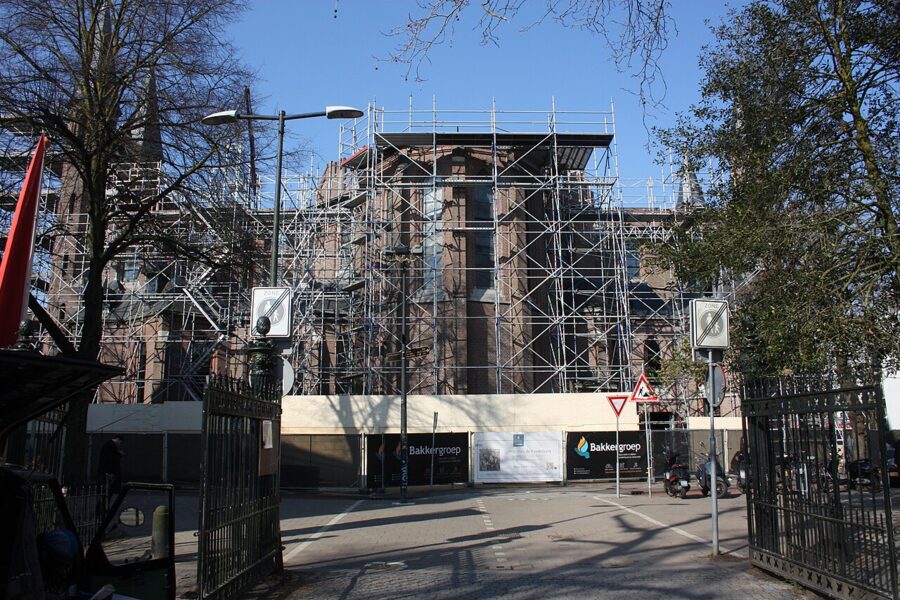
New Year’s 2026 brought a sadder sight. Shortly before 01:00 on 1 January, fire broke out in the tower of the Vondelkerk, Cuypers’ church of 1872 on the Vondelstraat, just outside the park. The tower collapsed and much of the roof came down; firefighters drew water from the park. The walls held, and a fund for the rebuilding had raised nearly €225,000 within two weeks.

Getting there, the entrances, and what to pair it with
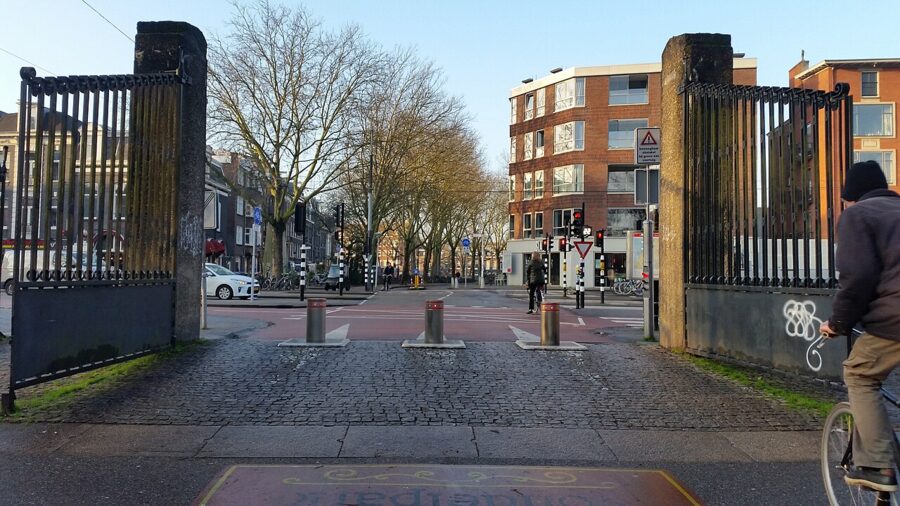
The park has 17 entrances. The main one is on the Stadhouderskade, a two-minute walk from the Leidseplein; others open from the Vondelstraat, the Zocherstraat, the Emmalaan, the Koningslaan and the Amstelveenseweg. The park listing on I amsterdam gives the full list and access notes: the paths are wide enough for wheelchairs, and assistance dogs are welcome.

- Stadhouderskade (east) end: trams 1, 2, 5, 7 and 19 stop at Leidseplein. Tram 2 runs there from Centraal Station.
- Middle, by the Vondelbrug: trams 2 and 12 stop at Van Baerlestraat. Since the March 2026 timetable, tram 12 has taken over the old tram 3 route across the Vondelbrug.
- North side: tram 1 stops at Eerste Constantijn Huygensstraat, at the north end of the Vondelbrug. Until 30 April 2027 it reaches that stop by a diversion from the west because of work on the Overtoomse Sluis.
- South and west entrances: tram 2 continues along the Willemsparkweg and Koninginneweg, a few minutes’ walk from the Emmalaan and Koningslaan gates.
- By car: don’t. If you must, Q-Park Museumplein (Van Baerlestraat 33B) is the nearest big garage.
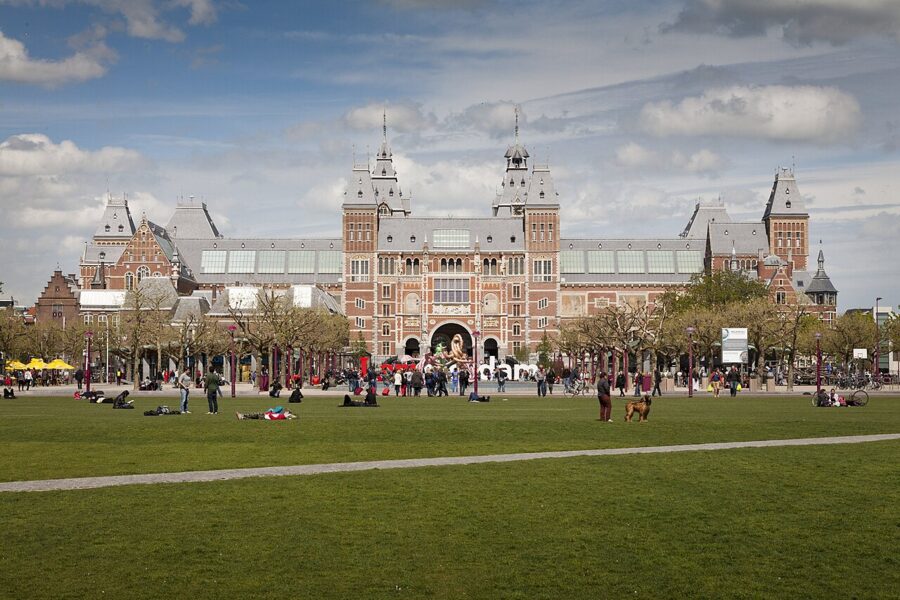
The obvious pairing is Museumplein, a short walk from the Van Baerlestraat gate: the Rijksmuseum, the Van Gogh Museum, the Stedelijk and the Concertgebouw are all there, and the Amsterdam museums guide sorts out which to book first. Book a morning museum slot and give the park the afternoon.
At the other end, the Leidseplein gives you the Stadsschouwburg and more bars than anyone needs. The Overtoom, just north of the park, is the quick way back toward the center, on foot or by tram 1.
Come on a weekday morning if you want the park the way the Zochers drew it, or on a summer Sunday if you want it the way Amsterdam uses it. Either way, leave the fatbike and the barbecue at home, take tram 2 to the Leidseplein, walk in through the Stadhouderskade gate, and keep going west until the crowds thin out by the old cow meadow.